Polynomial functors and polynomial monads
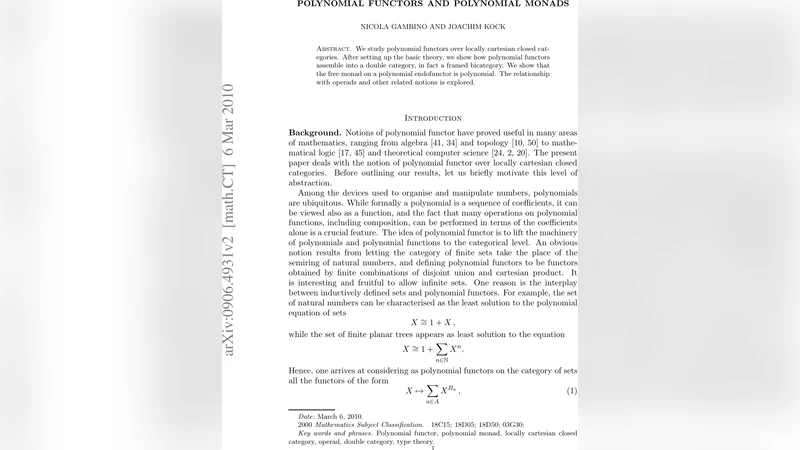
We study polynomial functors over locally cartesian closed categories. After setting up the basic theory, we show how polynomial functors assemble into a double category, in fact a framed bicategory. We show that the free monad on a polynomial endofunctor is polynomial. The relationship with operads and other related notions is explored.
💡 Research Summary
The paper develops a comprehensive theory of polynomial functors in the setting of locally cartesian closed categories (LCCC). A polynomial functor is presented as a span I ← E → J equipped with maps s:E→I, p:E→J and t:J→1, and is expressed categorically as the composite s⁎ · p₊ · t₊, where s⁎ is reindexing, p₊ is dependent sum, and t₊ is dependent product. This formulation makes explicit how polynomial functors preserve the fundamental LCCC structure (pullbacks and pushouts).
The authors then organize polynomial functors and their natural transformations into a double category: horizontal composition corresponds to span composition, vertical composition to natural transformations, and the interchange law follows from the pullback–pushout exchange. Moreover, this double category is shown to be a framed bicategory, meaning each object carries an intrinsic groupoid of vertical isomorphisms and the horizontal and vertical structures interact coherently. This framed bicategory framework provides a robust setting for manipulating complex combinations of polynomial functors.
A central technical result is that the free monad on any polynomial endofunctor is again polynomial. Given a polynomial endofunctor P, the authors construct its free monad T(P)=∑_{n≥0}Pⁿ and prove by induction that each iterated power Pⁿ retains a polynomial representation. The key observation is that the composition of polynomial functors corresponds to a new span obtained via successive pullbacks and pushouts, and the LCCC axioms guarantee that this composition stays within the class of polynomial functors. Consequently, T(P) can be described by a single span, establishing that the free monad construction is closed under polynomiality.
Finally, the paper explores connections with operads, Lawvere theories, and dependent type theory. Polynomial monads, a special class of monads arising from polynomial functors, encapsulate the algebraic structure of operads and provide a categorical bridge to type-theoretic data type definitions. By interpreting operadic composition as the multiplication of a polynomial monad, the authors unify several existing notions under a single categorical framework. This unification suggests new avenues for applying polynomial functor techniques to the semantics of programming languages, higher‑dimensional algebra, and homotopy‑theoretic contexts.
Overall, the work establishes polynomial functors as a versatile tool in LCCC, equips them with a rich double‑category/framed‑bicategory structure, proves the stability of polynomiality under free monad formation, and situates them within a broader landscape of algebraic and logical structures.
Comments & Academic Discussion
Loading comments...
Leave a Comment