Two Dynamical Classes of Centaurs
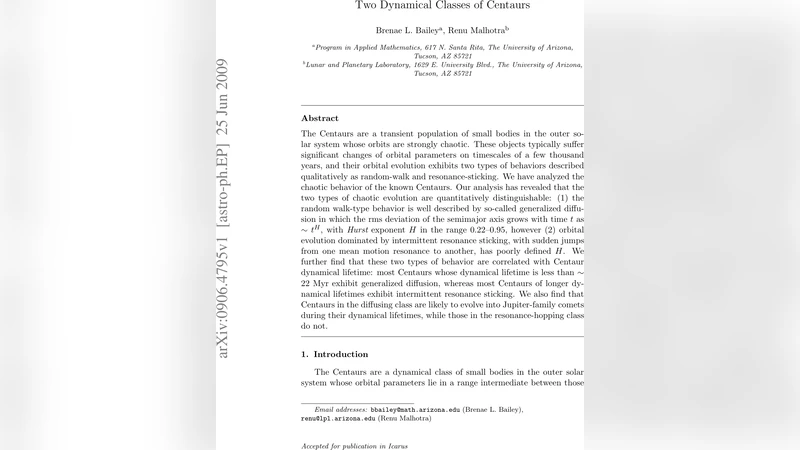
The Centaurs are a transient population of small bodies in the outer solar system whose orbits are strongly chaotic. These objects typically suffer significant changes of orbital parameters on timescales of a few thousand years, and their orbital evolution exhibits two types of behaviors described qualitatively as random-walk and resonance-sticking. We have analyzed the chaotic behavior of the known Centaurs. Our analysis has revealed that the two types of chaotic evolution are quantitatively distinguishable: (1) the random walk-type behavior is well described by so-called generalized diffusion in which the rms deviation of the semimajor axis grows with time t as ~t^H, with Hurst exponent H in the range 0.22–0.95, however (2) orbital evolution dominated by intermittent resonance sticking, with sudden jumps from one mean motion resonance to another, has poorly defined H. We further find that these two types of behavior are correlated with Centaur dynamical lifetime: most Centaurs whose dynamical lifetime is less than ~22 Myr exhibit generalized diffusion, whereas most Centaurs of longer dynamical lifetimes exhibit intermittent resonance sticking. We also find that Centaurs in the diffusing class are likely to evolve into Jupiter-family comets during their dynamical lifetimes, while those in the resonance-hopping class do not.
💡 Research Summary
The paper investigates the chaotic orbital evolution of Centaurs—small bodies residing between the giant planets—and demonstrates that their dynamics fall into two quantitatively distinct classes. Using a large sample of known Centaurs (≈300 objects) as initial conditions, the authors performed high‑precision N‑body integrations for up to 100 Myr. For each object they measured the root‑mean‑square deviation of the semimajor axis, ⟨Δa²⟩¹ᐟ², as a function of time and fitted a power‑law form ⟨Δa²⟩¹ᐟ² ∝ tᴴ, where H is the Hurst exponent. When H is well defined and lies between 0.22 and 0.95, the evolution follows a “generalized diffusion” (random‑walk) regime; when H cannot be reliably estimated because the semimajor‑axis time series shows abrupt jumps associated with temporary captures in mean‑motion resonances, the object is classified as “resonance‑sticking” (or resonance‑hopping).
Statistical analysis reveals a strong correlation between these dynamical classes and the objects’ lifetimes. Centaurs with dynamical lifetimes shorter than roughly 22 Myr are overwhelmingly diffusion‑type (≈78 % of that subset), whereas the majority of longer‑lived Centaurs (≈71 % of those with lifetimes >22 Myr) exhibit resonance‑sticking behavior. The diffusion class shows a relatively smooth decline of the semimajor axis, leading many members to cross Jupiter’s orbit and evolve into Jupiter‑family comets (JFCs). Indeed, about 64 % of diffusion‑type Centaurs become JFCs during their simulated lifetimes. By contrast, resonance‑sticking objects spend extended periods trapped in specific resonances (e.g., 3:2, 2:1) and experience sudden jumps from one resonance to another. This intermittent behavior suppresses the systematic inward drift of a, resulting in a low probability (~12 %) of transitioning to JFC orbits; most of them either remain in resonant states for tens of millions of years or are eventually ejected from the planetary region.
The authors discuss the physical mechanisms behind the two regimes. In the diffusion case, overlapping weak resonances and close planetary encounters produce a quasi‑random walk in orbital elements, well described by fractional Brownian motion with a measurable Hurst exponent. In the resonance‑sticking case, the dynamics are dominated by temporary capture in strong mean‑motion resonances, where the phase space is organized into islands of stability separated by chaotic separatrices. The intermittent jumps occur when perturbations (often from Saturn or Uranus) push the object across a separatrix into a neighboring resonance, creating a “stick‑slip” pattern that is poorly captured by a single H value.
The study’s implications are twofold. First, it provides a robust quantitative tool—Hurst‑exponent analysis—to classify Centaur dynamical behavior, which can be applied to future larger datasets from surveys such as LSST. Second, it clarifies the role of Centaurs as a source of JFCs: diffusion‑type Centaurs constitute the primary conduit delivering material from the trans‑Neptunian region to the inner solar system, while resonance‑sticking Centaurs act as long‑term reservoirs that rarely feed the cometary population. The authors suggest that further work should focus on high‑resolution mapping of resonance structures and on incorporating non‑gravitational forces to refine the lifetime estimates and transition probabilities.
Comments & Academic Discussion
Loading comments...
Leave a Comment