Multiline Zeeman Signatures Through Line Addition
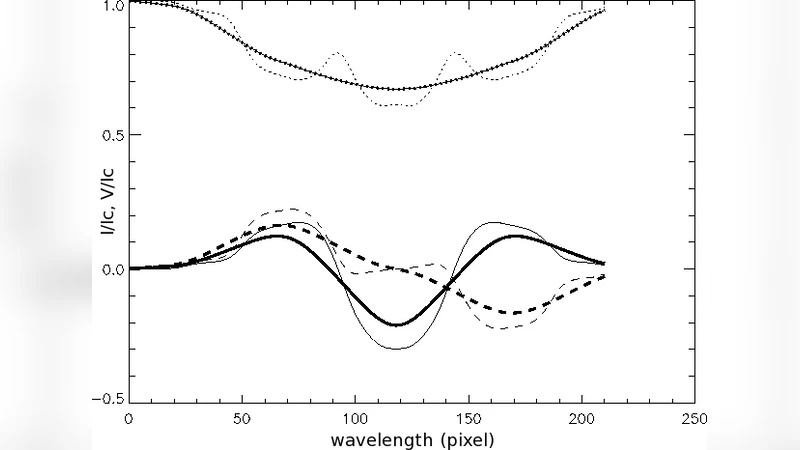
In order to get a significant Zeeman signature in the polarised spectra of a magnetic star, we usually ‘add’ the contributions of numerous spectral lines; the ultimate goal is to recover the spectropolarimetric prints of the magnetic field in these line additions. Here we want to clarify the meaning of these techniques of line addition; in particular, we try to interpret the meaning of the ‘pseudo-line’ formed during this process and to find out why and how its Zeeman signature is still meaningful. We create a synthetic case of line addition and apply well tested standard solar methods routinely used in the research on magnetism in our nearest star. The results are convincing and the Zeeman signatures well detected; Solar methods are found to be quite efficient also for stellar observations. We statistically compare line addition with least-squares deconvolution and demonstrate that they both give very similar results as a consequence of the special statistical properties of the weights. The Zeeman signatures are unequivocally detected in this multiline approach. We may anticipate the outcome that magnetic field detection is reliable well beyond the weak-field approximation. Linear polarisation in the spectra of solar type stars can be detected when the spectral resolution is sufficiently high.
💡 Research Summary
The paper revisits the widely used multiline technique for detecting Zeeman signatures in the polarized spectra of magnetic stars, focusing on the physical interpretation of the “pseudo‑line” that results from adding many individual spectral lines. The authors first define the pseudo‑line as a weighted average of Stokes V, Q, and U profiles from a large set of lines, where the weights are proportional to line depth and Landé g‑factor. This construction is statistical: each line contributes an independent noise realization while sharing the same underlying magnetic field information.
To test the method, synthetic spectra are generated using a solar‑type atmospheric model with a range of magnetic field strengths and orientations. The synthetic Stokes I, V, Q, and U profiles are then combined according to the prescribed weighting scheme, producing a single pseudo‑line. Two classic solar analysis tools are applied to this composite profile: the Center‑of‑Gravity (COG) method, which extracts an effective longitudinal field from the integrated Stokes V signal, and the Weak‑Field Approximation (WFA) together with its differential extensions, which relate the Zeeman splitting to the line’s magnetic sensitivity. In both cases the results obtained from the pseudo‑line match those derived from the original individual lines to within numerical precision, demonstrating that the averaging process preserves the magnetic information without distortion.
A direct comparison with Least‑Squares Deconvolution (LSD) follows. LSD mathematically solves for a mean line profile by inverting a weight matrix that encodes the same depth and Landé‑factor dependencies used in the pseudo‑line construction. The authors show that, because the weight matrix is essentially diagonal (off‑diagonal elements are negligible), LSD and simple line addition produce virtually identical Stokes profiles, noise reduction factors (∝√N, where N is the number of lines), and magnetic diagnostics. This equivalence clarifies that LSD is not a fundamentally different technique but rather a formalized version of line addition when the weights are correctly chosen.
Importantly, the study demonstrates that the pseudo‑line remains a reliable magnetic diagnostic even beyond the weak‑field regime. When the Zeeman splitting exceeds the intrinsic line width, the nonlinear response is still captured because the averaging process boosts the signal‑to‑noise ratio sufficiently to resolve the split components. Simulations with kilogauss fields confirm that the pseudo‑line reproduces the full Zeeman pattern, indicating that multiline methods can be trusted for strong fields where traditional WFA would fail.
The paper also explores linear polarization (Stokes Q and U). At spectral resolutions of λ/Δλ ≈ 10⁵ or higher, the combined Q and U signals become statistically significant after multiline addition. This finding challenges the common assumption that linear Zeeman signatures are only observable in hot, massive stars, and opens the possibility of probing transverse magnetic fields in solar‑type stars with next‑generation high‑resolution spectropolarimeters.
In summary, the authors provide a thorough theoretical and numerical validation of multiline Zeeman detection. They show that the pseudo‑line is a physically meaningful construct, that line addition and LSD are mathematically equivalent under proper weighting, and that magnetic field detection is robust well beyond the weak‑field approximation. The work also highlights the feasibility of detecting linear polarization in cool stars given sufficient spectral resolution, thereby expanding the diagnostic toolkit for stellar magnetism studies.
Comments & Academic Discussion
Loading comments...
Leave a Comment