SVOM: a new mission for Gamma-Ray Burst Studies
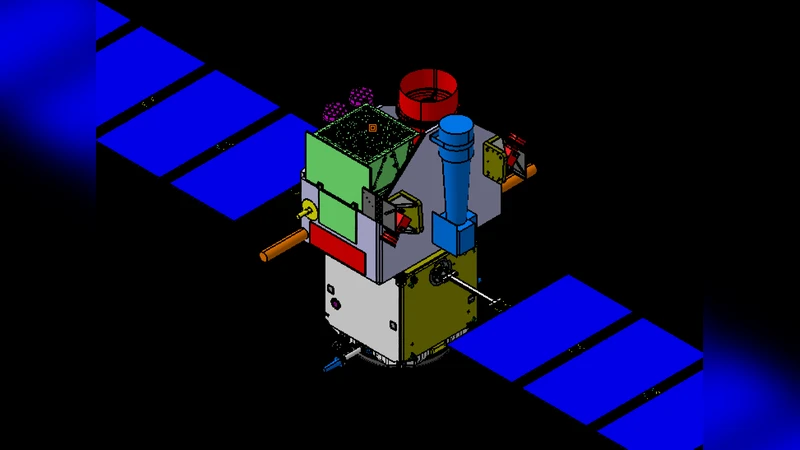
We present the SVOM (Space-based multi-band astronomical Variable Object Monitor) mission, that is being developed in cooperation between the Chinese National Space Agency (CNSA), the Chinese Academy of Science (CAS) and the French Space Agency (CNES). Its scientific objectives include the study of the GRB phenomenon, GRB physics and progenitors, cosmology, and fundamental physics. SVOM is designed to detect all known types of Gamma-Ray Bursts (GRBs), to provide fast and reliable GRB positions, to measure the broadband spectral characteristics and temporal properties of the GRB prompt emission. This will be obtained in first place thanks to a set of four space flown instruments. A wide field (~2 sr) coded mask telescope (ECLAIRs), operating in the 4-250 keV energy range, will provide the triggers and localizations, while a gamma-ray non-imaging spectrometer (GRM), sensitive in the 50 keV-5 MeV domain, will extend the prompt emission energy coverage. After a satellite slew, in order to place the GRB direction within field of view of the two narrow field instruments - a soft X-ray (XIAO), and a visible telescope (VT) - the GRB position will be refined and the study of the early phases of the GRB afterglow will be possible. A set of three ground based dedicated instruments, two robotic telescopes (GFTs) and a wide angle optical monitor (GWAC), will complement the space borne instruments. Thanks to the low energy trigger threshold (~4 keV) of the ECLAIRs, SVOM is ideally suited for the detection of soft, hence potentially most distant, GRBs. Its observing strategy is optimized to facilitate follow-up observations from the largest ground based facilities.
💡 Research Summary
The SVOM (Space‑based multi‑band astronomical Variable Object Monitor) mission is a joint Sino‑French space project aimed at advancing the study of gamma‑ray bursts (GRBs). Its scientific program encompasses four main goals: (1) a comprehensive characterization of the prompt emission across a broad energy range, (2) elucidation of GRB physics and progenitor systems, (3) exploitation of high‑redshift GRBs as probes of early star formation, metallicity evolution, and cosmology, and (4) integration with multi‑messenger astronomy (neutrinos, gravitational waves).
SVOM’s payload consists of four space‑borne instruments. The wide‑field coded‑mask telescope ECLAIRs covers ~2 sr and operates from 4 to 250 keV, providing real‑time triggers with a low energy threshold of ~4 keV. This low threshold is crucial for detecting soft, potentially very distant GRBs that are missed by higher‑threshold missions. The Gamma‑Ray Monitor (GRM) extends the spectral coverage to 5 MeV (50 keV–5 MeV) in a non‑imaging mode, enabling simultaneous broadband spectroscopy of the prompt phase. Upon trigger, the satellite autonomously slews to place the burst within the fields of view of the narrow‑field instruments: XIAO (0.5–10 keV X‑ray telescope) and the Visible Telescope (VT, 400–950 nm). XIAO refines the position to arcsecond accuracy and records early afterglow light curves with sub‑second timing, while VT reaches a limiting magnitude of ~23 mag, capturing the optical afterglow and allowing rapid photometric redshift estimates.
Complementing the space segment are three dedicated ground‑based facilities. Two Ground‑based Follow‑up Telescopes (GFTs) provide rapid infrared/optical imaging down to ~20 mag, and the Ground‑based Wide‑Angle Camera (GWAC) monitors a 5 deg² sky area for optical flashes contemporaneous with the gamma‑ray trigger. This coordinated network yields multi‑wavelength data from seconds to days after the burst, essential for probing the circumburst medium, host galaxy properties, and jet physics.
SVOM’s observing strategy is optimized for “anti‑sun” pointing, ensuring that detected GRBs are observable from major ground‑based observatories (e.g., VLT, Keck) shortly after the alert. Real‑time alerts are distributed via standardized VOEvent packets, allowing the global community to initiate follow‑up observations instantly.
The mission’s design promises a significant increase in the detection rate of soft, high‑z GRBs—potentially doubling the yield compared with Swift or Fermi—while delivering simultaneous coverage from 4 keV to 5 MeV. This broadband capability, combined with rapid, high‑precision afterglow localization, will enable detailed tests of emission mechanisms, jet composition, and energy dissipation processes. Moreover, SVOM’s integration with multi‑messenger facilities positions it as a key player in the emerging era of coordinated astrophysical observations, offering new insights into the most energetic transients in the universe.
Comments & Academic Discussion
Loading comments...
Leave a Comment