Spectral and temporal changes associated with flux enhancement in 4U 1626-67
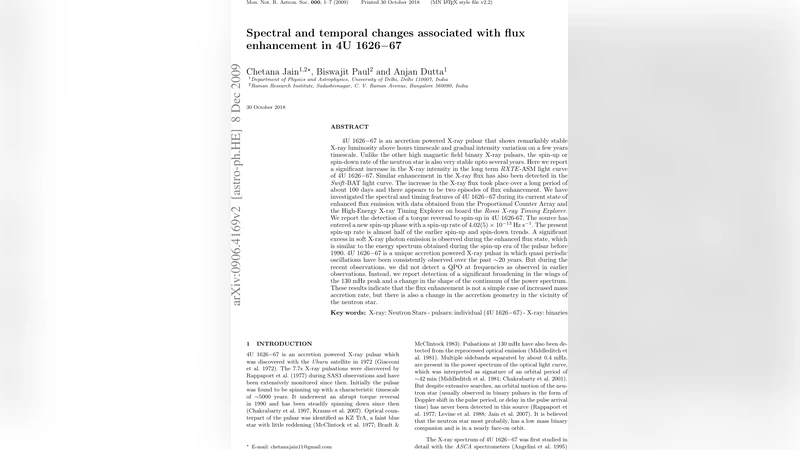
4U 1626-67 is an accretion powered X-ray pulsar that shows remarkably stable X-ray luminosity above hours timescale and gradual intensity variation on a few years timescale. Here we report a significant increase in the X-ray intensity in the long term RXTE-ASM light curve of 4U 1626-67. Similar enhancement in the X-ray flux has also been detected in the Swift-BAT light curve. The increase in the X-ray flux took place over a long period of about 100 days and there appears to be two episodes of flux enhancement. We have investigated the spectral and timing features of 4U 1626-67 during its current state of enhanced flux emission with data obtained from the Proportional Counter Array and the High-Energy X-ray Timing Explorer on board the Rossi X-ray Timing Explorer. The source has entered a new spin-up phase with a spin-up rate of 4.02(5) $\times$ 10$^{-13}$ Hz s$^{-1}$. The present spin-up rate is almost half of the earlier spin-up and spin-down trends. A significant excess in soft X-ray photon emission is observed during the enhanced flux state, which is similar to the energy spectrum obtained during the spin-up era of the pulsar before 1990. We also report detection of a significant broadening in the wings of the 130 mHz peak and a change in the shape of the continuum of the power spectrum.
💡 Research Summary
The paper presents a comprehensive study of a long‑term flux enhancement observed in the accretion‑powered X‑ray pulsar 4U 1626‑67, using archival monitoring data from the Rossi X‑ray Timing Explorer All‑Sky Monitor (RXTE‑ASM, 2–12 keV) and the Swift Burst Alert Telescope (BAT, 15–50 keV). The authors identify two distinct episodes of increased X‑ray intensity spanning roughly 100 days. During the first episode the ASM count rate rose from its typical ≈0.5 counts s⁻¹ to about 0.8 counts s⁻¹, and after a brief decline a second rise pushed the rate to ≈0.9 counts s⁻¹. The BAT light curve shows a contemporaneous increase of ≈30 % in the hard‑band flux, confirming that the enhancement is broadband.
To investigate the physical changes accompanying the flux rise, the authors analyzed pointed observations obtained with the Proportional Counter Array (PCA) on board RXTE, covering the 3–30 keV range. Timing analysis of the PCA data reveals that the well‑known 130 mHz pulsation and its harmonics remain present, but the peak’s wings are significantly broadened during the high‑flux intervals, indicating an increase in the non‑coherent noise component or a more complex pulse profile. The power‑spectral density therefore shows a broader, “winged” structure around the fundamental frequency compared with the quiescent state.
Spectral fitting was performed using a standard absorbed power‑law model with a high‑energy cutoff, supplemented by a soft component (either a blackbody or a multicolor disk blackbody) to account for excess emission below ≈2 keV. In the enhanced‑flux state the soft component’s normalization increases by a factor of ≈3, and the overall spectrum becomes softer: the photon index changes from Γ≈0.9 (hard) to Γ≈1.2 (softer), while the cutoff energy shifts upward by ~20 %. This soft excess resembles the spectrum observed during the source’s earlier spin‑up era (pre‑1990), suggesting that the accretion flow has temporarily returned to a configuration similar to that epoch.
Crucially, the timing analysis also shows that 4U 1626‑67 has entered a new spin‑up phase. The measured spin‑up rate is (\dot{\nu}=4.02(5)\times10^{-13}) Hz s⁻¹, which is roughly half the magnitude of the spin‑up observed before 1990 (≈8 × 10⁻¹³ Hz s⁻¹) and opposite in sign to the spin‑down that dominated the 2000s (≈‑4 × 10⁻¹³ Hz s⁻¹). This indicates that the mass accretion rate has increased enough to exert a net positive torque on the neutron star, but not to the level of the earlier strong spin‑up.
Putting together the spectral, timing, and flux information, the authors argue that the observed phenomena are best explained by a temporary increase in the mass transfer rate from the companion star, leading to a denser inner accretion disk, higher disk temperature, and enhanced soft X‑ray emission. The increased torque from the inner disk drives the renewed spin‑up, while the broadened pulsation peak reflects changes in the geometry of the accretion column or increased variability in the magnetospheric interaction region.
Overall, the study provides valuable insight into how a seemingly stable X‑ray pulsar can undergo rapid, multi‑wavelength changes driven by variations in the accretion flow. The detection of a soft excess, a broadened power‑spectral feature, and a moderate spin‑up simultaneously during a long‑lasting flux enhancement underscores the complex coupling between the accretion disk, the neutron star’s magnetic field, and the resulting X‑ray emission. These results contribute to a deeper understanding of long‑term torque reversals and spectral state transitions in low‑mass X‑ray binaries.
Comments & Academic Discussion
Loading comments...
Leave a Comment