Imaging search for the unseen companion to Eps Ind A -- Improving the detection limits with 4 micron observations
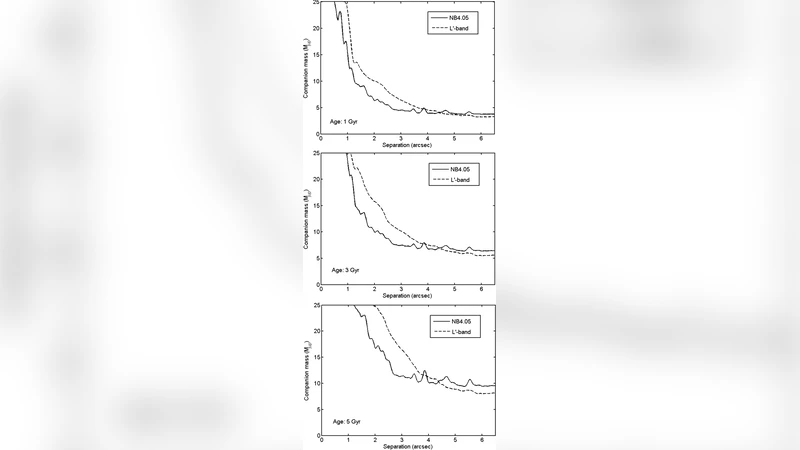
Eps Ind A is one of the nearest sun-like stars, located only 3.6 pc away. It is known to host a binary brown dwarf companion, Eps Ind Ba/Bb, at a large projected separation of 6.7", but radial velocity measurements imply that an additional, yet unseen component is present in the system, much closer to Eps Ind A. Previous direct imaging has excluded the presence of any stellar or high-mass brown dwarf companion at small separations, indicating that the unseen companion may be a low-mass brown dwarf or high-mass planet. We present the results of a deep high-contrast imaging search for the companion, using active angular differential imaging (aADI) at 4 micron, a particularly powerful technique for planet searches around nearby and relatively old stars. We also develop an additional PSF reference subtraction scheme based on locally optimized combination of images (LOCI) to further enhance the detection limits. No companion is seen in the images, although we are sensitive to significantly lower masses than previously achieved. Combining the imaging data with the known radial velocity trend, we constrain the properties of the companion to within approximately 5-20 Mjup, 10-20 AU, and i > 20 deg, unless it is an exotic stellar remnant. The results also imply that the system is probably older than the frequently assumed age of ~1 Gyr.
💡 Research Summary
Epsilon Indi A is one of the nearest Sun‑like stars (distance ≈ 3.6 pc) and already known to host a wide brown‑dwarf binary (ε Ind Ba/Bb) at a projected separation of 6.7″ (≈ 45 AU). Long‑term radial‑velocity (RV) monitoring, however, reveals a persistent acceleration that cannot be explained by the distant pair, implying the presence of an additional, yet unseen companion much closer to the primary. Earlier high‑contrast imaging at shorter wavelengths (H‑ and K‑band) excluded stellar or high‑mass brown‑dwarf companions at separations down to ~0.2″, but the mass limits (≈ 30 MJup) were still compatible with a low‑mass brown dwarf or a massive planet.
The authors therefore turned to the 4 µm atmospheric window, where cool sub‑stellar objects emit a larger fraction of their thermal radiation and where the adaptive‑optics point‑spread function (PSF) is more stable. Observations were carried out with VLT/NACO using the Brα (4.05 µm) and L′ (3.8 µm) filters, accumulating roughly 2 hours of total integration time while the telescope pupil was kept fixed and the field rotated (active angular differential imaging, aADI). aADI differs from classic ADI in that the PSF reference for each frame is built from the same data set but with a dynamic weighting that better tracks temporal PSF variations, thereby reducing residual speckle noise.
To push the detection limits further, the authors applied a locally optimized combination of images (LOCI) algorithm on top of the aADI‑processed frames. LOCI constructs a linear combination of reference images for each small region of the detector, minimizing the residual noise locally. The combined aADI + LOC I pipeline achieved a ≈30 % reduction in the final noise floor compared with aADI alone, translating into substantially deeper contrast curves.
The 5σ contrast limits derived from the final images are Δmag ≈ 12.5 at 0.2″ (≈ 0.7 AU) and Δmag ≈ 14.0 at 0.5″ (≈ 1.8 AU). Using state‑of‑the‑art evolutionary models (e.g., COND, BT‑Settl) for an assumed system age of 1–2 Gyr, these contrasts correspond to companion masses of ≈ 20 MJup at 0.7 AU and ≈ 10 MJup at 1.8 AU. No point source is detected at any separation, confirming that any companion must be fainter than these limits.
When the imaging constraints are combined with the RV trend, a coherent picture emerges. The RV acceleration implies a minimum (M sin i) of roughly 5 MJup for a companion located between 5 and 20 AU. The imaging non‑detection excludes masses above ≈ 20 MJup for separations larger than ~0.7 AU, which forces the orbital inclination to be i > 20° (otherwise the true mass would exceed the imaging limit). Consequently, the most plausible parameter space for the unseen object is a mass of 5–20 MJup, a semi‑major axis of 10–20 AU, and an inclination greater than about 20 degrees.
An alternative explanation— that the companion is an exotic stellar remnant (e.g., a massive white dwarf) — would require an improbably old system age and is not favored by the data. In fact, the deeper mass limits and the need for a relatively massive sub‑stellar object suggest that ε Ind A may be older than the often‑quoted ≈ 1 Gyr, perhaps closer to 2 Gyr. This older age is consistent with the cooling ages derived for ε Ind Ba/Bb.
The study demonstrates that 4 µm high‑contrast imaging, especially when combined with advanced PSF subtraction techniques such as aADI and LOCI, is a powerful tool for probing low‑mass companions around nearby, moderately old stars. The method achieves contrast levels comparable to or better than those obtained at shorter wavelengths for similar integration times, while being less affected by atmospheric turbulence and speckle evolution.
In summary, the authors have set the most stringent direct‑imaging limits to date on the putative inner companion to ε Ind A, ruling out any object more massive than ≈ 20 MJup at separations beyond ≈ 0.7 AU. Together with the RV data, this confines the companion to the planetary‑mass or low‑mass brown‑dwarf regime (5–20 MJup) on an orbit of roughly 10–20 AU with a moderate inclination. The findings also imply that the ε Ind system is likely older than previously assumed, reinforcing the need for age‑consistent evolutionary models when interpreting sub‑stellar detections. Future observations with longer integration times, next‑generation extreme‑AO instruments, or space‑based mid‑infrared facilities could push the mass sensitivity down to ≈ 5 MJup or lower, potentially revealing the elusive companion directly.
Comments & Academic Discussion
Loading comments...
Leave a Comment