Super Marios prison break -- a proposal of object-intelligent-feedback-based classical Zeno and anti-Zeno effects
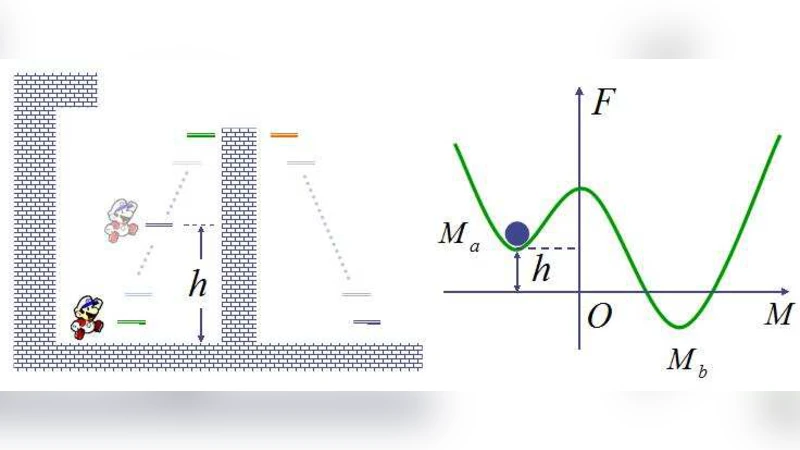
Super Mario is imprisoned by a demon in a finite potential well. He can escape from the well with the help of a flight of magic stairs floating in the space. However, the hateful demon may occasionally check his status. At that time, he has to make a judgement of either jumping to the inside ground immediately in order to avoid the discovery of his escape intention, or speeding up his escape process. Therefore, if the demon checks him too frequently such that there is no probability for him to reach the top of the barrier, he will be always inside the well, then a classical Zeno effect occurs. On the other hand, if the time interval between two subsequent checks is large enough such that he has a higher probability of being beyond the demon’s controllable range already, then the demon’s check actually speeds up his escape and a classical anti-Zeno effect takes place.
💡 Research Summary
The paper introduces a novel “object‑intelligent‑feedback” (OIF) framework to demonstrate classical analogues of the quantum Zeno and anti‑Zeno effects using a whimsical scenario: Super Mario is trapped in a finite potential well while a demon intermittently checks his status. Mario can escape by climbing a series of “magic stairs” that supply discrete energy pulses, propelling him upward toward the barrier. The demon monitors Mario at regular intervals τ. Upon each observation the demon either forces an immediate reset—sending Mario back to the bottom if he has not yet reached the escape region—or, if Mario is already beyond a predefined threshold, delivers an extra boost that accelerates his ascent.
Mathematically the system is modeled as a one‑dimensional particle in a finite well with stochastic transitions. The basic upward transition probability per stair step is denoted P₀. The demon’s actions introduce two τ‑dependent probabilities: a reset probability R(τ) and a boost probability A(τ). The dynamics are captured by a discrete‑time Markov chain with transition matrix
T(τ)= (1‑R(τ)‑A(τ))·P₀ + A(τ)·P_boost,
where P_boost represents the enhanced transition when the demon supplies extra energy. The dominant eigenvalue λ₁ of T determines long‑time behavior: λ₁≈1 corresponds to a “frozen” state (classical Zeno), while λ₁≪1 indicates rapid evolution (classical anti‑Zeno).
Numerical simulations explore how the observation interval τ influences the escape probability P_escape(τ) and the mean escape time ⟨t⟩. When τ is very short, the demon checks Mario so frequently that R(τ)≈1, causing almost every attempt to be nullified; ⟨t⟩ diverges and Mario remains trapped indefinitely—this is the classical Zeno regime. As τ increases, both R(τ) and A(τ) decrease, but A(τ) remains non‑negligible over a range of τ. In this regime the demon’s measurement acts as a feedback controller that injects energy, dramatically raising P_escape and reducing ⟨t⟩—the classical anti‑Zeno regime. An intermediate critical interval τ_c marks a sharp crossover where the system switches from Zeno‑like stagnation to anti‑Zeno acceleration. τ_c scales with the energy supplied by the stairs (ΔE) in a manner reminiscent of the quantum relation ℏ/ΔE, but here it is purely classical, set by the pulse magnitude and observation frequency.
The authors argue that the OIF scheme is experimentally realizable. A micro‑mechanical resonator could be driven by periodic force pulses (the “stairs”) while a laser or electron beam monitors its position at controllable intervals, applying a reset or boost via feedback electronics. Such a setup would directly test the predicted classical Zeno and anti‑Zeno behavior, bridging concepts from quantum measurement theory to classical control engineering.
Beyond the specific Mario‑demon narrative, the work highlights a broader principle: in classical systems, observation coupled with intelligent feedback can either freeze dynamics or accelerate transitions, depending on timing. This insight opens avenues for designing feedback‑controlled processes—ranging from chemical reaction rates to information‑processing devices—where the frequency and nature of monitoring become tunable parameters for manipulating system evolution. The paper thus provides a concrete, analytically tractable model that unifies Zeno‑type inhibition and anti‑Zeno acceleration under a single feedback‑driven framework, offering a fresh perspective on the interplay between measurement, control, and dynamics in classical physics.
Comments & Academic Discussion
Loading comments...
Leave a Comment