A Massive Substellar Companion to the Massive Giant HD 119445
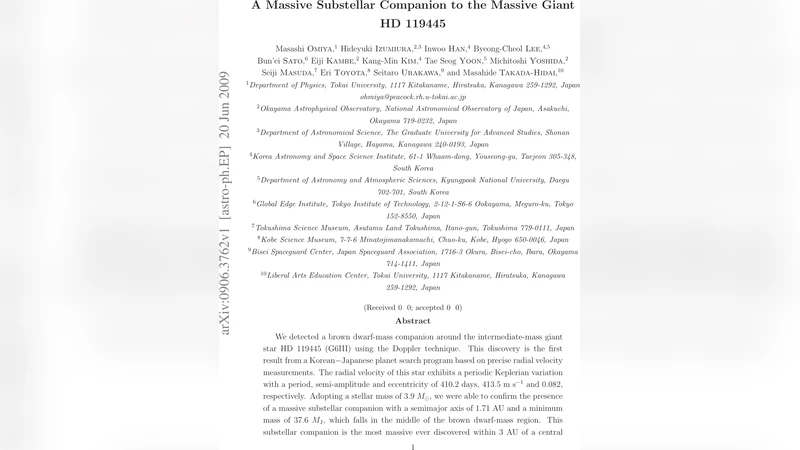
We detected a brown dwarf-mass companion around the intermediate-mass giant star HD 119445 (G6III) using the Doppler technique. This discovery is the first result from a Korean-Japanese planet search program based on precise radial velocity measurements. The radial velocity of this star exhibits a periodic Keplerian variation with a period, semi-amplitude and eccentricity of 410.2 days, 413.5 m/s and 0.082, respectively. Adopting a stellar mass of 3.9 M_solar, we were able to confirm the presence of a massive substellar companion with a semimajor axis of 1.71 AU and a minimum mass of 37.6 M_Jup, which falls in the middle of the brown dwarf-mass region. This substellar companion is the most massive ever discovered within 3 AU of a central intermediate-mass star. The host star also ranks among the most massive stars with substellar companions ever detected by the Doppler technique. This result supports the current view of substellar systems that more massive substellar companions tend to exist around more massive stars, and may further constrain substellar system formation mechanisms.
💡 Research Summary
The paper reports the discovery of a massive substellar companion—most likely a brown dwarf—orbiting the intermediate‑mass giant star HD 119445 (spectral type G6 III). The detection was made using precise radial‑velocity (RV) measurements obtained as part of a Korean‑Japanese planet‑search program that began in 2004. Observations were carried out with two high‑resolution echelle spectrographs: BOES on the 1.8 m telescope at Bohyunsan Optical Astronomy Observatory (Korea) and HIDES on the 1.88 m telescope at Okayama Astrophysical Observatory (Japan). Both instruments employed an iodine absorption cell for wavelength calibration, achieving typical internal RV uncertainties of 5–7 m s⁻¹. A total of 38 spectra were collected over a five‑year baseline (2004–2009).
The RV time series shows a clear, coherent periodic signal. A Lomb‑Scargle periodogram identifies a dominant peak at 410.2 days, which is confirmed independently in the BOES and HIDES data sets. A Keplerian fit using the RVLIN code yields the following orbital parameters: period P = 410.2 ± 0.6 days, velocity semi‑amplitude K = 413.5 ± 5.2 m s⁻¹, eccentricity e = 0.082 ± 0.015, and time of periastron passage Tₚ = JD 2453500.3 ± 3.1. No long‑term linear trend is detected, indicating that the observed motion is dominated by a single companion.
Stellar parameters were derived from high‑resolution spectroscopy, broadband photometry, and comparison with PARSEC evolutionary tracks. The host star has an effective temperature T_eff ≈ 5020 K, surface gravity log g ≈ 2.92, metallicity
Comments & Academic Discussion
Loading comments...
Leave a Comment