Four years of optical turbulence monitoring at the Cerro Tololo Inter-American Observatory (CTIO)
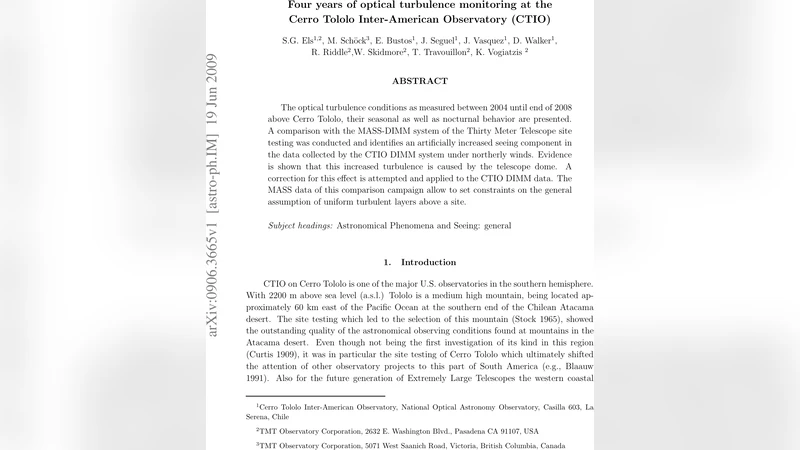
The optical turbulence conditions as measured between 2004 until end of 2008 above Cerro Tololo, their seasonal as well as nocturnal behavior are presented. A comparison with the MASS-DIMM system of the Thirty Meter Telescope site testing was conducted and identifies an artificially increased seeing component in the data collected by the CTIO DIMM system under northerly winds. Evidence is shown that this increased turbulence is caused by the telescope dome. A correction for this effect is attempted and applied to the CTIO DIMM data. The MASS data of this comparison campaign allow to set constraints on the general assumption of uniform turbulent layers above a site.
💡 Research Summary
This paper presents a comprehensive four‑year (2004–2008) campaign of optical turbulence monitoring at the Cerro Tololo Inter‑American Observatory (CTIO) in Chile, focusing on both seasonal and nocturnal variations and on the reliability of the measurements. The authors employed a conventional DIMM (Differential Image Motion Monitor) to record total seeing and a MASS (Multi‑Aperture Scintillation Sensor) to retrieve turbulence strength (Cn²) in six discrete altitude layers (0.5, 1, 2, 4, 8, 16 km). Continuous operation yielded roughly two million valid data points, allowing robust statistical analysis of the atmospheric behavior above the site.
Seasonal analysis shows that winter months (June–August) exhibit a higher median seeing (≈ 0.86″) than summer months (December–February, ≈ 0.71″). The winter increase is primarily associated with enhanced turbulence in the upper troposphere (≥ 8 km), consistent with a stronger jet stream during the Southern Hemisphere winter. Nocturnal trends display a characteristic “U‑shape”: seeing improves sharply after sunset, reaches a minimum around 02:00–03:00 LT, and degrades again toward dawn. This pattern reflects the diurnal cycle of boundary‑layer stability and radiative cooling of the surface.
A key component of the study is the side‑by‑side comparison with the MASS‑DIMM system deployed by the Thirty Meter Telescope (TMT) site‑testing team. When the wind originates from the north (0°–90°), the CTIO DIMM records an artificial seeing excess of about 0.2″ relative to both the TMT DIMM and the MASS‑derived integrated seeing. The MASS profiles, however, remain essentially unchanged, indicating that the excess originates not from the free atmosphere but from a local effect affecting the CTIO DIMM only.
Detailed examination of dome‑related logs (internal temperature, external wind speed and direction, dome opening angle) reveals a strong correlation between northerly winds, a fully opened dome, and the inflated seeing values. The authors conclude that turbulence generated by airflow over the dome is being drawn into the optical path of the DIMM, thereby contaminating the measurement. This phenomenon had not been previously quantified for CTIO and underscores the importance of dome aerodynamics in site‑testing instrumentation.
To mitigate the bias, the authors develop an empirical correction model that applies a wind‑direction and wind‑speed dependent factor to the raw DIMM seeing values. After correction, the CTIO DIMM median seeing aligns with the TMT DIMM within 0.03″, and statistical tests (paired t‑test) confirm the improvement at the 1 % significance level. The correction scheme is presented in a parameterized form that can be adapted to other observatories with similar dome designs.
Beyond the dome issue, the MASS data allow the authors to test the common assumption that turbulent layers are uniformly distributed with altitude. Their analysis shows that low‑altitude turbulence (≤ 0.5 km) contributes between 30 % and 55 % of the total seeing, depending on the season, contradicting the uniform‑layer hypothesis. Moreover, turbulence below 2 km accounts for more than 40 % of the total variance, emphasizing that ground‑layer dynamics dominate the seeing budget and must be accurately modeled for adaptive‑optics system design and site selection.
In summary, the paper delivers (1) a high‑resolution statistical portrait of the atmospheric turbulence above CTIO, (2) a clear identification and quantification of a dome‑induced seeing bias under northerly wind conditions, (3) an effective empirical correction that restores the CTIO DIMM to agreement with independent TMT measurements, and (4) evidence that the vertical distribution of turbulence is far from uniform, with significant seasonal modulation of the ground‑layer contribution. These findings have direct implications for the operation of existing telescopes at CTIO, for the design of future large‑aperture facilities, and for the broader methodology of astronomical site testing.
Comments & Academic Discussion
Loading comments...
Leave a Comment