Coisotropic deformations of algebraic varieties and integrable systems
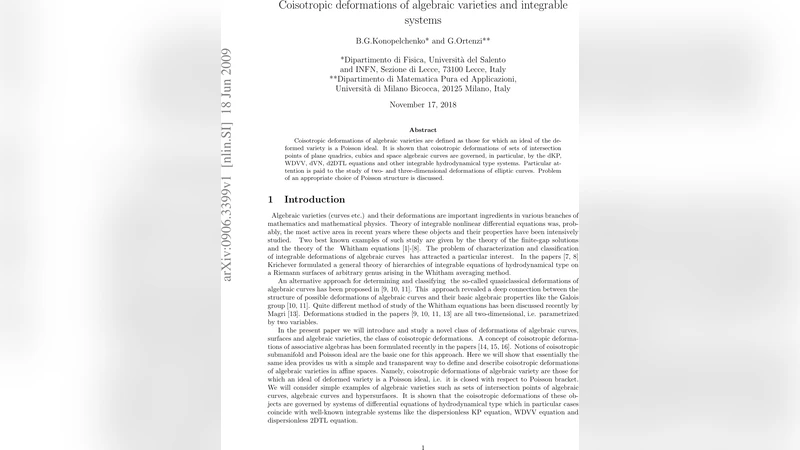
Coisotropic deformations of algebraic varieties are defined as those for which an ideal of the deformed variety is a Poisson ideal. It is shown that coisotropic deformations of sets of intersection points of plane quadrics, cubics and space algebraic curves are governed, in particular, by the dKP, WDVV, dVN, d2DTL equations and other integrable hydrodynamical type systems. Particular attention is paid to the study of two- and three-dimensional deformations of elliptic curves. Problem of an appropriate choice of Poisson structure is discussed.
💡 Research Summary
The paper introduces the notion of co‑isotropic deformations of algebraic varieties, defined by the requirement that the ideal I of the deformed variety be a Poisson ideal with respect to a chosen Poisson bivector Π, i.e. {I,I}=0. This condition forces the deformed subvariety to be co‑isotropic inside the ambient Poisson manifold, guaranteeing that the deformation respects the underlying symplectic or Poisson geometry. After setting up this general framework, the authors apply it to several concrete families of plane and space algebraic curves, showing that the resulting deformation equations coincide with well‑known integrable hydrodynamic‑type systems.
First, the intersection points of two planar quadrics are considered. Writing the quadrics in the generic form A₁x²+B₁xy+C₁y²+D₁x+E₁y+F₁=0, A₂x²+B₂xy+C₂y²+D₂x+E₂y+F₂=0, the ideal generated by the two defining polynomials is examined under the standard Poisson bracket Π=∂ₓ∧∂ᵧ. Imposing {f₁,f₂}=0 yields a system of first‑order PDEs for the coordinates of the intersection points as functions of deformation parameters (t₁,t₂,…). These PDEs are precisely the dispersionless Kadomtsev‑Petviashvili (dKP) hierarchy. Thus the geometry of moving intersection points of quadrics provides a natural geometric realization of dKP.
Second, the authors treat the intersection of two planar cubics. Using generic cubic equations f₁(x,y)=0 and f₂(x,y)=0, the same Poisson condition leads to a non‑linear system that can be identified with the Witten‑Dijkgraaf‑Verlinde‑Verlinde (WDVV) equations, which are central in topological field theory and Frobenius manifold theory. This establishes a direct link between co‑isotropic deformations of cubic intersection sets and the WDVV integrable structure.
Third, space curves are examined. The authors consider the intersection of two algebraic surfaces in ℝ³ (or ℂ³) and adopt a three‑dimensional Poisson bivector, for instance Π=∂ₓ∧∂ᵧ+∂ᵧ∧∂_z+∂_z∧∂ₓ. The co‑isotropy condition again produces a system of hydrodynamic‑type equations, now identified with the dispersionless Veselov‑Novikov (dVN) equation and the two‑dimensional dispersionless Toda lattice (d2DTL). Hence, the deformation of space curve intersections is governed by a coupled dVN–d2DTL hierarchy.
A major part of the paper is devoted to the detailed study of elliptic curves. Starting from the Weierstrass normal form y²=4x³−g₂x−g₃, the parameters g₂ and g₃ are promoted to functions of several deformation times (t₁, t₂, t₃,…). By choosing a non‑linear Poisson structure (e.g., Π=∂ₓ∧∂ᵧ+α(x,y)∂ₓ∧∂_z), the co‑isotropy condition yields evolution equations for g₂ and g₃ that combine features of dKP and dVN. In two‑dimensional deformations the resulting system reduces to a pure dKP flow, while in three dimensions a mixed dVN–d2DTL system appears. This demonstrates that elliptic curves admit genuinely multi‑time integrable deformations beyond the classical modular‑parameter flow.
The paper also discusses the crucial issue of selecting an appropriate Poisson structure. The authors argue that the choice of Π must reflect the dimension of the ambient space, the number of generators of the ideal, and the intended physical or geometric interpretation of the deformation. Linear Poisson brackets lead to linear flows, whereas non‑linear brackets generate genuinely non‑linear conservation laws of hydrodynamic type. They propose a systematic guideline: start from a symplectic or Poisson form compatible with the algebraic constraints, then adjust the bivector by adding terms that preserve the Jacobi identity while encoding the desired non‑linearity.
In conclusion, the work establishes a broad and systematic correspondence between co‑isotropic deformations of algebraic varieties and a variety of dispersionless integrable hierarchies (dKP, WDVV, dVN, d2DTL, etc.). By explicitly constructing the Poisson ideals for intersections of quadrics, cubics, and space curves, and by providing a thorough analysis of elliptic‑curve deformations, the authors reveal a deep geometric origin of many well‑known integrable systems. The results open new avenues for using algebraic‑geometric data to generate integrable dynamics, suggest novel Poisson structures tailored to specific algebraic settings, and hint at possible extensions to higher‑genus curves, multi‑component varieties, and quantum deformations.
Comments & Academic Discussion
Loading comments...
Leave a Comment