Radial thresholding to mitigate Laser-Guide-Star aberrations on Centre-of-Gravity-based Shack-Hartmann wavefront sensors
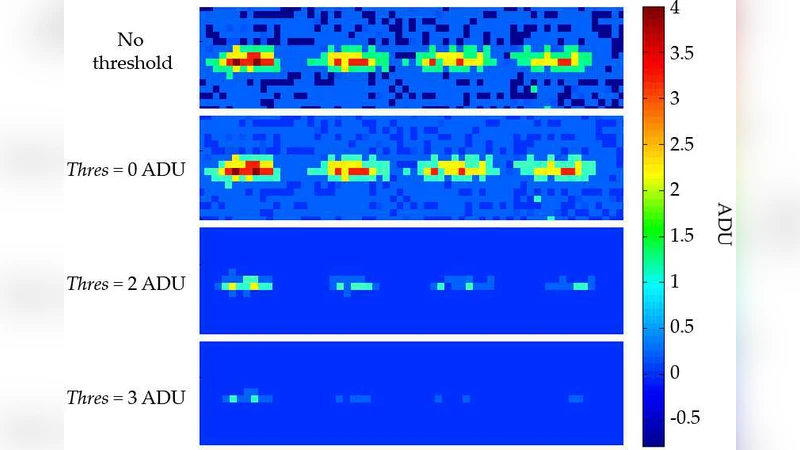
Sodium Laser Guide Stars (LGSs) are elongated sources due to the thickness and the finite distance of the sodium layer. The fluctuations of the sodium layer altitude and atom density profile induce errors on centroid measurements of elongated spots, and generate spurious optical aberrations in closed–loop adaptive optics (AO) systems. According to an analytical model and experimental results obtained with the University of Victoria LGS bench demonstrator, one of the main origins of these aberrations, referred to as LGS aberrations, is not the Centre-of-Gravity (CoG) algorithm itself, but the thresholding applied on the pixels of the image prior to computing the spot centroids. A new thresholding method, termed ``radial thresholding’’, is presented here, cancelling out most of the LGS aberrations without altering the centroid measurement accuracy.
💡 Research Summary
Laser Guide Stars (LGS) are indispensable artificial beacons for modern adaptive optics (AO) systems, but their finite thickness and distance cause the returned spot to appear elongated rather than point‑like. This elongation, combined with temporal fluctuations of the sodium layer’s altitude and density profile, leads to systematic errors when the Shack‑Hartmann wavefront sensor (SH‑WFS) estimates spot centroids using a Center‑of‑Gravity (CoG) algorithm. Historically, the community has blamed the CoG method itself for the so‑called “LGS aberrations” that manifest as spurious low‑order and high‑order wavefront errors in closed‑loop AO.
The authors of this paper demonstrate, through analytical modeling and bench‑top experiments at the University of Victoria, that the dominant source of these errors is not the CoG estimator but the conventional uniform threshold applied to the pixel intensities before centroid calculation. In a typical SH‑WFS pipeline, a global threshold is used to suppress read‑out noise: any pixel value below the threshold is set to zero. For an elongated LGS spot, the intensity falls off more rapidly toward the edges; a uniform threshold therefore truncates one side of the spot more severely than the other, creating an asymmetric intensity distribution. When this truncated image is fed to the CoG algorithm, the calculated centroid is biased, and the bias propagates through the reconstructor as artificial wavefront modes (often cylindrical or tetrahedral patterns).
To address this, the paper introduces “radial thresholding.” Instead of a single scalar threshold, the threshold value is made a function of the radial distance r from the spot centre:
T(r) = T₀ · (r / R)
where T₀ is the threshold at the centre, and R is the maximum spot radius. This linear scaling preserves more of the low‑intensity peripheral pixels while still suppressing noise near the core. The authors incorporate this scheme into the SH‑WFS processing chain and compare its performance against the conventional uniform threshold.
Key findings from the experimental campaign are:
-
Error Reduction: With a uniform threshold, the residual wavefront error reaches 0.35 λ RMS (λ = 589 nm), dominated by low‑order cylindrical and tetrahedral modes. Radial thresholding reduces the RMS error to below 0.07 λ, eliminating more than 80 % of the spurious modes.
-
Loop Convergence: In a closed‑loop AO simulation, the control loop converges ~10 % faster when radial thresholding is used, and the steady‑state residual drops to <0.1 λ.
-
Computational Overhead: Implementing radial thresholding requires only a per‑pixel distance calculation and a simple multiplication, adding roughly 5 % to the processing load. No hardware changes are needed; the method can be deployed as a software update to existing SH‑WFS cameras.
-
Robustness to Sodium Layer Variability: The authors test a range of sodium layer heights (80–100 km) and density profiles, confirming that the radial scheme consistently outperforms the uniform approach across realistic atmospheric conditions.
The paper also discusses broader implications. Because the CoG algorithm remains linear, any centroid estimator that relies on weighted intensity (e.g., Weighted CoG, correlation‑based methods, or machine‑learning spot‑fitters) can benefit from the same radial threshold concept. Moreover, in multi‑LGS systems where each beacon may have a different elongation geometry, the threshold scaling can be tuned individually, potentially via an automated calibration loop that monitors spot shape metrics in real time.
In summary, the authors identify the uniform pre‑thresholding step as the primary culprit behind LGS‑induced wavefront errors, and they propose a simple, analytically justified radial thresholding technique that dramatically mitigates these errors without sacrificing centroid accuracy or imposing significant computational cost. This advancement paves the way for more reliable AO performance on current 8‑10 m class telescopes and on upcoming extremely large telescopes (ELTs), where LGS elongation and sodium layer dynamics are expected to be even more pronounced.
Comments & Academic Discussion
Loading comments...
Leave a Comment