UVES/VLT high resolution absorption spectroscopy of the GRB080330 afterglow: a study of the GRB host galaxy and intervening absorbers
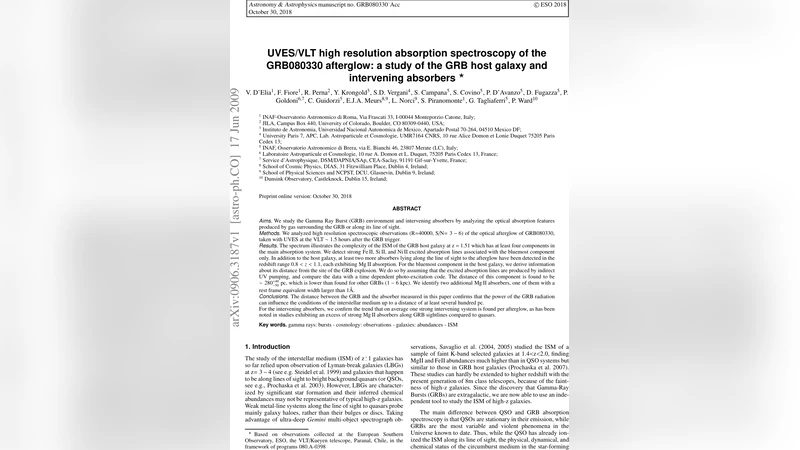
We study the Gamma Ray Burst (GRB) environment and intervening absorbers by analyzing the optical absorption features produced by gas surrounding the GRB or along its line of sight. We analyzed high resolution spectroscopic observations (R=40000, S/N=3 - 6) of the optical afterglow of GRB080330, taken with UVES at the VLT ~ 1.5 hours after the GRB trigger. The spectrum illustrates the complexity of the ISM of the GRB host galaxy at z = 1.51 which has at least four components in the main absorption system. We detect strong FeII, SiII, and NiII excited absorption lines associated with the bluemost component only. In addition to the host galaxy, at least two more absorbers lying along the line of sight to the afterglow have been detected in the redshift range 0.8 < z < 1.1, each exhibiting MgII absorption. For the bluemost component in the host galaxy, we derive information about its distance from the site of the GRB explosion. We do so by assuming that the excited absorption lines are produced by indirect UV pumping, and compare the data with a time dependent photo-excitation code. The distance of this component is found to be 280+40-50 pc, which is lower than found for other GRBs (1 - 6 kpc). We identify two additional MgII absorbers, one of them with a rest frame equivalent width larger than 1A. The distance between the GRB and the absorber measured in this paper confirms that the power of the GRB radiation can influence the conditions of the interstellar medium up to a distance of at least several hundred pc. For the intervening absorbers, we confirm the trend that on average one strong intervening system is found per afterglow, as has been noted in studies exhibiting an excess of strong MgII absorbers along GRB sightlines compared to quasars.
💡 Research Summary
The paper presents a detailed analysis of the optical afterglow of GRB 080330 obtained with the Ultraviolet and Visual Echelle Spectrograph (UVES) on the Very Large Telescope (VLT) roughly 1.5 hours after the burst. The spectrum, recorded at a resolving power of R ≈ 40 000 and a signal‑to‑noise ratio of 3–6, reveals a complex interstellar medium (ISM) in the host galaxy at redshift z = 1.51, as well as two intervening absorbers in the redshift interval 0.8 < z < 1.1.
The host absorption system is decomposed into at least four distinct velocity components. Only the bluest component exhibits strong fine‑structure (excited) transitions of Fe II, Si II, and Ni II. The authors interpret these excited lines as the result of indirect UV pumping: ultraviolet photons from the GRB afterglow populate higher electronic levels, which subsequently decay to the observed fine‑structure states. To quantify the distance between the GRB and the absorbing gas, they employ a time‑dependent photo‑excitation code that simulates the evolving radiation field and the population of the relevant levels. By fitting the observed column density ratios of ground‑state and excited‑state ions, the model yields a distance of 280 pc, with an uncertainty of +40/‑50 pc, for the bluest component. This distance is considerably smaller than the 1–6 kpc distances that have been inferred for similar components in other GRB afterglows, indicating that the intense radiation from GRB 080330 can affect the physical conditions of the surrounding ISM out to several hundred parsecs.
In addition to the host galaxy, the spectrum shows two separate Mg II absorption systems at z ≈ 0.84 and z ≈ 1.03. The latter system has a rest‑frame equivalent width larger than 1 Å, classifying it as a “strong” Mg II absorber. The detection of these intervening systems confirms the previously reported excess of strong Mg II absorbers along GRB sightlines compared with quasar sightlines; on average, one strong intervening system is found per GRB afterglow.
The authors performed Voigt‑profile fitting to derive column densities, Doppler parameters, and velocity offsets for each component. The fine‑structure line ratios provide constraints on the electron density (∼10²–10³ cm⁻³) and temperature (≲10⁴ K) of the gas in the bluest component, consistent with a medium that has been rapidly photo‑heated by the GRB and is now cooling.
The study highlights several important implications. First, the ability of GRB radiation to modify the excitation state of gas at distances of a few hundred parsecs demonstrates that afterglow spectroscopy can probe the immediate environment of the burst with unprecedented precision. Second, the multi‑component structure of the host absorption indicates that the ISM of GRB host galaxies is highly inhomogeneous, requiring models that account for both dense, UV‑pumped clumps and more diffuse, quiescent gas. Third, the confirmed prevalence of strong Mg II intervening absorbers along GRB sightlines reinforces the notion that GRBs preferentially intersect regions of higher galaxy density or that selection effects enhance the detection of such systems.
Overall, this work showcases the power of rapid, high‑resolution spectroscopy of GRB afterglows to measure distances to absorbing clouds, to assess the impact of GRB radiation on the surrounding medium, and to contribute to the broader discussion of absorber statistics in the high‑redshift universe.
Comments & Academic Discussion
Loading comments...
Leave a Comment