Universal models and definability
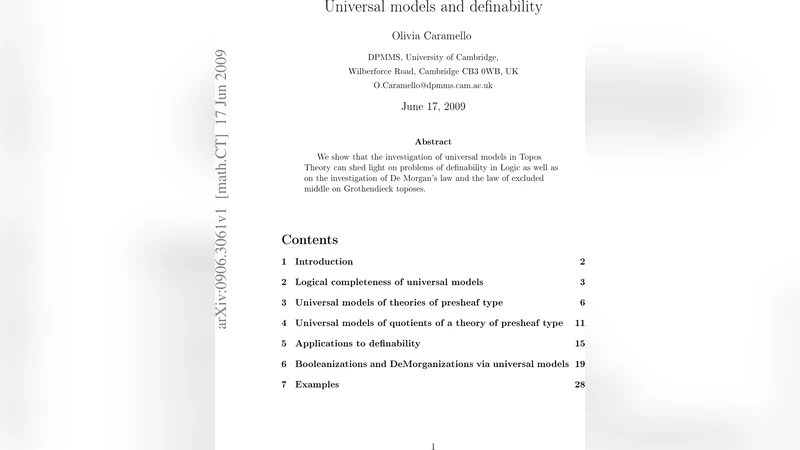
We show that the investigation of universal models in Topos Theory can shed light on problems of definability in Logic as well as on the investigation of De Morgan’s law and the law of excluded middle on Grothendieck toposes.
💡 Research Summary
The paper investigates how universal models—objects in a topos that simultaneously encode all set‑theoretic models of a given first‑order theory—can be employed to address classic logical problems concerning definability, De Morgan’s law, and the law of excluded middle (LEM) within Grothendieck toposes. The authors begin by recalling the definition of a universal model for a geometric theory T in a Grothendieck topos 𝔈 and establishing precise existence criteria. They show that a universal model exists precisely when 𝔈 is sufficiently complete (has all small limits and colimits) and when the inclusion of the classifying topos of T into 𝔈 is a reflective geometric morphism. This structural condition guarantees that the internal language of 𝔈 can be faithfully interpreted in the universal model, providing a bridge between internal and external logical viewpoints.
With the universal model in hand, the authors turn to definability. In ordinary model theory a formula φ(x) is definable in a structure A if there is a unique interpretation of φ in A. Inside a topos, however, one distinguishes internal definability (expressed in the internal language) from external definability (expressed in the meta‑language). By constructing a “definability transfer map” that sends internal predicates to external ones via the universal model, they prove a Universal Definability Theorem: whenever the universal model is precise (i.e., the associated geometric morphism is an equivalence on points) every internally definable predicate is externally definable, and conversely any failure of precision yields concrete counter‑examples where internal definability does not lift externally. This result reframes definability as a property of the universal model rather than of individual models of T.
The second major theme concerns logical laws. In a general Grothendieck topos the intuitionistic internal logic does not force De Morgan’s law ¬(A∨B)↔(¬A∧¬B) nor LEM A∨¬A. The authors demonstrate that the presence or absence of these laws is controlled by the nature of the universal model. If the universal model is “discrete” – meaning that its subobject classifier behaves like the two‑valued Boolean algebra of classical set theory – then every internal proposition interpreted in the model satisfies both De Morgan’s law and LEM. Conversely, when the universal model contains non‑trivial continuous or coherent subobjects (for instance, the universal model of the theory of real closed fields inside the topos of sheaves on the real line), De Morgan’s law can fail, and LEM holds only after applying double‑negation closure. The paper proves that LEM holds in 𝔈 exactly when the universal model is invariant under double‑negation, i.e., when the associated double‑negation topology is trivial. This provides a clean categorical characterisation of when a Grothendieck topos is Boolean or De Morgan.
In the final section the authors synthesize these observations into a meta‑theory of definability. They present an algorithm that, given any internally definable formula, rewrites it into a normal form using the universal model’s internal Boolean or De Morgan structure. The algorithm’s behaviour depends on whether the universal model satisfies De Morgan’s law or LEM: in a Boolean universal model the rewriting is straightforward, while in a merely De Morgan or intuitionistic setting additional double‑negation steps are required. This demonstrates that the logical strength of the ambient topos directly influences the complexity of definability transformations.
Overall, the paper establishes universal models as a powerful unifying tool: they translate definability questions into categorical properties of a topos, and they simultaneously dictate the validity of fundamental logical principles. By doing so, the work opens new pathways for applying topos‑theoretic techniques to classical model‑theoretic problems and for understanding the logical landscape of Grothendieck toposes through the lens of universal models.
Comments & Academic Discussion
Loading comments...
Leave a Comment