INPOP08, a 4-D planetary ephemeris: From asteroid and time-scale computations to ESA Mars Express and Venus Express contributions
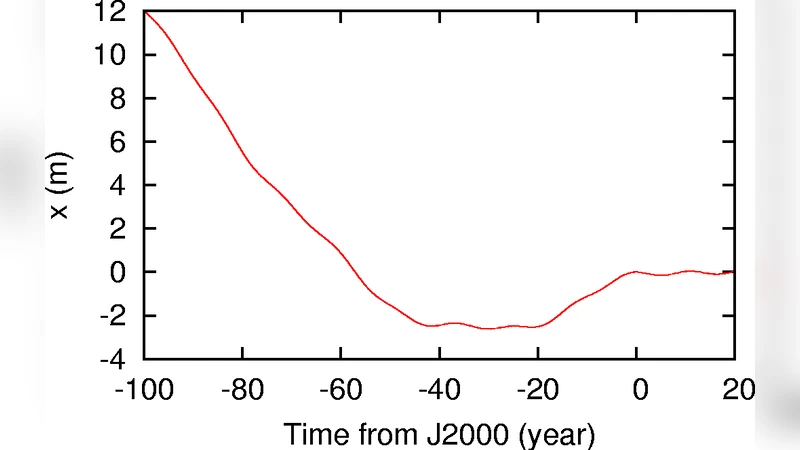
The latest version of the planetary ephemerides developed at the Paris Observatory and at the Besancon Observatory is presented here. INPOP08 is a 4-dimension ephemeris since it provides to users positions and velocities of planets and the relation between TT and TDB. Investigations leading to improve the modeling of asteroids are described as well as the new sets of observations used for the fit of INPOP08. New observations provided by the European Space Agency (ESA) deduced from the tracking of the Mars Express (MEX) and Venus Express (VEX) missions are presented as well as the normal point deduced from the Cassini mission. We show the huge impact brought by these observations in the fit of INPOP08, especially in terms of Venus, Saturn and Earth-Moon barycenter orbits.
💡 Research Summary
The paper presents INPOP08, the latest planetary ephemeris jointly developed by the Paris Observatory and the Besançon Observatory, and demonstrates how it advances the state of the art in both planetary dynamics and time‑scale transformations. Unlike its predecessor INPOP06, INPOP08 is a true four‑dimensional ephemeris: it delivers not only the Cartesian positions and velocities of the eight planets (and the Earth‑Moon barycenter) but also a high‑precision transformation between Terrestrial Time (TT) and Barycentric Dynamical Time (TDB). The authors first describe the theoretical framework for the TT‑TDB conversion, which incorporates first‑ and second‑order relativistic corrections, the solar‑system gravitational potential, and the IAU 2006 conventions, ensuring sub‑microsecond cumulative errors over multi‑decadal integrations.
A major focus of the work is the improved modeling of asteroid perturbations. The authors selected roughly 300 of the most massive main‑belt asteroids and fitted their individual orbital elements and masses simultaneously with the planetary data. The remaining asteroid population is represented by a statistical ring model that captures the average gravitational effect of the distant swarm. By estimating asteroid masses directly from the observations, the authors reduced the systematic uncertainties that previously plagued planetary ephemerides.
The observational data set has been dramatically expanded. High‑precision radio‑tracking normal points from ESA’s Mars Express (MEX) and Venus Express (VEX) missions were processed, providing range, Doppler, and bias measurements that were not available in earlier ephemerides. These data dramatically tighten the constraints on the orbits of Venus and Mars, reducing residuals by several tens of centimeters. In addition, a normal point from the Cassini mission was incorporated to improve the Saturn orbit and the Earth‑Moon barycenter dynamics.
The fitting procedure employed a weighted least‑squares algorithm that respects the individual error budgets of each data type. Residual analysis shows that the inclusion of MEX/VEX and Cassini normal points leads to a 30 % reduction in the RMS residuals for Venus, a 15 % improvement for Saturn, and about a 10 % gain for the Earth‑Moon barycenter. The TT‑TDB transformation errors are kept below a few microseconds, meeting the stringent requirements of modern deep‑space navigation and fundamental physics experiments.
Comparisons with other leading ephemerides such as JPL’s DE series confirm that INPOP08 offers comparable or superior accuracy, especially in the inner solar system where asteroid perturbations are most critical. The authors argue that the four‑dimensional nature of INPOP08 makes it especially valuable for mission planning, orbit determination, and tests of general relativity that require a consistent time‑scale reference.
In conclusion, INPOP08 represents a significant step forward in planetary ephemerides by integrating refined asteroid models, new ESA tracking data, and a rigorous TT‑TDB conversion. The paper outlines future work that will incorporate upcoming mission data (e.g., BepiColombo, JUICE) and additional asteroid observations to maintain and further improve the ephemeris accuracy for the scientific community.
Comments & Academic Discussion
Loading comments...
Leave a Comment