GMRT radio observations of the transiting extrasolar planet HD189733b at 244 and 614 MHz
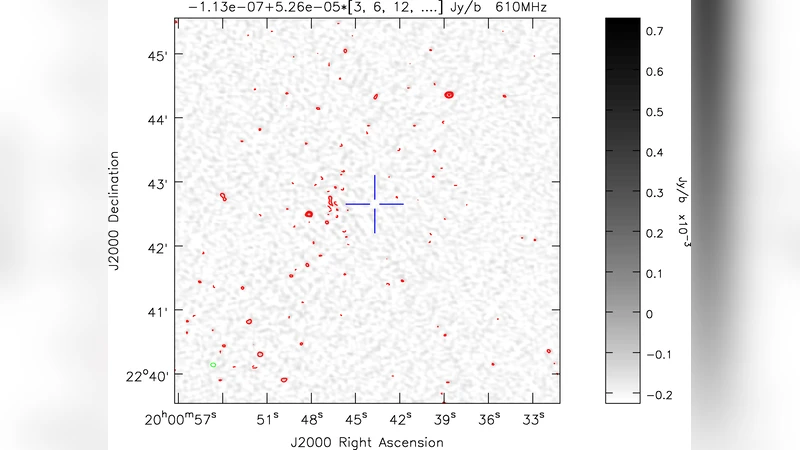
We report a sensitive search for meter-wavelength emission at 244 and 614 MHz from HD189733b, the nearest known extrasolar transiting planet of `hot-Jupiter’ type. To discriminate any planetary emission from possible stellar or background contributions, we observed the system for 7.7 hours encompassing the planet’s eclipse behind the host star. These GMRT observations provide very low (3 sigma) upper limits of 2 mJy at 244 MHz and 160 micro-Jy at 614 MHz. These limits are, respectively, about 40 and 500 times deeper than those reported recently at a nearby frequency of 340 MHz. Possible explanations of our non-detection include: (1) the Earth being outside the planet’s emission beam; (2) its highly variable emission with more rapid flaring than the temporal sampling in our observations; (3) the planetary emission being intrinsically too weak; or more likely, (4) the emission being predominantly at lower frequencies because of a weak planetary magnetic field. We briefly discuss these possibilities and the constraints on this exo-planetary system environment.
💡 Research Summary
The authors present a deep search for low‑frequency radio emission from the transiting hot‑Jupiter HD 189733b using the Giant Metrewave Radio Telescope (GMRT) at two separate bands, 244 MHz (8 MHz bandwidth) and 614 MHz (16 MHz bandwidth). The observations were timed to cover a full planetary eclipse (when the planet passes behind its host star) and lasted a total of 7.7 hours, providing a clean way to separate any planetary signal from stellar or background contributions. Standard AIPS processing, including radio‑frequency interference excision, complex gain calibration, and imaging, yielded final maps with rms noise levels of 0.66 mJy beam⁻¹ at 244 MHz and 53 µJy beam⁻¹ at 614 MHz.
No statistically significant source was detected at the planet’s position. The 3σ upper limits are 2 mJy at 244 MHz and 160 µJy at 614 MHz. These limits are dramatically more stringent than the previously reported 340 MHz limits (≈80 mJy), improving the constraints by factors of roughly 40 at 244 MHz and 500 at 614 MHz.
The paper discusses four plausible explanations for the non‑detection: (1) the cyclotron‑maser emission is beamed and the Earth lies outside the beam; (2) the emission is highly variable on timescales shorter than the 10–30 minute integration windows, causing any brief flares to be averaged out; (3) the intrinsic radio power of the planet is simply too low; and (4) the planet’s magnetic field is weak, shifting the bulk of the cyclotron‑maser power to frequencies below the GMRT bands (e.g., 10–30 MHz). The authors favor the fourth scenario because the cyclotron frequency ν_c ≈ 2.8 MHz × B(G) implies that a magnetic field of ~87 G would be required for detectable emission at 244 MHz and ~219 G for 614 MHz. Theoretical estimates for hot Jupiters typically predict surface fields of only a few to a few tens of gauss, suggesting that most of the emission would indeed lie at much lower frequencies.
Given these constraints, the study emphasizes the need for future observations with low‑frequency facilities such as LOFAR, the Murchison Widefield Array, or the low‑frequency component of the Square Kilometre Array, which can probe the 10–100 MHz regime where emission from a weakly magnetised hot Jupiter is expected to peak. Additionally, higher time‑resolution monitoring could capture rapid flares that would be smeared out in the present data. Multi‑wavelength campaigns that combine radio, optical, and X‑ray observations would also help to disentangle stellar activity from planetary signals and to refine models of exoplanetary magnetospheres.
In summary, this work provides the deepest meter‑wave limits to date on HD 189733b, demonstrates the challenges of detecting exoplanetary radio emission with current instruments, and outlines a clear roadmap for future low‑frequency, high‑time‑resolution studies aimed at unveiling the magnetic environments of close‑in giant exoplanets.
Comments & Academic Discussion
Loading comments...
Leave a Comment