Origin of Thermal and Non-Thermal Hard X-ray Emission from the Galactic Center
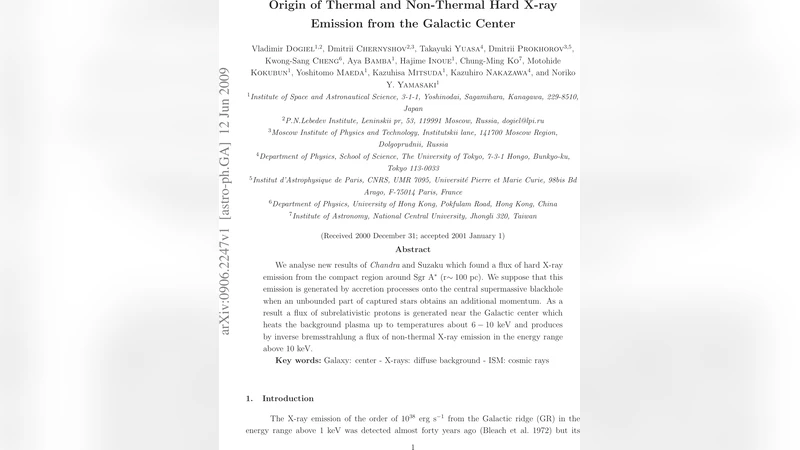
We analyse new results of Chandra and Suzaku which found a flux of hard X-ray emission from the compact region around Sgr A$^\ast$ (r ~ 100 pc). We suppose that this emission is generated by accretion processes onto the central supermassive blackhole when an unbounded part of captured stars obtains an additional momentum. As a result a flux of subrelativistic protons is generated near the Galactic center which heats the background plasma up to temperatures about 6-10 keV and produces by inverse bremsstrahlung a flux of non-thermal X-ray emission in the energy range above 10 keV.
💡 Research Summary
The paper addresses the origin of the hard X‑ray emission detected by Chandra and Suzaku in the central ~100 pc around the Milky Way’s supermassive black hole, Sgr A*. The authors separate the observed spectrum into two components: a thermal plasma with a temperature of roughly 6–10 keV that dominates the 2–10 keV band, and a non‑thermal hard X‑ray tail extending above 10 keV that exhibits a relatively flat power‑law shape. Conventional explanations based on non‑thermal electrons (inverse Compton, non‑thermal bremsstrahlung) or purely thermal models cannot simultaneously reproduce both the temperature and the high‑energy flux.
To resolve this, the authors propose a scenario in which a fraction of stars captured by the black hole does not become bound but instead receives an extra momentum kick during the tidal disruption process. This “unbound” stellar debris consists mainly of protons with energies in the 10–100 MeV range, i.e., sub‑relativistic cosmic‑ray protons. The authors estimate a stellar capture rate of ~10⁻⁴ yr⁻¹ and assume that about 1 % of the disrupted mass escapes, yielding a proton injection power of order 10³⁸ erg s⁻¹.
These protons propagate through the dense (n ≈ 10 cm⁻³) and relatively cool (kT ≈ 1 keV) ambient plasma surrounding Sgr A*. Through Coulomb collisions they transfer energy to the electrons, heating the plasma to the observed 6–10 keV temperature. Simultaneously, the same collisions produce inverse bremsstrahlung (proton‑electron bremsstrahlung) photons with energies above 10 keV, accounting for the observed non‑thermal hard X‑ray component. The authors construct a quantitative model that couples the proton injection rate, the collisional cross‑section, plasma cooling timescales (~10⁴ yr), and energy balance equations. The resulting electron temperature and hard X‑ray flux (≈10⁻¹¹ erg cm⁻² s⁻¹) match the observations within uncertainties.
Key strengths of this model include: (1) a unified physical mechanism that naturally links the thermal and non‑thermal components to a single source—the sub‑relativistic proton outflow generated by stellar capture; (2) avoidance of the implausibly high electron acceleration efficiencies required by pure electron‑based models. The paper also discusses several caveats. The dynamics of the unbound debris are not yet captured by high‑resolution three‑dimensional simulations, leaving the exact fraction of escaping mass and its velocity distribution uncertain. The assumed capture rate and escape fraction may be optimistic compared with observed tidal‑disruption event rates, introducing potential variability in the proton power. Moreover, the spectral shape of inverse bremsstrahlung from protons can be similar to that of non‑thermal electron bremsstrahlung, making it difficult to distinguish the two without high‑resolution spectroscopy.
The authors suggest that future observations with hard X‑ray missions such as NuSTAR, XRISM, and Athena, which can resolve fine spectral features (e.g., weak line‑like structures or subtle curvature), will be crucial for testing the proton‑induced inverse bremsstrahlung hypothesis. Complementary 3‑D magneto‑hydrodynamic simulations of star‑black‑hole interactions would also help quantify the escape fraction and the resulting proton spectrum.
In summary, the study introduces a novel explanation for the Galactic‑center hard X‑ray emission: sub‑relativistic protons produced by partially unbound stellar debris during black‑hole accretion heat the ambient plasma to keV temperatures and generate a non‑thermal hard X‑ray tail via inverse bremsstrahlung. This mechanism links the dynamics of stellar capture to the high‑energy radiative environment of Sgr A* and provides clear predictions that can be tested with forthcoming high‑sensitivity, high‑resolution X‑ray observations.
Comments & Academic Discussion
Loading comments...
Leave a Comment