Angular collapse of dipolar Bose-Einstein condensates
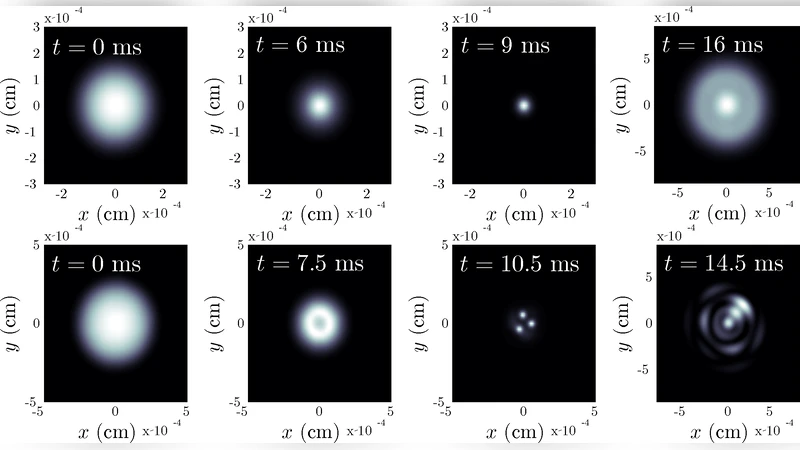
We explore the structure and dynamics of dipolar Bose-Einstein condensates (DBECs) near their threshold for instability. Near this threshold a DBEC may exhibit nontrivial, biconcave density distributions, which are associated with instability against collapse into “angular roton” modes. Here we discuss experimental signatures of these novel features. In the first, we infer local collapse of the DBEC from the experimental stability diagram. In the second, we explore the dynamics of collapse and find that a nontrivial angular distribution is a signature of the DBEC possessing a biconcave structure.
💡 Research Summary
The paper investigates the structural and dynamical properties of dipolar Bose‑Einstein condensates (DBECs) in the vicinity of their instability threshold, focusing on the emergence of non‑trivial, biconcave density profiles and the associated “angular roton” collapse modes. By extending the Gross‑Pitaevskii framework to include the anisotropic dipole‑dipole interaction term, the authors introduce the dipolar strength parameter ε_dd = C_dd/(3g) and explore how the trap aspect ratio λ = ω_z/ω_ρ and atom number N jointly determine the ground‑state morphology. In highly oblate traps (λ≫1) and for ε_dd approaching unity, the mean‑field solution departs from the usual Gaussian shape and develops a central density dip surrounded by a high‑density ring—a biconcave configuration. This geometry lowers the energy of angular‑momentum excitations (angular rotons) and renders the system susceptible to collapse via modes with non‑zero angular quantum numbers.
Experimentally, the authors map out a stability diagram by varying N and λ for strongly magnetic species such as ^52Cr, ^164Dy, and ^168Er. The diagram shows a clear boundary where the condensate abruptly loses coherence. Notably, in a narrow band of parameters (ε_dd≈0.9–1.1, λ≈5–10) collapse occurs at atom numbers well below the mean‑field prediction, indicating a local, rather than global, instability. To interpret this, time‑dependent Gross‑Pitaevskii simulations are performed. The protocol consists of a rapid quench of the dipolar interaction to push the system just beyond the critical point, followed by real‑time evolution over 1–10 ms using a Crank‑Nicolson scheme.
Two distinct collapse pathways emerge from the simulations. In the absence of a biconcave density distribution, the condensate undergoes a spherically symmetric collapse: the central density spikes uniformly and three‑body loss quickly depletes the atoms. When a biconcave profile is present, the collapse initiates in the high‑density ring and proceeds anisotropically. Specific angular sectors of the ring become unstable first, amplifying angular roton modes (ℓ = 2, 3, …). The resulting density pattern consists of several localized peaks arranged around the original ring, a clear signature of angular collapse. Fourier analysis of the evolving wavefunction confirms the dominance of non‑zero angular momentum components, while time‑of‑flight absorption images would display a non‑uniform, fragmented ring rather than a centrally concentrated cloud.
The authors propose experimental diagnostics: (i) imaging the post‑collapse density distribution to detect angular fragmentation, and (ii) Bragg spectroscopy to directly measure the softened angular roton branch. Both methods corroborate the theoretical prediction that a biconcave ground state predisposes the DBEC to collapse via angular modes.
In conclusion, the study identifies the biconcave density profile and the associated low‑energy angular roton excitations as the key determinants of collapse dynamics in dipolar condensates. This insight not only clarifies the nature of the instability observed in recent experiments but also provides a practical roadmap for detecting and controlling such phenomena. Future directions suggested include tuning dipole orientation with external fields, exploring multi‑trap geometries, and investigating the interplay between angular rotons and exotic quantum phases such as supersolids or dipolar quantum liquids. The work thus bridges theoretical predictions with experimentally accessible signatures, advancing our understanding of anisotropic quantum fluids.
Comments & Academic Discussion
Loading comments...
Leave a Comment