Supersolid phase with cold polar molecules on a triangular lattice
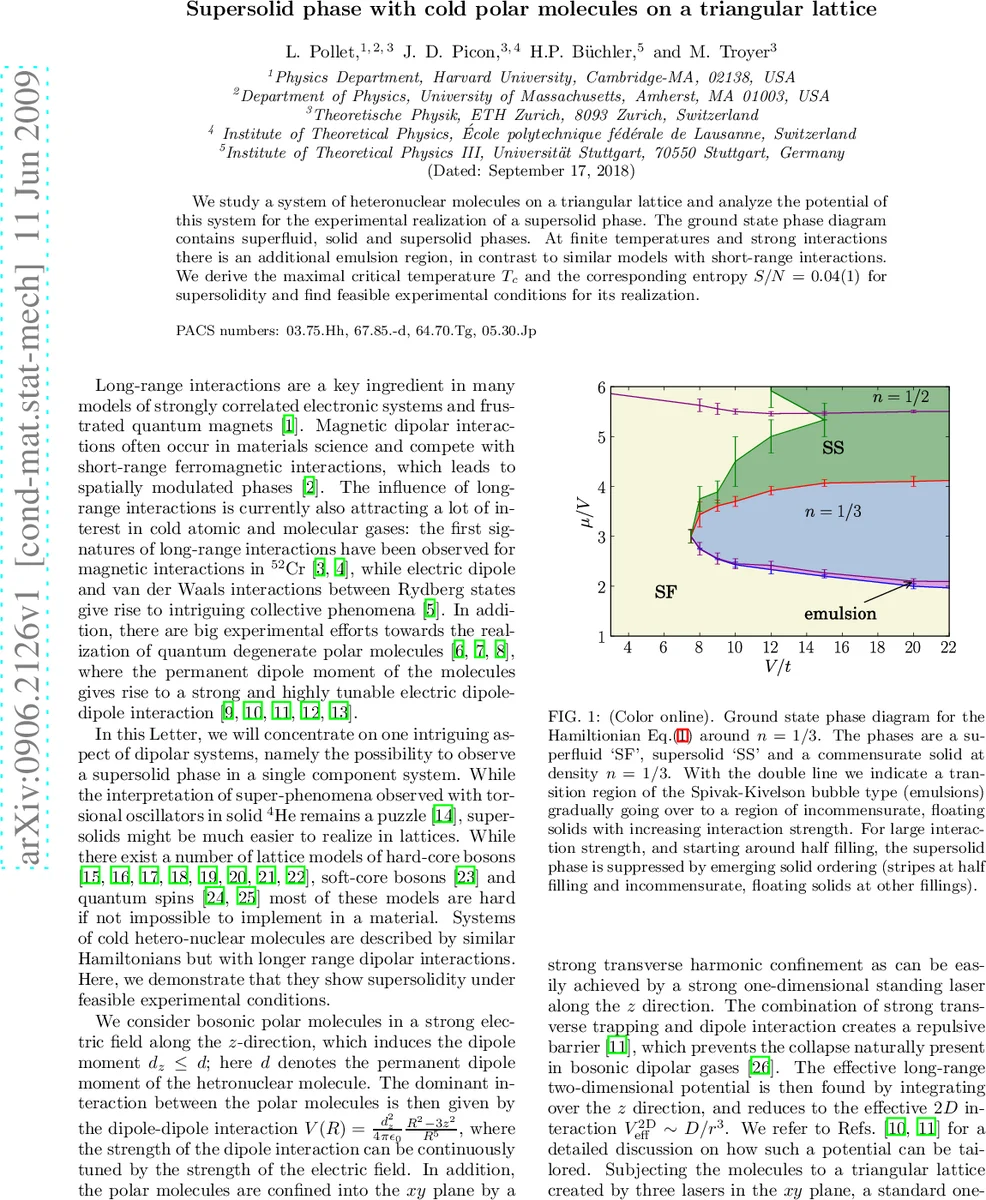
We study a system of heteronuclear molecules on a triangular lattice and analyze the potential of this system for the experimental realization of a supersolid phase. The ground state phase diagram contains superfluid, solid and supersolid phases. At finite temperatures and strong interactions there is an additional emulsion region, in contrast to similar models with short-range interactions. We derive the maximal critical temperature $T_c$ and the corresponding entropy $S/N = 0.04(1)$ for supersolidity and find feasible experimental conditions for its realization.
💡 Research Summary
The authors investigate a two‑dimensional system of heteronuclear polar molecules confined to a triangular optical lattice, with the aim of identifying realistic conditions for the experimental observation of a supersolid (SS) phase. The microscopic model is a hard‑core bosonic Hubbard Hamiltonian that includes a nearest‑neighbour hopping amplitude (t) and a long‑range dipole‑dipole interaction (V_{ij}=D/r_{ij}^{3}), where the dipolar strength (D) can be tuned by an external electric field. A chemical potential (\mu) controls the average filling (n). Because the triangular lattice lacks bipartite symmetry, commensurate density waves with a (\sqrt{3}\times\sqrt{3}) pattern are expected at fillings (n=1/3) and (2/3).
To map out the ground‑state and finite‑temperature phase diagram, the authors employ large‑scale quantum Monte‑Carlo simulations using the Worm‑Algorithm in the path‑integral representation. They monitor three key observables: (i) the superfluid stiffness (\rho_{s}) obtained from winding‑number fluctuations, (ii) the static structure factor (S(\mathbf{Q})) at the ordering wave‑vector (\mathbf{Q}=(4\pi/3,0)), and (iii) the particle density. By scanning the interaction ratio (V/t) and temperature (T), they identify four distinct regimes.
- Superfluid (SF) – at weak dipolar coupling ((V/t\lesssim 8)) and low temperature, (\rho_{s}>0) while (S(\mathbf{Q})) remains negligible.
- Supersolid (SS) – for intermediate coupling ((8\lesssim V/t\lesssim 14)) both (\rho_{s}) and (S(\mathbf{Q})) are finite, indicating simultaneous breaking of the global U(1) phase symmetry and the discrete (\mathbb{Z}_{3}) lattice symmetry. The SS region is widest near the 1/3 filling and exhibits a Kosterlitz‑Thouless transition for the superfluid component together with a three‑state Potts transition for the crystalline order.
- Solid (S) – at strong coupling ((V/t\gtrsim 14)) and low temperature the system freezes into a commensurate density wave with (\rho_{s}=0) and a large (S(\mathbf{Q})).
- Emulsion (E) – just above the solid phase, a narrow temperature window shows coexistence of solid domains embedded in a superfluid background. This mixed state, absent in short‑range models, is a direct consequence of the long‑range dipolar tail, which lowers domain‑wall energies and stabilises metastable configurations.
The maximal critical temperature for supersolidity is found at (V/t\approx 12!-!13) with (T_{c}^{\max}\simeq0.12,t/k_{B}). At this point the entropy per particle is (S/N=0.04(1)). By translating the dimensionless parameters into experimental units, the authors argue that with realistic dipole moments (e.g., KRb molecules with (d\approx0.5) Debye) and lattice depths that set (t) in the range of a few tens of nanokelvin, the required temperature and entropy are within reach of current cooling techniques.
The paper also outlines concrete detection protocols. Time‑of‑flight imaging can measure the momentum distribution and extract (\rho_{s}), while Bragg spectroscopy at the ordering wave‑vector directly probes (S(\mathbf{Q})). The simultaneous observation of a finite condensate fraction and a Bragg peak would constitute unambiguous evidence of a supersolid.
In the discussion, the authors emphasise that the emergence of an emulsion region highlights a richer landscape of quantum phase competition when long‑range interactions are present. This opens avenues for studying domain dynamics, metastability, and possible glassy behaviour in dipolar lattices. They conclude that a triangular lattice of polar molecules provides a promising and experimentally accessible platform for realizing supersolidity, and they suggest future work on dynamical control via electric‑field ramps, disorder effects, and extensions to three‑dimensional lattice geometries.
Comments & Academic Discussion
Loading comments...
Leave a Comment