Positive-Entropy Integrable Systems and the Toda Lattice, II
This note constructs completely integrable convex Hamiltonians on the cotangent bundle of certain k-dimensional torus bundles over an l-dimensional torus. A central role is played by the Lax representation of a Bogoyavlenskij-Toda lattice. The classi…
Authors: Leo T. Butler
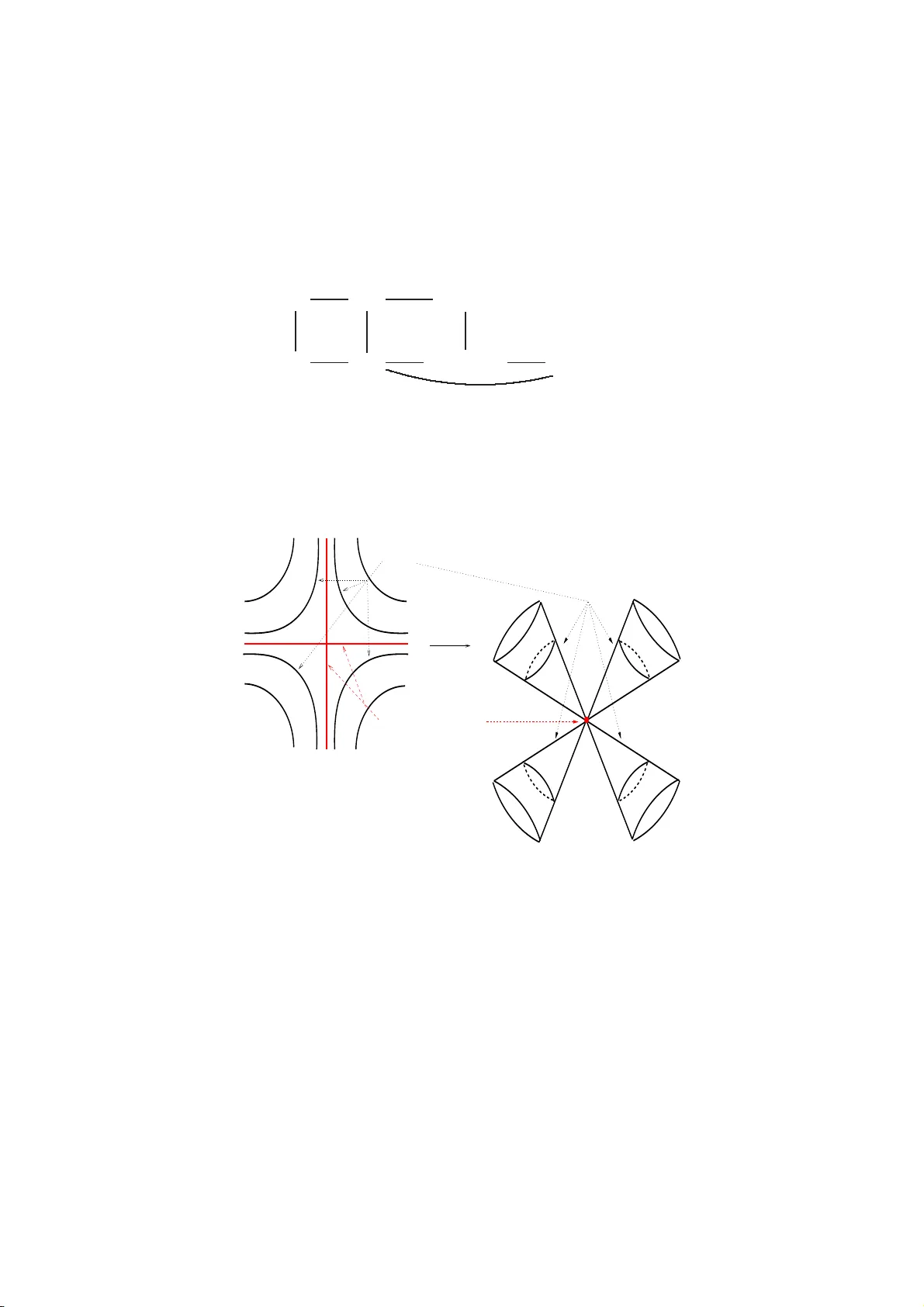
POSITIVE-ENTR OPY INTEGRABLE SYSTEMS AND THE TOD A LA TTICE, I I LEO T. BUTLER Abstract. This note constructs completely integrable con ve x H amiltonians on the cotangen t bundle of certain T k bundles ov er T l . A cen tral role i s pla ye d b y the Lax represen tat ion of a Bogo y a vlenskij-T oda lattice. The classifica- tion of these systems, up to i so-energetic topological conjugacy , is related to the class i fication of ab elian groups of Anosov toral automorphisms b y their topological entrop y function. 1. In tr oduction Say that a smo o th flow ϕ : M × R → M is inte gr able if there is an op en dense subset L ⊂ M suc h that L is fibr ed by b -dimensional tori and the smo oth bundle co ordinate charts ( I , φ ) : U → D a × T b conjugate ϕ to a smo oth transla tion- t yp e flo w t · ( I , φ ) = ( I , φ + tξ ( I )) o n the fibres of L . This lo cal form, classically known as actio n-angle co ordinates, suggests that integrable flows are dynamically unin teresting. The example of the geo desic flow o f a compact 3-dimensional S ol manifold which is completely integrable and ha s p ositive top olo gical entrop y , due to Bolsinov and T aimano v [6], is pro of that this is not the ca se. The present pap er g eneralises the examples of [6, 11]. First, it shows how to cons truct inte- grable conv ex hamiltonian systems on cotangent bundles of certain solmanifolds in higher dimensions tha t are analogues to the S ol geometric 3-ma nifo lds when the mono dro my group is not R -split; s econd, it shows that La x repres e ntations of Bogoy avlenskij-T oda lattices are essen tial to cons truct these in tegra ble systems, and moreov er, the double- br ack e t La x representations are essential to understand the dynamics on the singular set; third, the Lax map of a Bogoya v lenskij-T oda lattice and the ‘momentum ma p’ o f a na tural F -structure on the solmanifold f orm a dual pair; and, finally , the topo logical classification of these integrable s ystems can b e re s olved b y c lassifying ab elia n groups o f Anos ov toral automorphisms by the topo logical en tropy function. This appe ars to b e a novel a nd interesting phenomenon: the cons truction of these int egrable systems uses the ma chinery of Lax repres ent ations a nd R-matrices, while their dynamical classification uses machinery developed to understand hyperb olic dynamical systems. Let us no w sk etch the constr uctions and results of the pres ent pap er. 1.1. The S ol -manifol ds. Let A b e a torsion- free, ab elian gro up of diffeomor - phisms of T b . The g roup A acts on T b × A R , where A R = A ⊗ Z R , via the diagonal action ∀ α ∈ A, y ∈ T b , x ∈ A R : α ⋆ ( y , x ) := ( α ( y ) , x + α ⊗ 1 ) . (1.1) This actio n is fre e and pr op er. The compact, smo o th quotient is denoted by Σ or Σ A . The fibring of Σ b y the tori T b equips Σ with a natural F - structure. Henceforth it is a s sumed that A < GL( b ; Z ) is an ab elian gro up of semi-simple elements, hence co nt ained in a Cartan s ubgroup of GL( b ; C ), a nd therefor e an Date : October 29, 2018. 1 2 LEO T. BUTLER exp onential subgr oup o f GL( b ; C ). When A is an ex po nent ial subgr oup o f GL( b ; C ), the universal cov e r ˜ Σ of Σ admits the structure of a solv able Lie gro up as follows: When A is an expo nential subg roup o f GL( b ; C ), A R is naturally identified with a n ab elian subgroup of GL ( b ; R ). F rom this, there is a natural Lie group structure o n R b ⋆ A R =: S a nd Z b ⋆ A =: S Z is a la ttice subgro up o f S , c.f. 2.2. In the general case, A contains a finite-index expo nent ial subg roup A 2 [26, Theorem 4.28 ]. The finite cov er ing Σ 2 of Σ induced by A 2 has a universal c over with a s olv able Lie group structure; in this case, the fundamental g roup of Σ need no t embed a s a subgroup in this universal cov er, a ltho ugh it do es act as a free and proper group of deck transformations [26, pp.s 70 -71]. An elementary argument sho ws that if Γ is a finite g r oup o f deck transfor mations and ϕ is an integrable flow on M that is Γ-inv ariant , then the induced flow on M / Γ is integrable, a lso. So, to simplify the discussion in this intro duction, without losing genera lit y , it will b e assumed that A is an expo nent ial subgroup of GL( b ; C ). 1.2. In teg rable geo des ic flo ws. Let y i be co ordinates on C n which diago nalise A . Define complex-v alued differential 1- forms on Σ b y ν i = exp( − h ℓ i , x i ) d y i , and η i = d x i (1.2) where ℓ i ∈ Hom( A R ; R ) is the linear form which maps x ∈ A R to the loga r ithm of the mo dulus of its i -th eigenv alue and x i = h ℓ i , x i . A riemannian metric o n Σ can be defined by g = X i,j Q ij ν i · ν j + X i,j R ij η i · η j + X i,j S ij η i · ν j , (1.3) where Q, R and S ar e constant, complex symmetric matric e s c hosen so that g is a real, symmetric, po sitive-definite (0 , 2)-tenso r. The metr ic g is the general form o f a left-inv ariant metric o n S = R b ⋆ A R . When the off-diago nal term S v anishes , the subgroups R b and A R are orthogona l, totally g eo desic a nd flat. B y left-in v arianc e of g , each left tra ns late of these t wo subgroups share these pr op erties. Question A. Which metrics g have a c ompletely inte gr able ge o desic flow? Some answers are known. The examples of B o lsinov and T aimanov shows that when A is a cyclic group, then the geodesic flow is completely in teg rable for g with S = 0 and Q, R a rbitrary [6, 7]. The present author show ed that when A has rank b − 1 (so A is R -split), Q ij = δ ij ǫ 2 i , R is of a sp ecial form a nd S = 0, then the geo desic flow is completely integrable. T o explain the sp ecia l form o f R , write the Hamiltonian of g in canonical co ordinates : 2 H g = X ij Q ij ∗ exp( h ℓ i + ℓ j , x i ) + X ij R ij p x i p x j , (1.4) where Q ij ∗ = Q ij p y i p y j (no sum). Because y i is a cyclic v ariable, p y i is a first int egral. H g reduces to a family of Bogoya vlensk ij-T o da -like Hamiltonia ns in the canonical v ariables ( x, p x ). If one diago nalises Q , then the complete in teg rability of the Bogoya vlenskij-T oda Hamiltonian dictates the for m o f R . The intro duction of [11] has an explicit example. 1 The work of Adler & V an Moere b eke and Kozlov & T reschev suggests that when S = 0 the only completely in teg r able Hamilto nia ns H g arise from Bogoy avlenskij-T o da la ttices or their deformations [3, 23, 22]. The preceding argument glos s es over a subtlety: the cyclic v aria bles p y i are defined only on the universal cov er . In the ab ov e cases, o ne can construct smo o th int egrals that descend to the quotient; this is true in g eneral, but the difficult y lies in ch o osing R . This is related to Lax representations. 1 This is also referred to as th e T o da lattice or the Kostan t-T o da lattice, but K ostant in [21] attributes to Bogo ya vlenskij [4] the recognition of t he r ole play ed b y r oot systems of semisimple Lie algebras. ENTR OPY AND TODA LA TTICES 3 1.3. Lax Represen tations and mom e n tum maps. On the cov e r ing ˆ Σ = T b × A R , there is the o bvious free a ction of T b . T his induces an F -structur e on Σ, whic h one may think of as a lo cally-defined fre e action of T b . The momentum map ˆ f of the T b -action induces a map f b y e q uiv ariance, as illustra ted in the rig ht-hand s ide of (1.5): L ∗ R T ∗ ˆ Σ ˆ Π ˆ L o o ˆ f / / Lie( T b ) ∗ (mo d A ) (mo d ∼ ) ' ' O O O O O O O O O O O L ∗ R T ∗ Σ L o o f 3 3 / / Lie( T b ) ∗ / A coll . / / Lie( T b ) ∗ / ∼ . (1.5) Lie( T b ) ∗ / A is neither a s mo oth manifold nor a Hausdorff space but it do es co nt ain an ope n and dense subspace that is a smo o th manifold. One ca n c ollapse the singular set of Lie( T b ) ∗ / A to a sing le point to define a Hausdorff top ologica l space Lie( T b ) ∗ / ∼ , which is a smooth manifold outside o f a single po in t, as illus tr ated in figure 1. Since the collapse is A -inv ariant, the map f is defined naturally . The map f is a first integral o f H g and one ca n loos e ly think of f as the mo mentum map of the lo cally-defined T b action on T ∗ Σ. P S f r a g r e p la c e m e n t s regular orbits singular orbits mo d ∼ reduced space: Lie( T b ) ∗ / ∼ unreduced space: Lie( T b ) ∗ Figure 1. The quotient ma p fro m Lie( T b ) ∗ → Lie( T b ) ∗ / ∼ . The r egular p oints a re p oints with a non-zero co mpo nent in each eigenspace of A ; the singular set is the co mplemen t. On the left of (1.5) is a map L , c alled a Lax matrix, that is implicit in the ident ification of H g with a Bogoy avlenskij-T oda Hamiltonian. The construction of a Poisson Lax map that Poisson commutes with f is the k ey difficulty in proving the complete in teg rability o f H g . Question B. What c onditions on A imply t he existenc e of a Poisson L ax map L such t hat the T b -momentum map f and L form a dual p air? Implicit in the tw o pa per s o f Bo ls inov and T aima nov is the fa ct that if A is cyclic, then this question is tr iv ially soluble. In [1 1, p. 529], the pr esent author shows that there is a Poisson ma p that Poisson co mm utes with the T b -momentum map f when A < GL( b ; Z ) is R -split and of finite index in its cen traliser (the relation to Lax 4 LEO T. BUTLER maps is hinted at in the rema r k on [1 1, p. 52 9 ]). T o genera lise that construction, it appe ars necessary to use the mac hiner y of Lax r epresentations. P S f r a g r e p la c e m e n t s T b × 0 T b × v geodesic v · y y Figure 2. A return map. 1.3.1. Positive top olo gic al entr opy. The geo desic flow o f g m ust hav e po sitive top olo gical en tropy , since π 1 (Σ) has ex- po nential w ord g rowth [14]. When S = 0, there is a direct pro of o f this: since A R is flat a nd to tally geo desic in ˜ Σ, a s are all its left-translates , eac h curve t 7→ tv + y for v ∈ A R , y ∈ R b is a geo desic. On Σ, for v ∈ A , the geo des ic is per io dic and one sees that the ge o desic flow induces the re- turn map on T b defined by y 7→ v · y – which is a partially hyperb olic, a nd genera lly Anos ov, automor phism o f T b (see figure 2). The app eara nce of such ‘subsy stems’ heavily constra ins the to po logical co njugacy class of a completely in tegrable geo desic flow of the form of g . 1.4. Results. Let us sketc h the main theorems o f this paper . 1.4.1. Complete inte gr ability. Definition 1. A torsion-fr e e ab elian su b gr oup A < GL( b ; Z ) is maxima l if its elements ar e semisimple and it is of fin ite index in its c ent r aliser. Theorem 1. If A < GL( b ; Z ) is a m ax imal su b gr oup, then ther e is a Poisson L ax map L such that (1.5) describ es a dual p air, se e (3.14). In p articular, ther e is a r eversible Finsler met ric on Σ A whose ge o desic flow is c ompletely inte gr able. If, in addition, an irr e ducible element in A has exactly r r e al eigenval ues and 2 c non-r e al eigenvalues, then the ge o desic flow of the riemannian metric g (1.3) is c ompletely inte gr able when its Hamiltonian is define d as in (3.16) with r o ot system g ( m ) in t he c ases describ e d by T able 1. In al l c ases, the singular s et is a r e al-analytic variety. Conse quently, the inte- gr able systems ar e s e mi-simple in the sense of [10] . r c g ( m ) r c g ( m ) ∗ 0 A (1) n , D (2) n +1 2 1 D (3) 4 0 ∗ A (1) n , D (2) n +1 2 ∗ B (1) n , C (1) n 1 ∗ A (2) 2 n 3 ∗ A (2) 2 n − 1 4 ∗ D (1) n T able 1 . Conditions on eigenv alues a nd ro ot systems which pro - duce a riemannian metric with in tegrable geo desic flow ( ∗ is an arbitrar y p ositive in teger). The first row in the upper left corner of the table summarises the result of [11]. In the cases not cov ere d in the table, it is uncertain if Σ A admits a riemannian metric with completely in tegrable ge o desic flo w – the construction here yields only completely integrable geo desic flows of r eversible Finslers. If not, one would have the first example of a compac t smo oth ma nifold that admits a completely integrable reversible Finsler , but not a riemannian, geodesic flow. ENTR OPY AND TODA LA TTICES 5 1.4.2. T op olo gic al Entr opy and Iso-ener getic T op olo gic al Conjugacy. The tangent spaces to the T b -fibres of Σ form a s ub- bundle V ⊂ T Σ. Let V ⊥ ⊂ T ∗ Σ be the annihilator of V . The subspace V ⊥ is inv arian t under the geo des ic flow of Theo r em 1 and that geodesic flow has p o sitive top olo gical en tr opy on V ⊥ . W e prove Theorem 2. L et Σ = Σ A b e as in The or em 1 and let ϕ b e the H amiltonian flow on T ∗ Σ induc e d by t he Hamiltonian H define d in (3.16 ). Then (1) V ⊥ is a we akly normal ly hyp erb olic invariant manifold. Its stable and un- stable manifold s c oincide and e qual the pr e-image of the e quivalenc e class of 0 in L ie ( T b ) ∗ / ∼ u nder t he T b -momentum map f ; (2) the top olo gic al ent r opy of ϕ | H − 1 ( 1 2 ) e quals that of ϕ | V ⊥ ∩ H − 1 ( 1 2 ) , when H is induc e d by the A (1) n Bo goyavlenskij -T o da lattic e; (3) in al l c ases, the top olo gic al entro py of ϕ | V ⊥ ∩ H − 1 ( 1 2 ) is c alculable (s e e T ab le 5). The constructio n of the Lax map in theorem 1 is unique up to the action of a per mut ation gr oup. If φ 1 , φ 2 are tw o such permutations and ϕ 1 , ϕ 2 are the result- ing geo desic flows, an interesting q uestion is whether these flows ar e top ologica lly distinct. A topolo gical inv ariant, na mely the marked homology sp ectr um, do es distinguish these flows in many cases even when top o logical entrop y cannot. T o explain, let h( v ) = h top ( v ) h : A → R (1.6) be the entropy function, where v ∈ A is v iewed as a T b -automorphism. Theorem 3. If ther e is a top olo gic al c onjugacy of ϕ 1 , ϕ 2 on their re sp e ctive un it spher e bund les, then ther e is an automorphism f : A → A such that h ◦ f = h . (1.7) If the numb er- the or etic closur e of A is a gr oup of Anosov automorphisms, then f is induc e d by a Galois automorphism. In man y cases, the group of Galois automorphisms is trivial, which implies that each o f the constructed Hamiltonian flows must be top ologica lly non-conjugate. In general, one should not exp ect the n umber-theore tic closure of A to be a gro up of Anosov automor phisms, though. Question C. Which automorphisms of A fix the entr opy function h ? This leads to a further question, whose formulation is somewhat technical and is deferred to section 7, question F. Finally , theorem 7.3 provides information on the n umber of distinct top ologica l conjugacy classes of integrable Hamiltonian flows provided by theorem 1. Question C is a rig idit y question: to what ex ten t do es the entropy of an action determine tha t actio n. An approach to this question is to ask which embeddings of Z a ∼ = A in to GL( b ; Z ) hav e equal ent ropies. Kato k , Katok and Sc hmidt g ive examples of iso -entropic actions of Z 2 on T 3 by maximal subgroups of GL(3; Z ) that are conjugate in GL(3; Q ) but no t conjugate in GL(3; Z ) [20]. How ever, the susp ension ma nifolds o f these actions are not homotopy equiv ale nt. Indeed, if A ′ < GL( b ; Z ) is not conjugate to A in GL( b ; Z ), then π 1 (Σ A ′ ) is not isomor phic to π 1 (Σ A ). Th us, question C is so mewhat finer than the iso-entropic rigidity problem examined in [20]. 6 LEO T. BUTLER 1.5. Tw o additio nal questio ns. Let Σ b e a torus bundle ov er a to r us of the t yp e describ ed in section 1.1. Σ is a spherical and the fundamen tal group of Σ is a poly - Z group 2 , so Theorem 15B.1 of [29] implies that π 1 (Σ) determines Σ up to homeomorphism. The standar d smo o th s tr ucture on Σ is de fined b y the ab ove construction. In genera l, the top olo gical manifo ld Σ may admit several inequiv alent smo oth structures. Question D. Which smo oth structure s on the top olo gic al manifold Σ admit a rie- mannian or Finsler metric whose ge o desic flow is c ompletely int e gr able? This questio n is already quite in teresting when A = 1 and Σ is a tor us since [12] s hows that the integrals cannot all b e real-analytic if the smo oth structur e is non-standar d. It is unknown if there are analog ous o bs tructions when A 6 = 1. And, finally , Question E. What c onditions on A < GL( b ; Z ) imply that Σ A admits a riemann- ian or Finsler metric whose ge o desic flow is c ompletely inte gr able? Theorem 4.1 shows tha t there ar e natural exa mples of g roups A tha t are no t maximal, yet Σ A admits a completely integrable Finsler. These examples are con- structed using symmetries pr ovided by num be r-theoretic considerations . The diffi- cult y in the general case, where there ar e no obvious symmetries , is the constr uctio n of the Lax map L app ears to break down. 2. N ot a tion and Preliminar y Definitions 2.1. In teg rabil it y. The present pap er’s definition of complete integrabilit y follows that of [5, 11]. Let Σ b e a rea l-analytic ma nifold. The set of smo o th functions on the cotangen t bundle of Σ, C ∞ ( T ∗ Σ), ha s t wo canonical algebra ic structures: it is an a b e lia n algebra when equipp ed with the natural op erations of p oint-wise addition and mul- tiplication; a nd, coupled with the canonical Poisson br acket , { , } , ( C ∞ ( T ∗ Σ) , { , } ) is a Lie algebra of der iv ations of the algebr a C ∞ ( T ∗ Σ). A hamiltonian H ∈ C ∞ ( T ∗ Σ) induces a vector field Y H := { , H } . F or A ⊂ C ∞ ( T ∗ Σ) a nd P ∈ T ∗ Σ, let d A P = spa n { d f P : f ∈ A} and let Z ( A ) = { f ∈ A : {A , f } ≡ 0 } . Let k = sup P dim d A P , l = sup P dim d Z ( A ) P . L et us say P ∈ T ∗ Σ is A - r e gular if there exist f 1 , . . . , f k ∈ A suc h that P is a regular v alue for the map F = ( f 1 , . . . , f k ) and f 1 , . . . , f l ∈ Z ( A ); if P is not A -regular then it is A - critic al . Let L ( A ) b e the set of A -regular points. H is assumed to be pro p er . Definition 2 ( c.f. [5]) . H ∈ C ∞ ( T ∗ Σ) is integrable if ther e is a Lie sub algebr a A ⊂ C ∞ ( T ∗ Σ) su ch that: (1) H ∈ Z ( A ) ; (2) k + l = dim T ∗ Σ and L ( A ) is an op en and dense su bset of T ∗ Σ . If k = l = dim Σ , we wil l say that H is completely integrable . Bolsinov and Jov ano vic [5] in tro duced this definition of c omplete in teg rability . The standar d definition of complete integrabilit y (resp. non-co mm utative integra- bilit y) are sp ecia l cases of Definition 2 with A = span { f 1 , . . . , f k } and l = k (resp. l ≤ k ) and the r egular- p o in t set of F = ( f 1 , . . . , f k ) is dense. Definition 2 is b oth more intrinsic, and mor e suited to the examples of the present pap er. Note that the present definition o f integrabilit y is equiv alen t to that of Dazord & Delza nt [13]. 2 That is, there i s a sequence of s ubgroups 0 = D m ⊳ D m − 1 ⊳ · · · ⊳ D 0 = D such that D i / D i +1 ∼ = Z for all i . ENTR OPY AND TODA LA TTICES 7 2.2. Construction of the solm anifolds and num b er theory. There is a w ell- known corresp ondence betw een ab elian subgr oups of GL( b ; Z ) a nd groups of units in alg ebraic nu mber fields of degree d dividing b [20]. The present pa pe r exploits this cor resp ondence extensively . The following section establishes notatio n that is used througho ut. In terms of the terminolo gy in the in tro duction, we use the following transla tion table: ab elian A < GL( b ; Z ) → a g roup of units in the field generated by the eigenv alues of all a ∈ A ; Z b → a dir ect sum of copies o f a subgro up of the int egers of a n um b er field. 2.2.1. Pr eliminaries. Let Q ⊂ F ι ⊂ E be a n inclusion of a lgebraic n umber fields. F or a field extension E / F let the set of embeddings of E into C which fix F b e denoted by G E /F ; we adopt the conven tion / Q is omitted. Define vector spaces W E = X σ ∈ G E C σ , (2.1) and V E = { x ∈ W E : x ¯ σ = ¯ x σ ∀ σ ∈ G E } , (2.2) where ¯ denotes complex co njugation and ¯ σ is the embedding σ fol lowe d by complex conjugation. W e a lso define V o,E = { x ∈ V E : X σ ∈ G E x σ = 0 , & x σ = x ¯ σ ∀ σ ∈ G E } . (2.3) G E is a basis of V E which induces the dua l basis G ∗ E of V ∗ E . An element in the dual basis shall b e denoted by ˆ σ for σ ∈ G E . The basis a nd dual basis establish a linear isomo r phism betw e e n V E and V ∗ E which shall be denoted by the circumflex op erator , V E → V ∗ E : x 7→ ˆ x , whose inv er se is V ∗ E → V E : x 7→ ˇ x . One obtains a basis of V ∗ o,E as follows: note tha t ˆ t = 1 | G E | P σ ∈ G E ˆ σ a nd ˆ σ − ˆ ¯ σ v anish on V o,E for all σ ∈ G E . If one defines G r E to b e the set of r eal em b e ddings of E and G c E to b e one-half of the non-real embeddings suc h that G c E is dis jo in t from its complex conjugate, then one observes that V ⊥ o,E = R · ˆ t ⊕ X σ ∈ G c E R · ( ˆ σ − ˆ ¯ σ ) , V ∗ o,E = X σ ∈ B F R · ˆ σ | V o,E (2.4) where B E = G r E ∪ G c E . The inclusion F ι ⊂ E induces V E ι ∗ / / / / V F where ι ∗ ( σ ) = σ | F , and V ∗ E o o ι ? _ V ∗ F where ι ( ˆ τ ) = X σ ∈ G E ,σ | F = τ ˆ σ . (2.5) Finally , define a map V ∗ E α / / / / V ∗ o,F by α = ∗ ˆ ι ∗ , ˆ σ 7→ ˆ τ | V o,F where τ = σ | F , (2.6) 8 LEO T. BUTLER ∗ is the adjoint of the inclus ion map V o,F ⊂ V F and ˆ ι ∗ = ˆ ι ∗ ˇ . This allows one to define a pairing betw een V ∗ E and V o,F , denoted as follows h ˆ σ , x i := h α ( ˆ σ ) , x i ∀ σ ∈ G E , x ∈ V o,F , = h ˆ τ , x i where τ = σ | F . (2.7) Since x = P τ ∈ G F x τ · τ , it is a pparent that h ˆ σ , x i = x ( σ | F ) ∀ σ ∈ G E , x ∈ V o,F , (2.8) so the notation is natural. 2.3. An em b edding of O E in V E . Let O E be the ring of integers of E , a nd let U E be the g roup of m ultiplicative units of O E . Define a map η : O E → V E by η ( α ) := X σ ∈ G E σ ( α ) · σ, (2.9) for each α ∈ O E . Lemma 2.1. The map η is an emb e dding whose image—c al l it N E —is a discr ete, c o c omp act sub gr oup of V E . Pr o of. This is standard. Let T E = V E / N E be the r e sulting tor us. T E is equipp ed with a cano nical affine structure from V E and the group U E acts b y automorphisms of T E defined b y u · y = X σ ∈ G E σ ( u ) · y σ · σ + N E , (2.10) where y = P σ ∈ G E y σ · σ + N E is an element in T E and u ∈ U E . The actio n in (2.1 0) is w ell-defined since N E is mapp ed to itself b y U E . A fortiori , equation (2.10) also defines an a ction of U F ⊂ U E as an ab elian g r oup of automor phisms of T E . 2.4. An emb edding of U + F in V o,F . Define a ma p ℓ : U F → V F by ℓ ( u ) = X σ ∈ G F ln | σ ( u ) | · σ. (2.11) Since ¯ σ is σ follo wed by complex co njuga tion, it is clear that L L L F =: im ℓ ⊂ V o,F . Dirichlet’s theor em on the g roup of units of an algebra ic num b er field characterise s the image of ℓ a s a discrete, co compact subgroup of V o,F , while ker ℓ =: R F is the set o f units all o f whose conjugates lie on the unit circ le. Stated otherwis e, there is an unnatural splitting of U F via a comm utative diag ram R F / / = U F / / / / = U F / R F ℓ ∼ = / / ∼ = L L L F , ∼ = R F / / R F ⊕ U + F / / / / U + F ∼ = / / Z r + c − 1 , where r (resp. 2 c ) is the num b er o f re al (resp. non-r eal) embeddings of F . When F has a r eal embedding, which one ma y tak e to b e the iden tity embedding F ⊂ C , then R F = {± 1 } and U + F may be taken to b e the multiplicativ e gr oup o f p ositive units in U F — hence the notation. T o summarise Lemma 2 .2. The image of the map ℓ : U + F → V o,F — c al l it L L L F — is a discr ete, c o c omp act sub gr oup of V o,F isomorphi c to U + F . ENTR OPY AND TODA LA TTICES 9 2.5. An action of U + F on T E × V o,F . F or y ∈ T E , x ∈ V o,F and u ∈ U + F define u · ( y , x ) := ( u · y , x + ℓ ( u )) . (2.12) This actio n is clearly fr e e and prop er. Let Σ denote the compact manifold obtained by quotienting T E × V o,F by this action of U + F . Lemma 2.3. Ther e is a c ommutative diagr am of n atu r al maps V E × V o,F / / / / _ = T E × V o,F / / / / _ = ( T E × V o,F ) / U + F _ = ˜ Σ ˜ π / / / / ˆ Σ ˆ π / / / / Σ . (2.13) Ther efor e, π 1 (Σ) is n atur al ly isomorphic to the semi-dir e ct pr o duct ∆ = U + F ⋆ O E , while ther e is a natur al fibring of Σ by tori over a torus T E / / Σ p / / / / T o,F , (2.14) wher e T o,F = V o,F / L L L F . Pr o of. Naturality of the co nstruction implies the lemma. 2.6. The cotangen t bundle T ∗ Σ . The vector space structures on V E and V o,F give a tautological trivia lis ation of their cotangent bundles. Lemma 2 .3 therefo r e implies that there is a comm utative diag ram V ∗ E × V E × V ∗ o,F × V o,F / / / / _ = V ∗ E × T E × V ∗ o,F × V o,F / / / / _ = (V ∗ E × T E × V ∗ o,F × V o,F ) / U + F _ = T ∗ ˜ Σ ˜ Π / / / / T ∗ ˆ Σ ˜ Π / / / / T ∗ Σ , (2.15) where ˆ Π is the cov ering ma p induced by ˆ π , etc. Let us intro duce co ordinates on T ∗ ˆ Σ b y P ∈ T ∗ ˆ Σ ⇐ ⇒ P = ( Y , y + N E , X , x ) ∈ V ∗ E × T E × V ∗ o,F × V o,F . The action of U + F on T ∗ ˆ Σ is the natural lift of the action o n Σ u · P = ( u · Y , u · y + N E , X , x + ℓ ( u )) (2.16) where u · y is defined in equation (2.10) and u · Y = P σ ∈ G E Y σ · σ ( u ) − 1 · ˆ σ is the induced contragredient actio n. 2.7. F unctions on T ∗ Σ . The function P 7→ X is U + F -inv a riant, so one may view X as a submersion T ∗ Σ ։ V ∗ o,F . Fix a positive in teg er b σ for each σ ∈ G E and define the function γ σ ( P ) := exp( b σ · h ˆ σ , x i ) × | Y σ | b σ (2.17) where the pairing h ˆ σ , x i is defined in equation (2.7). Lemma 2.4. The function γ σ is U F -invariant and it is r e al-analytic if b σ is even. Pr o of. F rom equation (2.16), w e know that for each u ∈ U F γ σ ( u · P ) = γ σ ( P ) × ex p( b σ ln | σ ( u ) | ) × | σ ( u ) | − b σ = γ σ ( P ) . (2.18) It is clear that exp( b σ · h ˆ σ , x i ) is rea l-analytic, and | Y σ | b σ is rea l-analytic if b σ is a po sitive even in tege r . 10 LEO T. BUTLER Remark 2.1. Fix even in tegers b σ as in lemma 2.4. One may define a momentum- like map λ : T ∗ Σ → V ∗ o,F ⊕ V ∗ E by λ ( P ) = X ⊕ X σ ∈ G E γ σ ( P ) · ˆ σ , ∀ P ∈ T ∗ Σ . (2.19) When the universal cover ˜ Σ o f Σ admits the structure of a solv able Lie group with ∆ a s a lattice subg roup, V ∗ o,F ⊕ V ∗ E – as the dual of a Lie algebra – admits a canonical Poisson structure. In this case, the map λ is left-inv ariant and P oisson and therefore mimics the prop erties of the classical momen tum map. 3. Lax Represe nt a tions 3.1. Real split affine Lie algebras. Let us briefly reca ll the construction under ly- ing the Lax repr esentation of p erio dic Bogoya vlensk ij-T o da lattices. This discussion follows that in [27, 1, 2]. Let g b e a simple re a l Lie alg ebra with the r eal split Cartan sub-algebra h ; g is also known as the r e al normal form of the simple co mplex Lie algebra g ⊗ C . The Cartan-Killing form of g is denoted b y hh , ii when viewed as a bilinear form on g , and it is denoted by κ when viewed a s a linear isomorphism of g with g ∗ . Recall that hh , ii is non-deg enerate on h . As h is a real split Cartan sub-algebra , g decomp os es as g = h + X r ∈ Ψ ∗ g r (3.1) where Ψ ∗ ⊂ h ∗ is the set of ro ots and g r is the ro ot space asso c iated with r , g r = { x ∈ g : a d h x = h r , h i x ∀ h ∈ h } . There is a s et of simple ro ots Ψ 0 ⊂ Ψ ∗ such tha t e very ro ot is an integer line a r combination of the ro ots in Ψ 0 with ent irely non-negative or no n-p o sitive co efficients. The height of a ro ot is the sum of these co efficients; there is a unique ro ot, η , of minimal height. Let Ψ b e Ψ 0 ∪ { η } . Define L to be the set of Lauren t p oly nomials in the v ariable λ with co efficients in g ; L inherits an obvious Lie algebra structure. Let d = λ ∂ ∂ λ be a deriv ation; define [d , x · λ n ] = nx · λ n for all in teg ers n and x ∈ g . Then ˆ g = L + R · d is a rea l split Lie algebra with Ca rtan sub-alge br a ˆ h = h + R · d. The Ca rtan sub- a lgebra induces a w eight-space dec o mpo sition of L as L = h + X r ∈ Ψ Ψ Ψ ∗ L r (3.2) where Ψ Ψ Ψ ∗ = n r ∈ ˆ h ∗ : r | h ∈ Ψ ∗ ∪ { 0 } , h r , d i ∈ Z , r 6 = 0 o . The weigh t set Ψ Ψ Ψ ∗ has a basis of simple weigh ts Ψ Ψ Ψ = Ψ ∪ { η η η } , where η η η | h = η and h η η η , d i = 1. Each r ∈ Ψ Ψ Ψ ∗ is an in teger linear combination of roo ts in Ψ Ψ Ψ. By defining the heigh t of r as the sum of these coefficie n ts one obtains the principal grading L = X n ∈ Z L n , (3.3) where L 0 = h , L n = P ht ( r )= n L r otherwise, and [ L n , L m ] ⊆ L m + n for a ll m, n . It is observed that L ± 1 = g η λ ± 1 + X r ∈ Ψ g ± r = X r ∈ Ψ Ψ Ψ R · e ± r (3.4) the same sign appear ing throughout, and e r is a v ector normalised so that κ · [e r , e − r ] ∈ Ψ 0 . The sub-a lgebras L + = P n ≥ 0 L n , L − = P n< 0 L n per mit the definition of a second Lie algebra structure on L , defined by [ x, y ] R := [ x + , y + ] − [ x − , y − ] (3.5) for x = x + + x + , y = y − + y + ∈ L − ⊕ L + . T he Ca rtan-Killing for m κ a llows one to iden tify L ∗ n = L − n for all n , in such a w ay tha t κ (e r ) = e − r or h h e r , e − s ii = δ r , s . ENTR OPY AND TODA LA TTICES 11 Indeed, no te that e r = e r · λ n where r = r | h and n = h r , d i for all r o ots r ∈ Ψ Ψ Ψ, so it suffices to find a s uita ble bas is of g in order to define the v ectors e r . One also knows that Lemma 3.1. F or e ach µ ∈ L ∗ − 1 , the affine subsp ac e µ + L ∗ 0 + L ∗ 1 is a Poisson subsp ac e of L ∗ R . The Casimirs of L ∗ ar e in involution on L ∗ R . Pr o of. See refere nc e s [2 7, 1]. 3.2. A second spl itting. L et 0 L = h + P r ∈ Ψ Ψ Ψ ∗ R · e r , a sub-algebra of the lo op algebra L on which the Cartan-K illing form is non- degenerate. One can disting uish t wo s ub-algebra s 0 L ± such that 0 L = 0 L − ⊕ 0 L + as a v ector space: 0 L − = P r ∈ Ψ Ψ Ψ + R · (e r − e − r ) , 0 L + = h + P r ∈ Ψ Ψ Ψ + R · e r , so 0 L ∗ − ≡ 0 L ⊥ + = P r ∈ Ψ Ψ Ψ + R · e r , 0 L ∗ + ≡ 0 L ⊥ − = h + P r ∈ Ψ Ψ Ψ + R · (e r + e − r ) , (3.6) where Ψ Ψ Ψ + ⊂ Ψ Ψ Ψ ∗ is the s et of p os itive ro ots. One can define a grading on b oth 0 L ± by defining the height of a ro ot r ∈ Ψ Ψ Ψ + to be h t( r ) = ht( r ) + (1 + k ) h r , d i where k is the height of the maximal ro ot of g . With this gra ding , a basis of 0 L +1 (resp. 0 L − 1 ) is { e r : r ∈ Ψ Ψ Ψ } (resp. { e r − e − r : r ∈ Ψ Ψ Ψ } ) while a ba sis of 0 L ∗ +1 (resp. 0 L ∗ − 1 ) is { e r + e − r : r ∈ Ψ Ψ Ψ } (r esp. { e − r : r ∈ Ψ Ψ Ψ } ). One therefore knows that 0 L admits an R -brack et analogous to that defined in (3.5) and that Lemma 3.1 also holds for 0 L R . Remark 3.1 . If α is an automor phism o f the graded Lie algebr a L that fix e s h , then the fix e d p oint set of α is a s ub-algebra that inherits a gra ding, splitting and a ro ot space decomp osition from L . The constructions of b oth subsec tio ns 3.1 and 3.2 are applicable in this case, to o. The automorphism α satisfies α ( x · λ n ) = α ( x ) · ( ǫλ ) n for all x ∈ g and n , wher e ǫ is a primitiv e order( α ) ro ot of unit y . This cons tr uction yields the so-calle d twisted lo o p a lgebras. T he t wisted loop algebra is traditionally denoted by g ( m ) where m is the order of the automorphism α ; when m = 1, one has the usual loop algebr a L . 3.3. Examples. Le t g = A 2 = sl (3; R ). F or h one can take the sub-a lgebra o f trace zero diago nal matrice s and for the basis of po sitive ro ots of g one ca n tak e the ro ots r 1 and r 2 with the minimal ro ot η : r 1 = 1 0 0 0 − 1 0 0 0 0 , r 2 = 0 0 0 0 1 0 0 0 − 1 , η = − r 3 = − 1 0 0 0 0 0 0 0 1 , (3.7) which sa tisfy the linear rela tion r 1 + r 2 + η = 0. A ro ot r ∈ Ψ Ψ Ψ ma y b e wr itten formally as r = ± r i + n where n = h r , d i . The height of r is then computed to b e 3 n ± 1 for i = 1 , 2 and 3 n ± 2 for i = 3 . F r om this, one can see tha t the graded pieces of L , as in (3.3), are L 0 = h and L +1 = λa 1 α 1 0 0 λa 2 α 2 λα 3 0 λa 3 , L +2 = λ 2 a 1 0 α 3 λα 1 λ 2 a 2 0 0 λα 2 λ 2 a 3 , L − 1 = λ − 1 a 1 0 λ − 1 α 3 α 1 λ − 1 a 2 0 0 α 2 λ − 1 a 3 , L − 2 = λ − 2 a 1 λ − 1 α 1 0 0 λ − 2 a 2 λ − 1 α 2 α 3 0 λ − 2 a 3 , (3.8) where a i , α i are real n umber s and P a i = 0. 12 LEO T. BUTLER The splitting in (3.6) o f 0 L implies that the r o ot spa ces of height ± 1 and their duals are 0 L − 1 = 0 α 1 − α 3 λ − 1 − α 1 0 α 2 α 3 λ − α 2 0 , 0 L ∗ − 1 = 0 α 1 0 0 0 α 2 α 3 λ 0 0 , 0 L +1 = 0 α 1 0 0 0 α 2 α 3 λ 0 0 , 0 L ∗ +1 = 0 α 1 α 3 λ − 1 α 1 0 α 2 α 3 λ α 2 0 , (3.9) where the α i are real. 3.4. Bijections. Assume that F / Q is an algebr aic field of degre e m with r r eal embeddings and 2 c non- real embeddings such that r + c = n , and that g is a real split affine Lie a lgebra of rank n − 1. Since B F , the set of re al embeddings of F plus one-half the set of complex embeddings of F , has n elements and the simple ro ots of L , Ψ Ψ Ψ, ha ve n elements, the sets are isomorphic. Definition 3 . L et B b e the set of bije ctions B F → Ψ Ψ Ψ . Each ρ ∈ B ca n b e extended to a map G F → Ψ Ψ Ψ b y ρ ( ¯ σ ) := ρ ( σ ) for all σ ∈ B F . This extension shall be under s to o d throughout. Additionally , each ρ ∈ B natura lly induces a linear isomorphis m φ = φ ρ : V ∗ o,F → h ∗ . T o define φ let us recall t wo things. First, note that the pro jection ˆ h ∗ ։ h ∗ that is dual to the inclusion h ֒ → ˆ h induces the bijection Ψ Ψ Ψ ∼ = Ψ : r 7→ r = r | h . Second, there are unique positive in tege rs ω r such that X r ∈ Ψ ω r r = 0 , gcd( ω r : r ∈ Ψ) = 1 . (3.10) F or e a ch τ ∈ B F , define n τ to be 1 if τ is a real embedding; and 2 if not. Then, define φ ( ˆ τ | V o,F ) = n − 1 τ ω r r w he r e r = ρ ( τ ) . (3.11) Since ˆ τ equals ˆ ¯ τ when re s tricted to V o,F , the sole linear dependence r elation amongst the set n ˆ τ | V o,F : τ ∈ B F o is the relation X τ ∈ B F n τ ˆ τ | V o,F = X τ ∈ G F ˆ τ | V o,F = 0 . Thu s, equation (3.10) implies that φ extends to a linear isomorphism. 3.5. Lax represen tatio ns . Fix ρ ∈ B and let φ = φ ρ be the induced linear isomorphism. Let Φ : V ∗ o,F → h ∗ be a line a r map a nd let g ± : V ∗ E × G E → L ∗ ± be smo oth maps. Define a map L = L ρ, Φ : T ∗ ˜ Σ → L ∗ by κ − 1 · L ( P ) = X σ ∈ G E g − ,σ ( Y ) · e r + Φ( X ) + X σ ∈ G E g + ,σ ( Y ) · exp ( b σ · h ˆ σ , x i ) · e − r (3.12) where it is unders to o d that r = ρ ( σ | F ) in the sums and L ∗ is identifi ed with L v ia the Cartan-Killing form κ . There a re several choices of Lax representation that are useful. The first is (in all cases, r = ρ ( σ | F ) is understoo d) κ − 1 · L ( P ) = X σ ∈ G E | Y σ | b σ · e r + Φ( X ) + 1 2 × X σ ∈ G E exp( b σ · h ˆ σ , x i ) · e − r , (3.13) while the second is κ − 1 · L ( P ) = X σ ∈ G E e r + Φ( X ) + 1 2 × X σ ∈ G E | Y σ | b σ · exp( b σ · h ˆ σ , x i ) · e − r , (3.14) ENTR OPY AND TODA LA TTICES 13 and a third is κ − 1 · L ( P ) = Φ( X ) + 1 √ 2 × X σ ∈ G E | Y σ | 1 2 b σ · exp( 1 2 b σ · h ˆ σ , x i )(e r + e − r ) . (3.15) Note that the Lax representations in (3.13 – 3.1 4) are related to the splitting of the lo op algebra in se ction 3.1; the final Lax representation in (3.15) is related to the splitting in s e c tion 3.2. In all cases, the pullback of the Ca simir x 7→ 1 2 × κ ( x, x ) on L ∗ by any of the three La x matrices in (3.13 – 3.15) L is equal to H := 1 2 × hQ · X , X i + 1 2 X σ ∈ G E | Y σ | b σ · exp( b σ · h ˆ σ , x i ) , (3.16) where Q : V ∗ o,F → V o,F is defined by Q = Φ ∗ κ Φ. This Hamiltonian is fibre-wise quadratic — hence, induced by a rie ma nnian metric — iff b σ = 2 for all σ ; in all cases, it is fibre-wise conv ex. The next theorem implies that there ar e constraints on F if H is fibre-wis e q uadratic. As a second step, reca ll that sl 2 R has a basis h, e + , e − such th at [ h, e ± ] = ± e ± , and [e + , e − ] = 2 h . The Cartan-K illing form iden tifies the dua l ba s is as h, e − , e + . F or each σ ∈ G E , let sl 2 R σ be a copy of sl 2 R a nd let h σ , e ± ,σ be copies of h, e ± . Define L 1 : T ∗ ˜ Σ → g ∗ 1 , g 1 = X σ ∈ G E sl 2 R σ by L 1 ( P ) = X σ ∈ G E Y σ · h σ + exp( h ˆ σ , y i ) · e − ,σ . (3.17) Theorem 3.2. L 1 is a Poisson map. L = L ρ, Φ : T ∗ ˜ Σ → L ∗ R is a Poisson map iff ther e is a c ∈ 1 2 Z + such that: (1) for al l σ ∈ G E and r ∈ Ψ Ψ Ψ with ρ ( σ | F ) = r , one has n − 1 ( σ | F ) b σ ω r = c ; and (2) Φ = c − 1 × φ ρ . The map L 2 = L + L 1 : T ∗ ˜ Σ → L ∗ + g ∗ 1 is a Poisson emb e dding if either g + or g − is an emb e dding and E = F . Pr o of. The pro of shall assume that L is defined by equation (3.13); the remaining cases are not sig nificantly diff erent. T o prov e that L 1 is a Poisson map, one needs to prov e that { f ◦ L 1 , g ◦ L 1 } T ∗ ˜ Σ = { f , g } h ∗ 1 ◦ L 1 , (3.18) for all s mo oth functions f , g on h ∗ 1 . It suffices to verify equation (3.1 8) holds for linear functions f , g , for a sing le co py of s l 2 R , and a single pair of conjuga te v a riables Y a nd y . F or f = h and g = e + one sees that { h, e + } sl 2 R ∗ ◦ L 1 = − hh L 1 , [ h, e + ] ii = − e y , (3.19) while { h ◦ L 1 , e + ◦ L 1 } T ∗ ˜ Σ = { Y , e y } = − e y . (3.20) Since h and e + are functionally indep endent at almost a ll points o n almos t all co-adjoint or bits, this proves that L 1 is a Poisson map. T o prove the claim concerning L , one needs to prov e that { f ◦ L , g ◦ L } T ∗ ˜ Σ = { f , g } L ∗ R ◦ L , (3.21) for all f , g ∈ C ∞ ( L ∗ ). As ab ov e, it suffices to v erify equa tion (3.21) holds for all f , g ∈ L R . Given the brack et relations on L R , it suffices to prov e the equa tion for all f , g ∈ L − 1 + L 0 + L +1 . Let us break this in to cases: 14 LEO T. BUTLER (1) If f , g ∈ L 0 or f ∈ L − 1 and g ∈ L +1 or f ∈ L 0 and g ∈ L − 1 , then [ f , g ] R = 0 so { f , g } L ∗ R ◦ L = 0 . On the o ther hand, { f ◦ L , g ◦ L } T ∗ ˜ Σ = 0 since functions of X a lo ne, or a function of Y and a function of x , or a function of Y and a function of X alone P o isson comm ute. (2) If f , g ∈ L − 1 or f , g ∈ L +1 , then [ f , g ] R ∈ L ± 2 . Therefore, { f , g } L ∗ R ◦ L = − hh L , [ f , g ] R ii = 0 (3.22) since L lies in L − 1 + L 0 + L +1 . On the o ther ha nd, f ◦ L and g ◦ L are e ither functions of Y or x alone. In either case, they Poisson commute on T ∗ ˜ Σ. (3) If f ∈ L 0 and g ∈ L +1 , then it suffice s to assume that g = e r for some r ∈ Ψ Ψ Ψ. In this case, { f , g } L ∗ R ◦ L = − h L , [ f , e r ] R i = − h r , f i × hh L , e r ii (3.23) = − h r , f i × X σ ∈ G E s . t . ρ ( σ | F )= r exp( b σ h ˆ σ , x i ) . On the other hand, f ◦ L = h X , Φ ∗ f i , (3.24) g ◦ L = X σ ∈ G E s . t . ρ ( σ | F )= r exp( b σ h ˆ σ , x i ) , (3.25) so the Poisson brack et of these functions is { f ◦ L , g ◦ L } T ∗ ˜ Σ = − X σ ∈ G E s . t . ρ ( σ | F )= r exp( b σ h ˆ σ , x i ) × b σ h ˆ σ , Φ ∗ f i (3.26) Because ρ is a bijection o f B F with Ψ Ψ Ψ, there is a unique τ ∈ B F such that ρ ( τ ) = r . Ther e fore, due to the way that ρ is extended to G F , the σ ’s inv olved in the abov e summations all satisfy σ | F = τ or ¯ τ . Therefore , h ˆ σ , x i = h ˆ τ , x i for all σ ∈ G E such that ρ ( σ | F ) = r . This fact ab out the σ ’s also implies that h ˆ σ , Φ ∗ f i = Φ( ˆ τ | V o,F ) , f . Since ˆ τ will o nly app ea r when it acts on V o,F , the no tation | V o,F will b e sup- pressed. Therefore, if the r ight-hand sides o f equations (3 .23) and (3.26) are equated for all f ∈ L 0 , then one concludes that X σ ∈ G E s . t . ρ ( σ | F )= r exp( b σ h ˆ τ , x i ) × [ b σ Φ( ˆ τ ) − r ] = 0 . (3.27) The functions u 7→ e au , e bu are linearly indep endent if a 6 = b . If the b σ ’s in the ab ov e sum are not constant, then the sum in equa tio n (3.27) co ntains t wo linear ly indep endent functions. Therefore , the c o efficien ts o n these tw o functions must v anish. But this forces Φ( ˆ τ ) to equa l tw o different multiples of r . Absur d. Therefo r e, the b σ ’s in the sum must b e constant. This implies that b σ is determined b y r alone, or equiv alen tly , by τ alone. As cases (1—3) are the only indep endent cases to b e c onsidered, one co ncludes that if L is a Poisson map, then ther e ar e integers b τ , τ ∈ B F , such tha t the integers b σ , σ ∈ G E , satisfy b σ = b τ where σ | F = τ or ¯ τ . (3.28) Moreov er, equatio n (3.27) implies that if τ ∈ B F and ρ ( τ ) = r , then Φ( ˆ τ ) = b − 1 τ r . (3.29) ENTR OPY AND TODA LA TTICES 15 Summing ov er τ ∈ G F , and using the fact that ρ is a bijection of B F and Ψ Ψ Ψ, X τ ∈ G F Φ( ˆ τ ) = X τ ∈ B F Φ( n τ ˆ τ ) = X r ∈ Ψ n τ b − 1 τ r , (where ρ ( τ ) = r ) . (3.3 0) The left-hand side v anishes beca use P τ ∈ G F ˆ τ | V o,F = 0. Therefo r e X r ∈ Ψ n τ b − 1 τ r = 0 , (3.31) while the unique linear depe ndence rela tion in equation (3.10) implies tha t there m ust b e a consta nt c such that n − 1 τ b τ ω r = c for all r ∈ Ψ. The constant c is a po sitive in teger , or one-half such, since b τ and ω r are p ositive in tegers and n τ = 1 or 2. This implies part (1) of the Theorem. The equation that Φ m ust satisfy is, for all τ ∈ B F , Φ( ˆ τ ) = 1 cn τ × ω r r where r = ρ ( τ ) . (3.32) Compariso n with equation (3.1 1) shows that Φ = c − 1 × φ ρ , which is pa rt (2) of the Theorem. The claim that L 2 = L + L 1 is an em b e dding is ob vious. Remark 3 .2. Theorem (3.2) exploits the naturalit y of the c onstructions. In cases where the gr oup A is not of finite index in U F , one encounters the problem that there is no ob vious Lax map. T his is what mak es question D difficult. Remark 3.3 . Co ndition (1 ) implies that b σ depe nds o nly on σ | F . Condition (2) implies that 2 c is divisible by a ll ω r , hence b y their lcm, ω . Therefore, ther e is a unique choice of Φ and in teg ers b σ if one insists that c b e as small as p ossible a nd the b σ be even. In case F is totally real, condition (1) implies that c is div is ible by ω = lcm( ω r : r ∈ Ψ). When c is chosen to b e 2 ω – so that b σ = 2 ω /ω r is even –, c ondition (2) implies that Φ( ˆ σ | F ) = 1 2 w r r , where w r = ω r /ω , and ρ ( σ | F ) = r . This co ndition is stated in [11, Lemma 7], except for the fa c tor of 1 2 in Φ. 3 This discrepancy is due to the choice of a slightly different Poisson structure in [1 1, equation (9-10)]. With these choices, the Hamiltonian H in equation (3.1 6) is equal to that in [11, equation 15] when E = F is totally real. In particular ( c.f. equation 3.16), Q = φ ∗ ρ · κ · φ ρ . (3.33) In the ev ent that F ha s no real embeddings, this smallest choice is c = ω and b σ = 2 ω / ω r ; in other ev ents, the solution is somewhat more in volved to state, as it depends on the bijection ρ (see tables 2 – 4 in sectio n 4 .1 .3 for examples ). It is po ssible to state Prop ositi o n 3.1. L et r b e the numb er of r e al emb e ddings of F , and 2 c the numb er of non-r e al emb e ddings. If t he Hamiltonian H is fibr e-wise quadr atic, then table (1) is true. In p articular, if r > 4 and c > 0 , t hen none of the Hamiltonians H ar e fibr e-wise quadr atic. Pr o of. F rom equation (3.16), it is clear that H is fibre- wise quadr atic iff b σ = 2 for all σ . Since, for all ro ots r , ω r = n τ c/ 2 where τ = σ | F and ρ ( τ ) = r , one has τ ∈ G c F : τ ∈ G r F : ω r = c ω r = c/ 2 . 3 The co efficient s b σ in [11] are one-half those in the present paper. 16 LEO T. BUTLER This sho ws tha t each weight is 1 or 2. If c = 0, then c = 2 and ω r = 1 for all roo ts. If r = 0 , then c = 1 and ω r = 1 for all ro ots. If r , c > 0 , then c = 2 and Ψ Ψ Ψ has r ro ots with w eight 1 and c ro ots with weigh t 2 . Insp ectio n of the ro o t systems in figures (8 – 9) completes the pro of. 3.6. Quotients of the Lax R epresenta tions. Lemma 3.3. Ther e is a natur al action of ∆ = U + F ⋆ O F —which factors thr ough U + F —on L ∗ R such that the map define d in e quation (3.1 3) is ∆ -e quivariant, henc e induc es a Poisson map T ∗ ˜ Σ L / / ˜ Π L ∗ R T ∗ Σ L / / L ∗ R / U + F . The action of U + F on im L ⊂ L ∗ R is fr e e and pr op er. Pr o of. Define the action of g = ( u, α ) ∈ U + F ⋆ O F on L ∗ R by g · e r = | σ ( u ) | − b σ · e r if r ∈ Ψ Ψ Ψ , ρ ( σ ) = r | σ ( u ) | b σ · e r if − r ∈ Ψ Ψ Ψ , ρ ( σ ) = r e r otherwise , (3.34) and g | L 0 = 1. It is straightforw ard to see tha t L ( g · P ) = g · L ( P ) for all g and P ∈ T ∗ ˜ Σ. Since the coefficients of e r , − r ∈ Ψ Ψ Ψ, do not v anish on im L , o ne sees that the action of U + F is s emi-conjugate to its action on V o,F . Hence, it is free a nd pro pe r. Remark 3 .4. The preceding lemma implies that H a nd all the “ sp ectral” integrals of H descend, but with some additio na l work. The alter native Lax matrix, equation (3.14), gives us a simple pro of of this fact. Lemma 3.4. The map define d in e quation ( 3.14 ) is U + F ⋆ O F -invariant, henc e it induc es a Poisson map T ∗ ˜ Σ L / / ˜ Π L ∗ R T ∗ Σ . L 7 7 o o o o o o o o o o o o o Conse quently, if h is a Casimir of L ∗ , then h ◦ L Poisson c ommutes with H . Pr o of. By equation (2.17), one can write L ( P ) = X σ ∈ G E e r + Φ( X ) + 1 2 × X σ ∈ G E γ σ · e − r . (3.35) By Lemma 2.4, eac h function γ σ is U + F -inv a riant, hence U + F ⋆ O F -inv a riant. 3.7. Additional In tegrals. A co nsequence of Theorem 3 .2 is that the function P 7→ Y : T ∗ ˆ Σ → V ∗ E is a first integral of any function on L ∗ R pulled-back to T ∗ ˆ Σ by the Lax matrix L (equatio n (3.13)). Unfortunately , this map is no t U + F -inv a riant. How ever, one is a ble to construct a map, f , from Y whic h is U + F -inv a riant. Naively , one might try to define f by means of equiv a riance. That is the ta sk of this sectio n. F or eac h τ ∈ G F , let the subs pa ce of V E spanned by { σ : σ | F = τ } be denoted by V τ ,E . One ma y define Y τ = X σ | F = τ Y σ · ˆ σ , (3.36) ENTR OPY AND TODA LA TTICES 17 for all τ ∈ G F . Since Y ¯ σ = ¯ Y σ for all σ , it is clear that complex conjugation induces a re a l linear isomor phism b etw een V ∗ τ ,E and V ∗ ¯ τ ,E . T his linear isomor phis m maps Y τ → Y ¯ τ , whic h implies that a s real v ector spa c e s V ∗ E ∼ = X τ ∈ B F V ∗ τ ,E . (3.37) In the sequel, this natural isomorphism is understoo d. The group U + F acts on V ∗ E by u · ˆ σ = σ ( u ) − 1 · ˆ σ . Since u ∈ F , this action is ( c.f. e q uation 2.16) u · Y = X τ ∈ B F τ ( u ) − 1 · Y τ . (3.38) Lemma 3.5. L et V ∗ E , 0 = { Y ∈ V ∗ E : ∀ τ ∈ B F , Y τ 6 = 0 } . (3.39) The set V ∗ E , 0 is U + F -invariant and V ∗ E , 0 / U + F is a smo oth manifold of dimension dim V ∗ E . Pr o of. Insp ection of equatio n (3.38) shows the inv ariance o f V ∗ E , 0 . T o prov e that the action of U + F is free and proper , define ˆ q : V ∗ E , 0 → V o,F / L L L F by ˆ q ( Y ) = X τ ∈ G F ln | Y τ | · τ − X τ ∈ G F ln | Y τ | · t mo d L L L F , ( 3.40) where t = 1 | G F | X τ ∈ G F τ . F ro m equation (3.38), one sees that u ∗ | Y τ | = − ln | τ ( u ) | + | Y τ | , so ˆ q is U + F -inv a riant, hence it defines a cont inuous map q : V ∗ E , 0 / U + F → V o,F / L L L F . The actio n of U + F is therefore b oth free and proper , since q maps cosets on to cosets. Define a function g τ : T ∗ ˆ Σ → R b y g τ ( P ) = | Y τ | 2 = X σ | F = τ | Y σ | 2 . (3.41) These functions are first integrals of H (see below), but they a re not U + F -inv a riant. How ever, their pro duct is inv ariant: k = Y τ ∈ G F g τ = Y τ ∈ G F X σ | F = τ | Y σ | 2 . (3.42) F ro m k one obtains the imp or tant subspac es U = { P ∈ T ∗ Σ : k( P ) 6 = 0 } , Z = { P ∈ T ∗ Σ : k( P ) = 0 } . (3.43) It is clea r fr om the definition of k that Z is the unio n ∪ τ ∈ G F Z τ , wher e Z τ = g − 1 τ (0) (although g τ is not U + F -inv a riant, its ze r o set is). It is a lso clear that U is an op en and dense analytic submanifold of T ∗ Σ, Z = Σ × V ∗ o,F × V ∗ E , 0 , and that Z is an analytic sub-v ariety . Lemma 3.6. Define the map f : U → V ∗ E , 0 / U + F by, for al l P ∈ U , f ( P ) = Y · U + F (3.44) wher e the action of U + F is given by e quation (3.38). Then f is an analytic submer- sion. Pr o of. This is clear. 18 LEO T. BUTLER Remark 3.5. (1) U is a union of regular L io uville to ri a nd sing ular tori (see below). The singula r set Z ha s co-dimensio n e q ual to [ E : F ]. Ther efore, when F ( E , the co-dimension is t wo or mor e. In this case, the set of regula r Liouville tori is connected. (2) The top ological s tructure o f V ∗ E , 0 / U + F is interesting. The map q is a submersion whose typical fibr e is diffeomorphic to the Ca rtesian pr o duct of the unit spheres in V ∗ τ ,E , for τ ∈ B F , with the positive r eal n umbers . The bundle is generally no n-trivial, since the action of U + F t wists the fibres. Indeed, one sees that the map q × k is a prop er submersion with Q τ ∈ B F S d τ − 1 / / V ∗ E , 0 / U + F q × k / / / / V o,F / L L L F × R + (3.45) where w e iden tify k with a function defined on V ∗ E and d τ = [ E : F ]. This als o exhibits V ∗ E , 0 / U + F as a compact manifold times R + . The compact manifold is something like a to rus bundle ov er a torus. In particular , the ends o f V ∗ E , 0 / U + F are quite unco mplicated. (3) Let us rela te the prec eding discuss ion to that in the int ro duction, c.f. diag r am (1.5) a nd figure 1. Let ∼ b e the equiv alence r elation on V ∗ E that is genera ted by defining Y ∼ 0 if Y τ = 0 for some τ ∈ B F and Y ∼ u · Y for all u ∈ U + F . The topo logical space V ∗ E / ∼ is a quo tient of V ∗ E / U + F where one co llapses the set { Y : Q τ ∈ B F Y τ = 0 } to a p oint. W e ha ve the following commutativ e diagra m: ˆ U Y / / incl. y y s s s s s s s s s s s s / U + F V ∗ E , 0 / U + F incl. y y s s s s s s s s s s s T ∗ ˆ Σ / U + F ˆ f = Y / / V ∗ E / U + F U f / / incl. y y s s s s s s s s s s s s s V ∗ E , 0 / U + F % % K K K K K K K K K K incl. % % K K K K K K K K K K incl. y y s s s s s s s s s s T ∗ Σ / / f 4 4 V ∗ E / U + F collapse / / V ∗ E / ∼ (3.46) in (1 .5) and ˆ f = Y is the momentum -map of the torus V E / N E acting on T ∗ ˆ Σ. One ca n s ee that V ∗ E , 0 / U + F is the complement o f the coset of 0 in V ∗ E / ∼ and that the first-integral map f is the natural extension of the map f from U to T ∗ Σ. F ro m the diagr am (3 .45), one can see that V ∗ E / ∼ is homeo morphic to the cone on R + \ V ∗ E , 0 / U + F , where R + acts b y scalar multip lication. The diagra m (3.45) also shows that when F = E , the fibres of q × k are disconnected, so that V ∗ E / ∼ is a union o f disjo int cones pinched at the co ne p oint a s in figure (1). When F is a prop er subfield of E , then the fibres o f q × k a re co nnected and V ∗ E / ∼ is a cone o n a connected spac e . (4) There a r e globally-de fined, U + F -inv a riant functions o n V ∗ E . The most na tural construction is a gener alisation o f the quadr a tic Casimir from the 3-dimensional S ol manifo lds and the Ca simir in the totally r eal case [6 , 11]. E ach copy of V τ ,E may b e natura lly iden tified with V E /F , 4 and similarly for the dual spaces. One can therefore define the map k ( Y ) = Y τ ∈ G F Y τ , k : V ∗ E → S d (V E /F ) (3.47) 4 Note that V E /E = R . ENTR OPY AND TODA LA TTICES 19 where d = [ E : F ] and S ∗ (V E /F ) is the vector space o f p oly nomial functions on the vector space V E /F . It is c le ar that k is U + F inv a riant. A simple computation sho ws that q × k is a submersion on V ∗ E , 0 / U + F . (5) One migh t w ant to use the map Y 7→ X τ ∈ B F Y τ | Y τ | , V ∗ E , 0 → Y τ ∈ B F S d τ − 1 ⊂ X τ ∈ B F V ∗ τ ,E to “ split” the fibre bundle in (3.45). In genera l, howev er, the map induced by equiv - ariance is not well-defined. Rather, to obtain a well-defined map by equiv ariance, the set U τ = τ ( u ) / | τ ( u ) | : u ∈ U + F needs to b e finite for all τ ∈ G F ; if one of these sets is not finite, then the co-domain of the induced map is not a manifold; if all the s ets are finite, then the induced ma p’s co- do main is a pro duct of le ns spaces so it do e s not split the fibre bundle, but it do e s split a suitable finite covering. Finiteness fails in many impor tant c a ses: if F p oss esses a unit o f infinite order on the unit circle, for example. (6) The map f induces a sub-a lg ebra of C ∞ ( T ∗ Σ) b y R = f ∗ h : h ∈ C ∞ (V ∗ E , 0 / U + F ) , h ha s compact suppor t . (3.48) The s ub-algebra R is the substitute on T ∗ Σ for the momen tum map P 7→ Y on the level of alg ebras of functions. 4. Complete Integrability Let Z ∞ ( L ∗ ) b e the s et of smo oth Casimir s of L ∗ with its standar d Poisson brack et. This section proves that Theorem 4.1. L et h ∈ Z ∞ ( L ∗ ) b e a Casimi r and let L : T ∗ Σ → L ∗ R b e the L ax matrix of e quation (3.13) L ( P ) = X σ ∈ G E e r + Φ( X ) + X σ ∈ G E | Y σ | b σ · exp( b σ · h ˆ σ , x i ) · e − r , wher e Φ : V ∗ o,F → h ∗ satisfies the c onclusions of The or em (3.2). Then, the fol lowing ar e true (1) H := L ∗ h is a c ompletely inte gr able Hamiltonian with smo oth inte gr als; (2) the algebr as L := L ∗ Z ∞ ( L ∗ ) and R form a dual p air; (3) the singu lar set is an analytic variety. Pr o of. (1-2) Let ˆ R = ˆ Π ∗ R b e the pullback of R to T ∗ ˆ Σ. By the constr uction of R , ˆ R ⊂ Y ∗ C ∞ (V ∗ E ) and their functional dimension is equal on ˆ U . A Casimir h of L ∗ is, a fortiori , inv ariant under the co-adjoint action of L 0 . Therefore, h | L ∗ − 1 + L ∗ 0 + L ∗ +1 m ust b e functionally dependent on the co - adjoint inv a ri- ants of L 0 , e r · e − r , r ∈ Ψ Ψ Ψ and x ∈ L 0 . F ro m the formula for L , the function H = L ∗ h must therefor e b e a function of γ σ = | Y σ | b σ exp( b σ h ˆ σ , x i ) and X . These functions, and therefore H , a re in volution with ˆ R . This pro ves that L and R are c o mmu ting algebras of functions whose sum L + R is also abelia n. Let R ⊂ e + L ∗ 0 + L ∗ +1 be the set of regular p o in ts of the a lgebra Z ∞ ( L ∗ ) restricted to the subspace e + L ∗ 0 + L ∗ +1 , where e = P r ∈ Ψ Ψ Ψ e r . T his reg ular-p oint set is an op en and dense r eal-analy tic subset of e + L ∗ 0 + L ∗ +1 . Since L | U is an a na lytic submer sion whose image is o p en in e + L ∗ 0 + L ∗ +1 , L − 1 ( R ) is an op en and dense a nalytic subs e t of U . Therefore, for all P ∈ L − 1 ( R ), dim d L P = r a nk Ψ = dim V o,F , dim d R P = dim V E , while it is clear that d L P ∩ d R P = { 0 } . 20 LEO T. BUTLER Since dim Σ = dim V o,F + dim V E , this pro ves (1-2 ). (3) The singular set o f R + L is the union of L − 1 ( R c ) and Z = k − 1 (0). Bo th ar e real-ana lytic subsets o f T ∗ Σ, hence their union is, too. The or em 1. Let A be maximal in the sense of definition 1. This implies that Z b is an irreducible A -mo dule. Let T ∈ GL( b ; C ) b e a matrix that conjugates A to a subgro up of the s et of diag o nal matrices in GL( b ; C ) a nd let Γ = T − 1 AT a nd M = T − 1 Z b . Let F b e the extensio n field of Q tha t is generated by the (1 , 1)- ent ries of γ ∈ Γ; since A is maximal, F / Q ha s degree b . The map δ , defined for each γ ∈ Γ b y , δ ( γ ) := γ 11 δ : Γ → U F is a g roup homomorphism. Indeed, the maps δ j ( γ ) = γ j j are gro up homo mo rphisms int o the group of units of the j -th conjuga te o f F . It is clear that the first column of the matrix T can be supp o sed to hav e entries in O F and the j -th c olumn o f T can b e supp os ed to b e the j -th conjugate of the first column. It is claimed that det T = q · d wher e q is a no n- zero int eger q and d is the differen t of F . By definition, d = det U where the entries of the fir st co lumn of U form a Z -bas is of O F and the remaining columns are the conjuga tes of the first column. Let v be the first column of T . If the entries of v do no t r ationally spa n F , then there is a non- z ero t ∈ Z b such that h t, v i = 0. O ne can take the co njugates of this linear equation and conclude that t is ortho g onal to each column of T and therefore t = 0. Absurd. O ne concludes tha t the en tries of v genera te a finite index subgroup of O F . The index of this s ubgroup is det T /d . This proves the claim. Therefore, for a ll m ∈ M , the j -th entry of q d × m lies in the j -th co njugate of O F . Define the map δ for each m ∈ M by δ ( m ) := q d · m 1 δ : M → O F , where m 1 is the first entry of m . It is clear that δ is a morphism o f mo dules that faithfully intert wines the r epresentation of Γ on M with that of δ (Γ) o n δ ( M ); or, δ extends to a group embedding M ⋆ Γ / / O F ⋆ U F whence there is a group embedding Z b ⋆ A / / O F ⋆ U F . Because Z b is an irre ducible A -mo dule, the degree of F / Q is b so Z b is em- bedded as a finite index subgr oup of O F . Since A is maximal, A is em b edded a s a tor sion-free, finite-index subgr oup of U F . Since δ (Γ) is torsion-free, there is a choice of U + F such that δ (Γ) ⊂ U + F . Therefor e, one has obtained an embedding Z b ⋆ A / / O F ⋆ U + F which is of finite index. This proves that Σ A is a finite cov er ing of the manifold Σ constructed in lemma (2.3) with E = F . The pro o f of the theorem follows now by virtue of theo r em 4.1 a nd the fact that the cov er ing map T ∗ Σ A → T ∗ Σ is a lo c a l symplectomorphism. 4.1. Examples. Le t us illustrate the results of this section with tw o examples. 4.1.1. A non-normal cubic ex tension. T o illustrate the co nstruction b ehind Theo- rem 1 tak e the case where A ⊳ GL(3; Z ) is the group generated b y A 1 = 0 1 0 3 0 1 1 2 0 , A 2 = − 2 1 0 3 − 2 1 1 2 − 2 . (4.1) ENTR OPY AND TODA LA TTICES 21 A is conjugate b y a T ∈ SL(3; R ) to the group Γ g enerated by B 1 = α 1 0 0 0 α 2 0 0 0 α 3 , B 2 = α 4 0 0 0 α 5 0 0 0 α 6 , (4.2) where α j for j = 1 , 2 , 3 are the r o ots of the c ubic f ( x ) = x 3 − 5 x − 1 a nd α j = α j − 3 − 2 for j = 4 , 5 , 6. F or definiteness, one can take T to b e the matrix T = 4 3 α 3 + α 2 3 α 3 + α 2 6 5 α 2 + α 1 5 α 2 2 + α 2 1 1 α 3 α 2 3 , (4.3) whence det T = √ 473, which is the different o f f and the n umber field F = Q [ α 1 ]. Let M = T − 1 ( Z 3 ) and ∆ = M ⋆ Γ so that T ∗ Σ A = T ∗ (∆ \ R 3 × R 2 ). T o define the Lax matrix in (3.14), it is con venien t to em be d A by A log ◦ Ad T − 1 / / h , A 2 i +1 / / log | α 3 i +1 | log | α 3 i +2 | log | α 3 i +3 | for i = 0 , 1, where h ∼ = R 2 is the Ca rtan subalge bra of SL(3 ; R ) cons isting of trace zero diagonal 3 × 3 matrice s. This embeds A as a lattice in h . One can define the co ordinates for P = ( Y , y , X , x ) ∈ T ∗ ˜ Σ = T ∗ R 3 × T ∗ h a nd thereby obtain the Lax matrix L ( P ) = 0 0 λ − 1 1 0 0 0 1 0 + X 1 0 0 0 X 2 0 0 0 X 3 + 1 2 × 0 δ 1 0 0 0 δ 2 λδ 3 0 0 (4.4) where δ i = | Y i | 2 exp(2 x i − 2 x i +1 ) and P X i = P x i = 0. One obtains the tw o Poisson-commuting functions H = 1 2 × T r( L 2 ) = 1 2 × X 2 1 + X 2 2 + X 2 3 + 1 2 × ( δ 1 + δ 2 + δ 3 ) (4.5) F = 1 3 × T r( L 3 ) ≡ 1 3 × X 3 1 + X 3 2 + X 3 3 − 1 2 × ( δ 1 X 3 + δ 2 X 1 + δ 3 X 2 ) (4.6) that are in in volution with Y . One may p ermute the indice s i ; it is cle ar that a cyclic permutation yields the same H and it is not difficult to see that transp ositions yield equiv alent hamiltonians (remark 7.2). 4.1.2. A non-normal cubic ext en sion and Z 6 . T o illustra te the construction b ehind Theorem 1 take the case where A ⊳ GL( 6; Z ) is the group g enerated by A 1 = 0 2 − 4 0 1 − 2 0 0 0 − 2 2 1 − 1 0 0 − 1 0 1 0 0 − 1 0 0 − 2 0 1 − 1 0 0 1 0 0 0 − 1 1 0 , A 2 = − 2 2 − 4 0 1 − 2 0 − 2 0 − 2 2 1 − 1 0 − 2 − 1 0 1 0 0 − 1 − 2 0 − 2 0 1 − 1 0 − 2 1 0 0 0 − 1 1 − 2 . (4.7) A is conjugate b y a T ∈ SL(6; R ) to the group Γ g enerated by B 1 = α 1 I 2 0 0 0 α 2 I 2 0 0 0 α 3 I 2 , B 2 = α 4 I 2 0 0 0 α 5 I 2 0 0 0 α 6 I 2 , (4.8) where I 2 is the 2 × 2 identit y matrix and α j for j = 1 , 2 , 3 are the ro ots of the cubic f ( x ) = x 3 − 5 x − 1 and α j = α j − 3 − 2 for j = 4 , 5 , 6. One notes that the matrix A 1 22 LEO T. BUTLER is the matrix of the r o ot α 1 acting o n the integers of O E , where E = Q [ α 1 , √ 473] is the normal closure of the field F of the previous example. There is not a simple expression fo r such a matr ix T , b ecause unlik e the previous exa mple A 1 is not conjugate ov er Z to its co mpanion matrix. In a ll even ts, let M = T − 1 ( Z 6 ) and ∆ = M ⋆ Γ so that T ∗ Σ A = T ∗ (∆ \ R 6 × R 2 ). T o define the Lax matrix in (3.14), it is con venien t to em be d A by A log ◦ Ad T − 1 / / h , A i +1 / / log | α 3 i +1 | I 2 log | α 3 i +2 | I 2 log | α 3 i +3 | I 2 consisting of trace zero diagona l 6 × 6 matrices. This embeds A a s a lattice in the subspace h 2 ⊂ h consisting of matrices whic h are of the form B ⊗ I 2 for a 3 × 3 diagonal, trace ze r o matrix B . One can de fine the co ordina tes for P = ( Y , y , X , x ) ∈ T ∗ ˜ Σ = T ∗ R 6 × T ∗ h 2 and thereby o btain the Lax matrix L ( P ) = 0 0 λ − 1 I 2 I 2 0 0 0 I 2 0 + X 1 I 2 0 0 0 X 2 I 2 0 0 0 X 3 I 2 + 1 2 × 0 δ 1 I 2 0 0 0 δ 2 I 2 λδ 3 I 2 0 0 (4.9) where δ i = | Y i | 2 exp(2 x i − 2 x i +1 ) and P X i = P x i = 0. One obtains the tw o Poisson-commuting functions H = 1 4 × T r( L 2 ) = 1 2 × X 2 1 + X 2 2 + X 2 3 + 1 2 × ( δ 1 + δ 2 + δ 3 ) (4.10) F = 1 6 × T r( L 3 ) ≡ 1 3 × X 3 1 + X 3 2 + X 3 3 − 1 2 × ( δ 1 X 3 + δ 2 X 1 + δ 3 X 2 ) (4.11) that are in in volution with Y ( ≡ indicates equality modulo functions of Y ). 4.1.3. A n on-normal quartic extension. T o illustrate the cons truction b ehind The- orem 1 tak e the case where A ⊳ GL(4; Z ) is the group generated b y A 1 = 1 − 1 − 1 1 1 0 0 1 0 − 1 0 0 0 1 0 1 , A 2 = 0 1 1 1 0 1 0 1 0 0 0 − 1 1 0 − 1 1 . (4.12) A is conjugate b y a T ∈ SL(4; R ) to the group Γ g enerated by B 1 = diag ( α 1 , . . . , α 4 ) , B 2 = diag ( α 5 , . . . , α 8 ) , (4.13) where α j for j = 1 , . . . , 4 are the ro ots of the palindr o mic quar tic f ( x ) = x 4 − 2 x 3 + x 2 − 2 x − 1 a nd α j = α 3 j − 4 − α 2 j − 4 − 1 for j = 5 , . . . , 8 . The ro o ts α j equal 1 2 × 1 + s √ 2 + t q (1 + s √ 2) 2 − 4 where s, t ∈ {± 1 } , j = 1 , . . . , 4. This gives t wo real re c ipro cal ro ots that ar e approximately 1 . 883 and 0 . 5 31 and tw o conjugate complex ro ots on the unit circle that ar e approximately 0 . 2 0 7 ± 0 . 978 √ − 1. Since f is Q -irr educible, the complex r o ots are not r o ots of unity , which also implies that the large s t po sitive ro ot is a Salem num b er. One no tes that the ma trix A 1 is the matrix of the ro ot α 1 acting on the in tegers of O F , where F = Q [ α 1 ]. As with example 4.1.1, one can co mpute a straightf orward re pr esentation of T − 1 α 4 − α 3 + α 2 − 2 α 1 α 2 4 − α 2 3 + α 2 2 − 2 α 2 1 α 3 4 − α 3 3 + α 3 2 − 2 α 3 1 0 α 4 − α 3 + α 2 − α 1 α 2 4 − α 2 3 + α 2 2 − α 2 1 α 3 4 − α 3 3 + α 3 2 − α 3 1 1 − α 4 + α 3 + α 1 − α 2 4 + α 2 3 + α 2 1 − α 3 4 + α 3 3 + α 3 1 2 α 3 + α 1 α 2 3 + α 2 1 α 3 3 + α 3 1 (4.14) ENTR OPY AND TODA LA TTICES 23 and one can v erify that det T = − 8 √ − 7, which is the different of F . In all even ts, let M = T − 1 ( Z 4 ) and ∆ = M ⋆ Γ so that T ∗ Σ A = T ∗ (∆ \ R 4 × R 2 ). T o define a Lax matrix as in (3.14), it is conv enient to em b ed A in to the Cartan subalgebra h ∼ = R 2 of the real symplectic group of 4 × 4 matrices h = { diag( a, b, − a, − b ) : a, b ∈ R } by the embedding A log ◦ Ad T − 1 / / h , A i +1 / / diag(log | α 4 i +1 | , lo g | α 4 i +2 | , lo g | α 4 i +4 | , lo g | α 4 i +3 | ) for i = 0 , 1 . T o make this a n em b edding, o ne must stipulate that the roo ts α j and α 5 − j m ust be r ecipro cals for j = 1 , 2 ; it is also supposed that α 1 (resp. α 2 ) has po sitive imag inary pa rt (resp. is the la rgest real ro o t of f ). This e mbeds A as a lattice in h . O ne can define the co ordinates for P = ( Y , y , X , x ) ∈ T ∗ ˜ Σ = T ∗ R 4 × T ∗ h and thereb y obtain the Lax matrix L ( P ) 0 1 0 0 0 0 0 1 λ − 1 0 0 0 0 0 − 1 0 + Φ( X ) z }| { a 1 X 1 0 0 0 0 a 2 X 2 0 0 0 0 − a 1 X 1 0 0 0 0 − a 2 X 2 + 1 2 × 0 0 λδ 3 0 δ 1 0 0 0 0 0 0 − δ 1 0 δ 2 0 0 (4.15) where δ i , a i are determined in T able 2 . O ne obtains the tw o Poisson-commuting functions H = 1 4 × T r( L 2 ) = 1 2 × a 2 1 X 2 1 + a 2 2 X 2 2 + 1 2 × ( δ 1 + 1 2 δ 2 + 1 2 δ 3 ) (4.16) F = det L ≡ δ 2 δ 3 4 + δ 2 1 4 − δ 1 a 1 a 2 X 1 X 2 + a 2 2 X 2 2 δ 3 2 + a 2 1 X 2 1 δ 2 2 + a 2 1 a 2 2 X 2 1 X 2 2 (4.17) that are in in volution with Y ( ≡ indicates equality modulo functions of Y ). T o ex plain the fo llowing choices fo r the functions δ i , o ne defines the em b eddings of the num b er field F by τ i ( α 1 ) = α i , so tha t B F = { τ 1 , τ 2 , τ 3 } and τ 4 = ¯ τ 1 . A bijection ρ : B F → Ψ Ψ Ψ is identified as a permutation s of { 1 , 2 , 3 } under the conv ention that ρ ( τ i ) = r s ( j ) . Only three c hoices are listed since the remaining three are obtained by p ermuting Y 2 and Y 3 in the form ulae b elow (these unlisted choices are also conjugate to the listed c ho ices, since this p ermutation induces an analytic symplectomorphism of T ∗ Σ). c ρ b τ a 1 , a 2 δ 1 δ 2 δ 3 2 (1 ) 2 , 2 , 2 1 , 1 2 | Y 1 | 2 e 2 x 1 − 2 x 2 | Y 2 | 2 e 4 x 2 | Y 3 | 2 e − 4 x 1 4 (2 1) 8 , 2 , 4 1 2 , 1 4 | Y 2 | 2 e 4 x 1 − 8 x 2 2 | Y 1 | 8 e 16 x 2 | Y 3 | 4 e − 8 x 1 4 (3 1) 8 , 4 , 2 1 4 , 1 2 | Y 3 | 2 e 8 x 1 − 4 x 2 | Y 2 | 4 e 8 x 2 2 | Y 1 | 8 e − 16 x 1 T able 2. Choic es for the La x matr ix L ; y i ( Y i ) is a coor dina te on the α i -eigenspace with y 1 = ¯ y 4 ( Y 1 = ¯ Y 4 ). See Theorem 3.2. With these choices of δ i , (4 .15) gives a Lax representation o f the hamiltonian vector field o f H (4.16) with the integral F (4.17). Although fibrew is e conv ex for all c hoices, the hamiltonian H is only fibre-wise quadratic for the fir st choice. A dditional L ax R epr esen t ations. O ne can define additional La x repr esentations with the aid of the remaining rank 2 a ffine Kac-Mo o dy algebras . 24 LEO T. BUTLER A (1) 2 . E m b ed A in to the Cartan subalgebra h ∼ = R 2 of SL(3; R ) via A log ◦ Ad T − 1 / / h , A i +1 / / diag(2 log | α 4 i +1 | , lo g | α 4 i +2 | , lo g | α 4 i +3 | ) where the roots α j are la b elled as abov e. This em b eds A as a lattice in h . One ca n define the co o rdinates for P = ( Y , y , X , x ) ∈ T ∗ ˜ Σ = T ∗ R 4 × T ∗ h and ther eby obtain the Lax matrix L ( P ) = 0 0 λ − 1 1 0 0 0 1 0 + a 1 X 1 0 0 0 a 2 X 2 0 0 0 a 3 X 3 + 1 2 × 0 δ 1 0 0 0 δ 2 λδ 3 0 0 (4.18) where P a i X i = P a − 1 i x i = 0 and δ i is defined b elow. One obta ins the tw o Poisson- commuting functions H = 1 2 × T r( L 2 ) and F = det L where H = a 2 1 X 2 1 + a 1 X 1 a 2 X 2 + a 2 2 X 2 2 + 1 2 × ( δ 1 + δ 2 + δ 3 ) (4.19) F ≡ − a 1 X 1 a 2 2 X 2 2 − a 2 1 X 2 1 a 2 X 2 + 1 2 a 1 X 1 ( δ 1 − δ 2 ) + 1 2 a 2 X 2 ( δ 1 − δ 3 ) , (4.20) where the funct ions δ i are determined in table 3, follo wing the c o nv entions in table 2. c ρ b τ a 1 , a 2 δ 1 δ 2 δ 3 2 ( 1) 2 , 2 , 4 1 2 , 1 2 | Y 1 | 2 e 2 x 2 − 4 x 1 | Y 2 | 2 e − 4 x 2 − 4 x 1 | Y 3 | 4 e 2 x 2 +8 x 1 2 (1 2) 2 , 4 , 2 1 , 1 2 | Y 2 | 4 e 4 x 2 − 2 x 1 2 | Y 1 | 2 e − 8 x 2 − 2 x 1 | Y 3 | 2 e 4 x 2 +4 x 1 2 (1 3) 4 , 2 , 2 1 , 1 | Y 3 | 2 e 2 x 2 − 2 x 1 | Y 2 | 2 e − 4 x 2 − 2 x 1 2 | Y 1 | 4 e 2 x 2 +4 x 1 T able 3. Choic es for the La x matr ix L ; y i ( Y i ) is a coor dina te on the α i -eigenspace with y 1 = ¯ y 4 ( Y 1 = ¯ Y 4 ). See Theorem 3.2. G (1) 2 . O ne pro ceeds as above and obtains the hamiltonian H = 1 24 × a 2 1 X 2 1 + 3 a 1 X 1 a 2 X 2 + 3 a 2 2 X 2 2 + 16 × (3 δ 1 + δ 2 + δ 3 ) (4.21) where δ i is defined by c ρ b τ a 1 , a 2 δ 1 δ 2 δ 3 12 (1) 8 , 6 , 12 1 4 , 1 3 2 | Y 1 | 8 e 16 x 1 − 6 x 2 | Y 2 | 6 e 12 x 2 − 24 x 1 | Y 3 | 12 e − 6 x 2 12 (3 2 ) 8 , 12 , 6 1 4 , 1 3 2 | Y 1 | 8 e 16 x 1 − 12 x 2 | Y 3 | 6 e 24 x 2 − 24 x 1 | Y 2 | 12 e − 12 x 2 24 (3 2 1) 2 4 , 4 , 6 1 3 , 1 12 | Y 3 | 6 e 48 x 1 − 4 x 2 2 | Y 1 | 24 e 8 x 2 − 72 x 1 | Y 2 | 4 e − 4 x 2 12 (2 1 ) 6 , 2 , 6 1 , 1 3 | Y 2 | 2 e 12 x 1 − 2 x 2 2 | Y 1 | 6 e 4 x 2 − 18 x 1 | Y 3 | 6 e − 2 x 2 12 (2 3 1) 6 , 6 , 2 1 3 , 1 | Y 2 | 6 e 12 x 1 − 6 x 2 | Y 3 | 2 e 12 x 2 − 18 x 1 2 | Y 1 | 6 e − 6 x 2 24 (3 1 ) 24 , 6 , 4 1 2 , 1 3 | Y 3 | 4 e 48 x 1 − 6 x 2 | Y 2 | 6 e 12 x 2 − 72 x 1 2 | Y 1 | 24 e − 6 x 2 T able 4. Choic es for the La x matr ix L ; y i ( Y i ) is a coor dina te on the α i -eigenspace with y 1 = ¯ y 4 ( Y 1 = ¯ Y 4 ) and x i is the co ordinate on h induced b y the simple coro ots [1 7, p. 346]. ENTR OPY AND TODA LA TTICES 25 5. The singular set and gradient flows Two prefatory comments: fir st, the fibre bundle structure V E / O E / / Σ p / / / / V o,F / L L L F induces the sub-bundle V = ker dp ⊂ T Σ a nd its annihilator V ⊥ ⊂ T ∗ Σ. The sub-bundle V ⊥ is naturally isomor phic to Σ × V ∗ o,F . Second, recall that the stable manifold of a point p is the set o f p oints whose orbits con verge to that of p ’s as time go es to ∞ ; the un stable manifold is defined symmetrically as time g o es to −∞ ; the stable and unstable manifolds of a set a re the union of the stable and unstable manifolds of each p oint in the set. In this sec tion it is sho wn that Theorem 5. 1. V ⊥ is an invariant set for t he Hamiltonian flow of H (e quation 3.16). The stable and unstable manifolds of V ⊥ , W ± ( V ⊥ ) , c oincide and W ± ( V ⊥ ) = Z (= k − 1 (0)) . (5.1) Before pro c e eding with the pro of, let us expla in why theor em 5.1 is natural from the p er s pe c tive o f Bo goy avlenskij-T o da lattices. It is a well-kno wn result that the op en Bogoya vlens k ij-T o da la ttices undergo scattering : the par ticles in teract over some time in terv al and then separate and pro ceed off to infinit y . The net result of the interaction is that the momenta of the particles may b e per mut ed fro m t = −∞ to t = ∞ ; in ter ms of the La x matrix, L ( −∞ ) a nd L ( ∞ ) are diagona l matrices which differ by the a c tion of some element in the W ey l group. Since the op en Bogoya vlensk ij-T o da lattices ar e o btained from the perio dic Bogoya v lenskij-T oda lattices b y turning off the potential term asso ciated to the ro ot η η η , it is plausible that when o ther p o tent ial ter ms are turned off, the system should still e xhibit such scattering behaviour. T o confirm this, one must develop the double-br ack e t or gradient repr esentation of these systems. 5.1. Double-brac ket and gradient representa tions. Let us r e call the co nstruc- tions of [9], where it is demonstrated that the open Bog oy avlenskij-T oda lattices may b e viewed as g radient flows. Let g b e a s emi-simple Lie algebr a with Car tan- Killing for m κ = hh , i i . F or x ∈ g ∗ let O x denote the c o -adjoint orbit of x , let g x be the sta biliser a lgebra o f x and let g ⊥ x be the κ -o r thogonal complement of g x . T he map v 7→ ad v x is a linear is omorphism of g ⊥ x with T x O x . Definition 5 .1. The norma l metr ic , n , on O x is define d at T x O x by ∀ u, v ∈ g ⊥ x : n (ad u x, ad v x ) = hh u, v ii (5.2) Lemma 5.2. If H ∈ C ∞ ( g ∗ ) , then the gr adient ve ctor field of H |O x at x is n ∇ H ( x ) = − [ x, [ x, y ]] ∈ T x O x (5.3) wher e y = ∇ H ( x ) is t he κ -gr adient of H . F or a pro of, see [9]. 5.2. Bogo y a vlens kij-T o da lattices and do uble brac k ets . Let us sp ecialise the construction of the previous section. The semi-simple Lie alg ebra is the lo op algebra L or its twisted counterpart of section 3 .1. Let Ψ Ψ Ψ 0 ( Ψ Ψ Ψ b e a pr op er subset obtained by removing a s ingle ro ot from Ψ Ψ Ψ. Let x = h + X r ∈ Ψ Ψ Ψ 0 x r (e r + e − r ) ∈ L ∗ , m = X r ∈ Ψ Ψ Ψ 0 x r (e r − e − r ) , X ( x ) = [ x, m ] , (5.4) where h ∈ h . The vector field X is a Bog oy avlenskij-T oda-like vector fie ld asso ciated to the splitting of 0 L ⊂ L as in section 3.2. 26 LEO T. BUTLER Lemma 5. 3. X is a gr adie nt ve ctor field re lative to the normal metric, henc e X is tangent to O x . Pr o of. It suffices to determine a y ∈ h such that X = n ∇ H w he r e H ( x ) = h h x, y ii . T o do so , it suffices to determine y such that m = − [ x, y ]. This re duce s to the solubility of the equa tions ∀ r ∈ Ψ Ψ Ψ : x r = x r h r , y i . (5.5) Since at least one o f the x r v anishes, and an y subset of Ψ Ψ Ψ of cardinality # Ψ Ψ Ψ − 1 restricts to a basis of h ∗ , there is alwa ys a solution to (5.5) . The v ector field X is equiv alent to the differential equations − ˙ h = X r ∈ Ψ Ψ Ψ 0 2 x 2 r h r , and ∀ r ∈ Ψ Ψ Ψ : ˙ x r = x r h r , h i , (5.6) where h r = [e r , e − r ]. I n particular, X is tangent to x r = 0 fo r an y r . It is als o clear that X v anishes at x iff ∀ s ∈ Ψ Ψ Ψ : x s h s, h i = 0 and X r ∈ Ψ Ψ Ψ 0 2 x 2 r hh s, r ii = 0 , (5.7) where the iden tity h s, h r i = hh s, r ii has be e n used. Since the matrix [ hh s, r i i ] r,s ∈ Ψ Ψ Ψ 0 has full rank, the second part o f (5.7) implies that x r = 0 for a ll r ∈ Ψ Ψ Ψ 0 and therefore for all r ∈ Ψ Ψ Ψ. This prov es that Lemma 5.4. X vanishes at x iff x ∈ h . It remains to prove that all orbits o f X limit onto h . Since ˙ H = hh y , − [ x, [ x, y ]] ii = hh ad y x, ad y x ii , and ad y x = − P r ∈ Ψ Ψ Ψ x r h r , y i (e r − e − r ) one concludes fr om (5.5)that ˙ H = − 2 X r ∈ Ψ Ψ Ψ x 2 r ≤ 0 (5.8) with equality iff X = 0. Thus, the ω -limit s et of every p oint x lies in h , hence O x ∩ h . The latter is a finite set a nd s ince X is a gr a dient vector field on O x , the ω -limit set is a sing le p o in t. Let h 0 ∈ O x ∩ h be this p oint and let Ψ Ψ Ψ 1 = { r : x r = 0 } . Let us linearise X ab out h 0 sub ject to the condition that x r = 0 for all r ∈ Ψ Ψ Ψ 1 : − δ ˙ h = 0 , and ∀ r 6∈ Ψ Ψ Ψ 1 : δ ˙ x r = δ x r h r , h 0 i , (5.9) where δ x, δ h denote v a riations. It is clear that a necessa ry condition for stabilit y of h 0 is that h r, h 0 i ≤ 0 for a ll r 6∈ Ψ Ψ Ψ 1 . A simple argument inv olving the tra nsitivity of the action of the W eyl gro up on the W eyl chambers, shows that suc h an h 0 m ust exist. This prov es Lemma 5 .5. F or e ach x of the form in e quation (5.4), the ω -limit set of x un der the gr adient flow of X = n ∇ H is a p oint h 0 ∈ O x ∩ h that satisfies h r, h 0 i ≤ 0 for al l r ∈ Ψ Ψ Ψ 1 . A simila r statement is true for the α -limit set, too. It should b e obser ved that while h contains the ω -limit set of every p oint x , h is not a no rmally h yp erb olic manifold. One can see this from (5.9): when h h 0 , r i = 0, one loses h yp er bo licity . The or em 5.1. F o r each τ ∈ G F the Hamilto nia n vector field of H in (3.1 6), when restricted to the inv a riant set g − 1 τ (0) (equation 3 .4 1), is semi-conjuga te to a v ecto r field o f the form of X in (5 .4). The s emi-conjugacy is provided by the Lax r epre- sentation in equation (3.15). Lemma 5.5 implies that the ω -limit s et of a p o int P ∈ g − 1 τ (0) lies in V ⊥ . Simila rly for the α - limit set of P . Since k − 1 (0) = ∪ τ ∈ G F g − 1 τ (0), this prov e s the theorem. ENTR OPY AND TODA LA TTICES 27 6. U niqueness up to E ner gy-Preser ving Topological Conjugacy 6.1. Mark ed Ho mology Sp ectrum of a Flow. Tw o flows φ : M × R → M and ϕ : N × R → N a re top o logically co njugate if there is a homeomorphism h : M → N such that hφ t = ϕ t h for a ll t ∈ R . Let P φ be the set of p erio dic po int s of the flow φ . F or each perio dic orbit γ of φ , let the homology class of γ b e denoted b y ¯ γ and its perio d by Perio d( γ ). Let P φ, ¯ γ , T denote the unio n of perio dic orbits of φ whos e homolog y clas s is ¯ γ and p erio d is T . The num b er o f connected comp onents of P φ, ¯ γ , T is denoted b y β φ, ¯ γ , T . T he fo llowing tw o definitions originate in Sc hw ar tzman’s work [28]. Definition 4. L et M φ = { ( ¯ γ , Period( γ ) , β φ, ¯ γ , Perio d( γ ) ) : γ ∈ P φ } . We c al l M φ the mar ked homolog y s pe ctrum of φ . The marked homology sp ectrum is a subset of H 1 ( M ; Z ) × R × N tha t is an in- v ariant of topolog ical conjugacy in the following sense: if φ and ϕ are top olog ically conjugate then ( h ∗ × id R × id N )( M φ ) = M ϕ , where h ∗ : H 1 ( M ; Z ) → H 1 ( N ; Z ) is the obvious isomor phism. Example 6. 1 . Let v ∈ V o,F and define the flo w φ v : Σ × R → Σ by φ v t ( y , x ) = ( y , x + tv ) mo d ∆ . (6.1) A p oint ( y , x ) ∈ Σ is p er io dic o f p er io d T for φ v iff T v = ℓ ( u ) for s ome u ∈ U + F and u · y = y mo d N E . The map u : V E / N E → V E / N E is a toral automorphism. The num ber of fixed po int s o f u is , up to sig n, the deg ree of the map u − 1. The latter is det( u − 1) = Q σ ∈ G E σ ( u − 1), whic h is also the nor m o f u − 1 ∈ E . But since u − 1 ∈ F , this norm equals N F ( u − 1) [ E : F ] . Thu s, M φ v = n ( ℓ ( u ) , T , | N F ( u − 1) | [ E : F ] ) : ∀ u ∈ U + F & T ∈ R + s . t . T v = ℓ ( u ) o (6.2) Example 6.2 . Let Q : V ∗ o,F → V o,F be a linear isomo rphism and M = T ∗ (V o,F / L L L F ) = V ∗ o,F × V o,F / L L L F . Let φ t ( X , x ) = ( X , x + t Q · X mo d L L L F ). Clearly , η ± ( X , x ) = {±Q · X } for all ( X , x ) ∈ M . Let V 1 = { ( X , x ) ∈ M : hQ · X , X i = 1 } be the unit-s phere bundle, φ 1 = φ |V 1 and | m | Q = p |hQ − 1 m, m i| for all m ∈ V o,F . The mar ked homolo gy sp ectrum of φ 1 is easily seen to equal M φ 1 = { ( ℓ ( u ) , | ℓ ( u ) | Q , 1 ) : u ∈ U + F } . (6.3) Example 6.3 . The fibre- bundle structure V E / N E / / Σ p / / / / V o,F / L L L F allows one to pullback the unit-sphere bundle V 1 and the flow φ 1 of the pr evious example. Let ϕ 1 be the pulled-bac k flo w on p ∗ V 1 . The pr evious t wo exa mples s how that the marked homolo gy spectrum of ϕ 1 is M φ 1 = { ( ℓ ( u ) , | ℓ ( u ) | Q , | N F ( u − 1) | [ E : F ] ) : u ∈ U + F } . (6.4) The mar ked homolog y sp ectrum is especia lly interesting b ecause it contains in- formation abo ut b oth the quadra tic form restricted to the Diric hlet lattice, a nd it con tains information about the p erio dic points of the tor a l a utomorphisms u : V E / N E → V E / N E for u ∈ U + F . In [11], this extra information ab out the fixed 28 LEO T. BUTLER po int s of the toral automorphisms w as not noticed. It turns out that this informa- tion is extremely impor ta nt . 6.2. Asymptotic Homol ogy of a Fl o w. Let π : ˆ M → M b e the universal ab elian cov er ing of M . The flow φ is co vered b y a flow ˆ φ : ˆ M × R → ˆ M . Let F ⊂ ˆ M be a fundamental domain for the gr oup of deck transforma tio ns Dec k( π ). F or ea ch p ∈ M , c ho ose ˆ p ∈ F ∩ π − 1 ( p ). F or each t there is a g ∈ Deck( π ) suc h that ˆ φ t ( p ) ∈ g .F ; let g t ( p ) b e one such element and let 1 t g t ( p ) ∈ Deck( π ) ⊗ Z R . Recall that Dec k( π ) ⊗ Z R ≃ H 1 ( M ; R ). Definition 5 . L et η φ ( p ) := \ T ≥ 0 1 t g t ( p ) : t ≥ T b e the a symptotic homology of p ∈ M . L et η ± φ = η φ ± wher e φ ± t = φ ± t . One can show that η φ ( p ) is indep endent of the choice of r e pr esentativ es and if M is co mpa ct then η φ ( p ) is non-empt y for all p . It is also clear tha t if there is a semi-conjugacy h with h ◦ φ = ϕ ◦ h , then h ∗ η ± φ ( p ) = η ± ϕ ( h ( p )). Lemma 6.1. L et H b e a Hamiltonian define d by e quation 3.16, and let ϕ : T ∗ Σ × R → T ∗ Σ b e its Hamiltonian flow. Le t U τ = { g τ 6 = 0 } for e ach τ ∈ G F . If P ∈ U τ , then h η ± ϕ ( P ) , ˆ τ i ≤ 0 . R emark. This lemma is very close in sprir it to lemma 5 .5. Pr o of. Let ˆ P = ( Y , y + N E , X , x ) ∈ ˆ U σ and let P = Π( ˆ P ), c.f. (2.15). Since g τ ( ˆ P ) 6 = 0, Y τ 6 = 0 . If v ∈ η ± ϕ ( P ), then there is a seq uence T k → ±∞ such that v = lim k →∞ 1 | T k | ( x ( T k ) − x (0)) , where ˆ ϕ t ( y + N E , Y , X , x ) = ( Y ( t ) , y ( t ) + N E , X ( t ) , x ( t )) and ˆ ϕ t is the lift o f ϕ t to T ∗ ˆ Σ. Thus: h v , ˆ τ i = lim k →∞ 1 | T k | h x ( T k ) , ˆ τ i . On the o ther hand ˆ H and g τ are first in tegrals of ˆ ϕ t . Insp ection of equa tio n 3.16 shows that ˆ H ( ˆ P ) ≥ g b τ / 2 τ exp( b σ h x ( T ) , ˆ τ i ) for all T . Since b σ , b τ > 0 and g τ 6 = 0, this inequality implies that 1 | T k | h x ( T k ) , ˆ τ i ≤ 1 | T k | b σ ln ˆ H − b τ 2 ln g τ k →∞ − → 0 . Since v ∈ η ± ϕ ( P ) w a s arbitrary , this prov es the lemma. As noted ab ov e, the fibr e bundle structure V E / N E / / Σ p / / / / V o,F / L L L F of Σ induces the sub-bundle V = ker dp ⊂ T Σ and its annihilator V ⊥ ⊂ T ∗ Σ. The sub-bundle V ⊥ is the intersection of Z τ = g − 1 τ (0) over all τ ∈ B F ; it is also isomorphic to Σ × V ∗ o,F . Lemma 6.2. L et H 1 , H 2 b e define d by e quation 3.16 with r o ot b ases Ψ 1 , Ψ 2 . If h : T ∗ Σ → T ∗ Σ c onjugates their Hamiltonian flows, then h ( V ⊥ ) = V ⊥ . ENTR OPY AND TODA LA TTICES 29 Pr o of. Let U be th e set o f p oints in V ⊥ that are mappe d o ut o f V ⊥ under h . Since P 6∈ V ⊥ iff ∃ τ ∈ B F such that g τ ( P ) 6 = 0 , one sees that U = h − 1 ( ∪ τ ∈ B F U τ ) ∩ V ⊥ . It suffices to prove that U is empty , since a symmetric argument a pplies to h − 1 . Therefore, it suffices to pro ve that U τ = h − 1 ( U τ ) ∩ V ⊥ is empty for all τ . Since U τ is op en, U τ is an op en subset of V ⊥ , so to prove that it is empty , it suffices to show that U τ is no where dense. As noted a b ove, V ⊥ is naturally isomorphic to Σ × V ∗ o . Let π o : V ⊥ → V ∗ o denote the pro jectio n o nt o the second factor. Clearly , π o is an op en map and π o ( P ) = X where P = Π(0 , y , X , x ) ∈ V ⊥ . It suffices to show that π o ( U τ ) lies in a h yp er-pla ne to pro ve the lemma. Let ϕ i be the Hamiltonian flow of H i , a nd Q i the quadratic form used to define H i (Equation 3.16). If P ∈ U τ , then P ∈ V ⊥ so η ± ϕ 1 ( P ) = {±Q 1 · X } , while h ( P ) ∈ U τ , so from the pr evious lemma h η ± φ 2 ( h ( P )) , ˆ τ i ≤ 0 . Since ϕ 2 t h = hϕ 1 t , η ± ϕ 2 ( h ( P )) = h ∗ η ± ϕ 1 ( P ) which implies that ±h h ∗ Q 1 X , ˆ τ i ≤ 0 . Therefore, h h ∗ Q 1 X , ˆ τ i v a nishes. Since h ∗ Q 1 is non-degener ate, X = π o ( P ) lies in a fixed hyper- plane. Thus, π o ( U τ ) lies in a hyp e r-plane. Since π o is an op en map, U τ is empt y . Remark 6. 1. Lemmas 6.1 and 6.2 can b e refor m ulated and shown to hold in m uch greater g enerality . Let Σ A be defined as in 1.1 and let H : T ∗ Σ A → R be a smo oth, fibre- wise conv ex hamiltonian that is left-in v ariant. L e ft-in v ariance implies that H enjoys the in tegra l f (1.5). In particula r, if o ne defines the function γ i ( P ) = | p y i exp( h ℓ i , x i ) | , then the propernes s of H implies that there is a function c = c ( H ) s uch that 0 ≤ γ i ( P ) ≤ c ( H ( P )) for all P ∈ T ∗ Σ A . The pro o f of lemma 6.2 a pplies to show that if γ i ( P ) 6 = 0, then h ℓ i , v i ≤ 0 for all v ∈ η ± ( P ). This implies that the asymptotic homo logy of a p oint P with Q i γ i ( P ) 6 = 0 is trivia l a nd that a top ologica l conjugacy of tw o suc h hamiltonian flo ws m ust map V ⊥ to itself. Definition 6. A ho me omorphism h : T ∗ Σ → T ∗ Σ is energy-pres erving if h ( { H 1 = 1 2 } ) = { H 2 = 1 2 } . W e use the notation of Lemma 6.2 and its proo f: Theorem 6.3. L et H 1 , H 2 b e de fine d by Equation 3.16 c orr esp onding to ro ot b ases Ψ 1 , Ψ 2 . If h ∈ Homeo( T ∗ Σ) is an ener gy-pr eserving c onjugacy of ϕ 1 with ϕ 2 , then (1) h ∗ : H 1 ( T ∗ Σ) → H 1 ( T ∗ Σ) induc es automorphisms of L L L F and U + F such that the fol lowing c ommutes U + F α / / ℓ U + F ℓ L L L F f / / L L L F ; ( ∗ ) (2) f is an isometry of ( L L L F , Q 2 ) with ( L L L F , Q 1 ) ; (3) α pr eserves t he nu m b er of fixe d p oints of u ∈ U + F acting on V E / N E : | N F ( α ( u ) − 1) | = | N F ( u − 1) | ∀ u ∈ U + F . 30 LEO T. BUTLER Pr o of. (1) The ma p h ∗ on H 1 induces an a utomorphism f of L L L F . The isomorphism ℓ allows the definition of α as an automorphism of U + F and shows that (*) commutes. (2) Let V i = V ⊥ ∩ H − 1 i ( 1 2 ). Since h is energy pr eserving, Le mma 6.1 implies that h ( V 1 ) = V 2 . Let ϕ i |V i be deno ted b y Φ i and let h |V 1 contin ue to be denoted by h . Examples 6.1 and 6.1 sho w that M Φ i = { ( ℓ ( u ) , | ℓ ( u ) | Q i , | N F ( u − 1) | [ E : F ] ) : u ∈ U + F , u 6 = ± 1 } for i = 1 , 2 . (3) Finally , b y hypo thesis h Φ 1 equals Φ 2 h , so from the identit y M Φ 2 = ( h ∗ × id R × id N ) M Φ 1 one sees that | ℓ ( u ) | Q 1 = | f ◦ ℓ ( u ) | Q 2 = | ℓ ( α ( u )) | Q 2 , (6.5) | N F ( u − 1) | = | N F ( α ( u ) − 1) | (6.6) for all u ∈ U + F . Eq ua tion (6 .5) s hows that f is an isometry , while equation (6.6) shows that α preser ves the num b er of fixed points. Let us dualise Theorem 6 .3. Let φ i be a linear iso morphism V ∗ o,F → h ∗ i induced by a bijection ρ i : B F → Ψ (see Definition 3). The no r ms | · | Q i on L L L F are equiv a lent mo dulo Aut( L L L F ) iff the dual nor ms | · | ∗ Q i on L L L ∗ F are equiv alent modulo Aut( L L L ∗ F ). Since, by Theorem 3.2, there is a c i ∈ N such that | X | ∗ Q i = c − 1 i p hh φ i ( X ) , φ i ( X ) ii i , Theorem 6.3 implies Corollary 6.4. If ϕ 1 and ϕ 2 ar e top olo gic al ly c onjugate by an ener gy-pr eserving home omorphism, then ther e exists µ ∈ I s om( h ∗ 2 ; h ∗ 1 ) and g = f ∗ ∈ Aut( L L L ∗ F ) su ch that µ = c 2 c 1 × φ 1 g φ − 1 2 . (6.7) Remark 6.2. One might attempt to use Co rollary 6.4 to tr y to determine the top ological conjugacy cla sses of Hamiltonian flo ws. This is the appr o ach taken in [11]. Howev er , this appro ach leads to s o me very delic a te and lo ng-outstanding issues in tra nscendence a nd algebr aic-indep endence theory . This pap er skirts thos e difficulties b y employing a ll the information in the marked homo logy spectrum. 6.3. P eri o dic p oints of toral automorphi s ms. Part (3) of Theo rem 6.3 has a useful corolla r y: the num b er of p erio d- k p er io dic points of the a uto morphisms u and α ( u ) of the to r us V E / N E are equal for all k . Ther efore, their asymptotic ra tes of growth ar e e q ual. Define the function h : V o,F → R by h( v ) = X τ ∈ B F n τ h ˆ τ , v i + (6.8) for all v ∈ V o,F , where • + = max( • , 0). Since the growth r ate o f the n umber of per io d- k p erio dic po int s of u ∈ U + F is [ E : F ] × h( ℓ ( u )), this prov es Lemma 6.5. U nder the hyp otheses of The or em 6.3, t he automorphism f : L L L F → L L L F satisfies h = h ◦ f . The function h is piecewise linear . O ne can characterise the sets on which h is linear as follows. F or J ⊂ B F , let V J o,F := { v ∈ V o,F : ∀ τ ∈ J, h ˆ τ , v i > 0 & ∀ τ 6∈ J, h ˆ τ , v i < 0 } . (6.9) Note that if J = ∅ or J = B F , then V J o,F is empty; o therwise V J o,F is an op en set that is clo sed under addition and multiplication by po sitive scalars. Since V J o,F is ENTR OPY AND TODA LA TTICES 31 op en and it is c lo sed under positive dila tions, it co ntains balls of ar bitr arily lar ge diameter and hence it con tains points in L L L F . Therefore, L L L J F := L L L F ∩ V J o,F (6.10) is a non-empty subset of L L L F , for all J ⊂ B F with J 6 = ∅ and B F . T o return to h: for all J ⊂ B F , define r J := X τ ∈ J n τ ˆ τ . (6.11) Lemma 6.6. The fol lowing is t rue: (1) if v ∈ V J o,F , then h( v ) = h r J , v i ; (2) if v ∈ L L L J F and f ( v ) ∈ L L L I F , then r J = f ∗ r I ; (3) for e ach J ⊂ B F with J 6 = ∅ and B F , ther e is a un ique I ⊂ B F such that f ( L L L J F ) ⊂ L L L I F ; (4) f induc es a p ermu t ation π π π of the p ower set 2 B F that sat isfies (a) π π π ( ∅ ) = ∅ and π π π ( B F ) = B F ; (b) π π π ( J ) = I iff f ( L L L J F ) ⊂ L L L I F . Pr o of. (1) h may b e characterised as: h( v ) = max I ⊂ B F h r I , v i . On the set V J o,F , this maximum is achieved uniquely at I = J . This prov es that h = r J on V J o,F . (2) Let v ∈ L L L J F and f ( v ) ∈ L L L I F . Lemma (6.5) implies that h r J , v i = h( v ) = h( f ( v )) = h f ∗ r I , v i . It is clear that the set L L L J F ∩ f − 1 ( L L L I F ) is a n intersection of Zariski dense subsets of V o,F , hence is Zariski dense since it is non-empty . Therefore r J m ust equal f ∗ r I on V o,F . (3) Let v i ∈ L L L J F and a ssume that f ( v i ) ∈ L L L I i F . Therefore, from the previo us step f ∗ r I 1 = r J = f ∗ r I 2 . Since f is a n automorphism r I 1 = r I 2 . Since the map I 7→ r I : 2 B F → V ∗ o,F is injective ex cept at ∅ and B F (bo th ar e s ent to 0 ), one concludes that I 1 = I 2 . (4) F ro m step (3), the pro p e rties (a- b) uniquely define a map π π π : 2 B F → 2 B F bec ause V J o,F 6 = ∅ —hence L L L J F 6 = ∅ — for all J ⊂ B F , J 6 = ∅ , B F . This map π π π is inv ertible b ecaus e f is induced b y the homeomorphism h : o ne can eq ua lly start with h − 1 , get f − 1 and define π π π ′ th usly . Step (3) shows that π π π ′ = π π π − 1 . Let us b e more precise a bo ut the nature o f f . Lemma 6.7 should be co mpared with [11, Theo rem 7], wher e the Gel’fond co njecture [19] is inv oked to obtain the weak er conclusion that f ∗ ∈ Aut( L L L ∗ F ) ∩ Aut(V ∗ o,F , Q ) . Lemma 6.7. L et V ∗ o,F , Z b e the Z -mo dule sp anne d by n τ ˆ τ | V o,F : τ ∈ B F and L L L ∗ F = Hom( L L L F , Z ) . Then f ∗ ∈ Aut( L L L ∗ F ) ∩ Aut(V ∗ o,F , Z ) (6.12) Pr o of. Note that π π π is defined b y r J = f ∗ r π π π ( J ) for all J . If J = π π π − 1 { τ } , then f ∗ ( n τ ˆ τ ) = r J ∈ V ∗ o,F , Z , (6.13) since r { τ } = n τ ˆ τ . On the other ha nd, if J = { τ } , then ( f ∗ ) − 1 ( n τ ˆ τ ) = r π π π ( J ) ∈ V ∗ o,F , Z . This proves that f ∗ ∈ Aut(V ∗ o,F , Z ), and since f ∈ Aut( L L L F ), the lemma is proven. 32 LEO T. BUTLER Lemma 6.8. L et π π π : 2 B F → 2 B F b e the p ermu tation define d in L emma 6.6. If I , J ⊂ B F ar e disjoint sets, then π π π ( I ⊔ J ) = π π π ( I ) ⊔ π π π ( J ) , ⊔ = disjoint union. Conse quen tly, π π π is induc e d by a p ermu tation of B F . Pr o of. Since I ∩ J = ∅ , r I ⊔ J = r I + r J . Therefore r π π π ( I ⊔ J ) = ( f ∗ ) − 1 r I ⊔ J = ( f ∗ ) − 1 ( r I + r J ) = r π π π ( I ) + r π π π ( J ) . (6.14 ) Assume tha t π π π ( I ) and π π π ( J ) a r e not disjoin t. Then, there is a τ ∈ π π π ( I ) ∩ π π π ( J ). The co efficient on ˆ τ in the right-hand side of (6.1 4) is ther efore 2 n τ . The co e fficient on ˆ τ in the left-hand side of (6.14) is a t mo st n τ , how ever. Absurd. Therefor e π π π ( I ) ∩ π π π ( J ) must b e empty . Consider the # B F + 1 subsets o f B F that con tain at most 1 element. This is the largest family of pairwise disjoint subsets of B F . Therefore, π π π m ust b e map this family to itself. Since π π π ( ∅ ) = ∅ , π π π maps the singleton sets to singletons. Let the p ermutation of B F induced b y π π π b e denoted b y π π π , too . Equa tion (6.13 ) is thereb y simplified to ∀ τ ∈ B F : n σ f ∗ ˆ σ = n τ ˆ τ ⇐ ⇒ π π π ( τ ) = σ. (6.15) Int uitively , one wan ts to say that π π π should not mix up the rea l a nd no n- real em- bedding s, so the co efficients on bo th sides o f (6.15) ought to b e equal. T o prov e this, observe that (6.1 5) implies that ∀ u ∈ U + F : f ◦ ℓ ( u ) = X τ ∈ G F n τ n π π π ( τ ) ln | τ ( u ) | · τ . (6.16) Since f ∈ Aut( L L L F ), the right-hand side lies in L L L F ⊂ V o,F for a ll u . Let ξ = P τ ∈ G F n τ n π π π ( τ ) ˆ τ ∈ V ∗ F ; o ne sees that h ξ , ℓ ( u ) i = 0 since f ◦ ℓ ( u ) ∈ V o,F . Since L L L F spans V o,F , this sho ws that ξ ∈ V ⊥ o,F . Since V ⊥ o,F = spa n ( τ − ˆ τ , ǫ : τ ∈ G c F , ǫ = X τ ∈ G F ˆ τ ) , (6.17) and the co efficients n τ /n π π π ( τ ) are constant under the in volution τ 7→ ¯ τ , o ne sees that ξ m ust b e a multiple of ǫ . Therefore, n τ /n π π π ( τ ) m ust b e independent of τ . Since π π π is a per m utation, this forces n τ /n π π π ( τ ) to b e iden tically equal to unit y . This prov es Lemma 6.9. The p ermutat ion π π π of G F pr eserves the t yp e of e ach emb e dding. I n p articular, ∀ τ ∈ B F : f ∗ ˆ σ = ˆ τ ⇐ ⇒ π π π ( τ ) = σ. (6.18) Lemma 6. 1 0. F or e ach τ ∈ B F , ther e exists a homomorphism ζ τ : U + F → S 1 such that (1) for al l u ∈ U + F , τ ( α ( u )) = ζ τ ( u ) · σ ( u ) wher e π π π ( σ ) = τ ; (2) ζ τ maps U + F into S 1 ∩ U K wher e K is the normal closur e of F . Pr o of. The equa tion f ( ℓ ( u )) = ℓ ( α ( u )) implies, via equation (6.18), that | τ ( α ( u )) | = | σ ( u ) | when σ = π π π − 1 ( τ ). Therefore, there is a unit mo dulus num b er ζ = ζ τ ( u ) such that τ ( α ( u )) = ζ · σ ( u ). The num b er ζ is a ratio of num b ers in co njugates of F , hence it lies in the smallest field co ntaining all conjugates of F , K . Mor eov er , one sees that ζ τ is a ratio of tw o homomor phisms, hence it is a homomorphism. Finally , since ζ is a ratio of units o f K , it is a unit of K . ENTR OPY AND TODA LA TTICES 33 6.4. Strictly Hyp erb olic Num b er Fiel ds. Lemma 6.10 shows that, if one ca n force ζ τ to b e trivial, then α is an automo r phism of F a nd π π π is induced by right comp osition by α − 1 . O ne exp ects that this is always the case: the s ymmetries of the num b er field F / Q ought to appear as s y mmetries (=top olog ical co njugacies) of the Hamiltonian system, and vice versa. Howev er, when K contains infinite o rder elements in S 1 , it is difficult to s ay an y thing meaningful about ζ τ . This is quite likely r e la ted to the fact that if u ∈ U K ∩ S 1 has infinite order, then the induced automorphism of the torus V K / O K is p artial ly hyp erb olic . Definition 7. A unit u ∈ U F is hyper b olic if none of its c onjugates have un it mo dulus. F is hyperb o lic if its only non-hyp erb olic units ar e r o ots of unity. F is strictly h yp erb olic if its normal closur e, K , is hyp erb olic. In other w or ds, F is hyper bo lic iff # U F ∩ S 1 < ∞ . (6.19) If F is hyperb olic, then U + F acts on the torus V F / N F as a gr oup of Anosov au- tomorphisms; if F is strictly hyp erb olic , then the ‘closure’ of U + F , U + K , ac ts o n the torus V K / O K as a group of Anoso v automorphisms. Strict h y per b olicity is a pro p er t y of the normal closure K : K itself is strictly hyperb olic a nd so, therefor e, are a ll its subfields. Examples of str ic tly hyperb olic nu mber fields are legion; there also app e ar to b e ma ny hyperb olic but not str ic tly hyperb olic n umber fields. Examples. (1) F is total ly r e al if all its co njugates are r eal. In this case, its normal closur e is also totally real a nd so U K ∩ S 1 = {± 1 } . Th us, all to tally rea l num b er fields are strictly h yp erb olic. (2) Let ζ b e a p -th roo t of unit y for so me o dd prime p . The fie ld K = Q ( ζ ) has the totally re al subfield F = Q ( ζ + ζ − 1 ) of index 2 . The Dirichlet theorem on the group of units implies that U F is of finite index in U K . Since F is to tally rea l, K is strictly h yp erb olic. (3) More gener ally , let K/ Q be a non-r eal, normal extensio n of Q . If K ha s a totally r eal subfield F o f index 2, then, as a bove, U F is a finite-index subgroup of U K , hence K is strictly h yp erb o lic . (4) A p enultimate, concrete example: let F = Q ( a ) where a is the unique rea l ro ot of p ( x ) = x 3 + 3 x − 1. The discrimina n t of p is d = − 27 × 5, so √ d 6∈ Q , which implies tha t F is not a normal e xtension o f Q ( p ’s ro ots are approximately 0 . 3222 , − 0 . 1611 ± 1 . 7544 √ − 1, whic h also implies F ca nnot b e normal). Therefor e, the normal closur e of F is a degree 6 extension K . The group U + K has r a nk 2 since K has no rea l embedding s, while a and one of its conjugates are multiplicatively independent units in U + K , neither of which lies on S 1 . This means that U K ∩ S 1 m ust b e finite, so K and F ar e strictly hyperb olic. (5) Let us end with an example of a hyper b o lic n umber field that is no t strictly hyperb olic. Let a, b, c be the r o ots of p ( x ) = x 3 + 3 x − 1 where a is the real ro ot as in the previous example. It is clear that | b | = 1 / √ a . Let E = Q ( √ a ), which is a real, degree 6 extension o f Q and le t E ′ = Q ( √ b ) a nd E ′′ = Q ( √ c ) be the co njugates of E . It is c laimed that E is hyperb olic, that is, if u ∈ U E has a co njugate v of unit modulus, then u = ± 1 . T o v erify this claim, let u ∈ E ha ve a conjuga te o f unit mo dulus. Without loss of gener ality , this conjuga te can b e a ssumed to be some v ∈ E ′ . Since ¯ b = c , one sees that ¯ v ∈ E ′′ and that v ¯ v = 1 implies that v , ¯ v ∈ E ′ ∩ E ′′ . The field E ′ ∩ E ′′ is of degree 1 , 2 , 3 or 6. It cannot be 6 , since E ′ 6 = E ′′ , so its deg ree is 1 , 2 o r 3. The degr ee of E ′ ∩ E ′′ cannot b e 3 so it must be 1 or 2. If the degree is 1, then the claim is prov e d; if the deg ree is 2, then v is a 34 LEO T. BUTLER unit in a complex q ua dratic num b er field, hence v is a ro ot of unity . This implies that u is a roo t o f unit y in the real field E , hence u = ± 1 as claimed. On the other hand, the normal closur e L of E con tains √ a and b and ther efore the unit modulus n umber η = b √ a . If η were an n -th ro ot o f unity , then 1 = η 4 n = b 4 n a 2 n ; but a and b ar e multiplicativ ely independent in K = Q ( a, b, c ), so n = 0. This shows that η ∈ U L ∩ S 1 has infinite o rder and completes the pro of that E is hyperb olic but not strictly h yp e rb olic. Let us turn to a theore m which demonstra tes the imp or tance of strictly hyp e r- bo lic num b er fields. The choice of the s et B F inv olves an arbitra riness which it has bee n p ossible to av o id up to this p o int. T o w ork ar o und this arbitrar iness, let the map π π π b e extended to a map of G F by π π π ( τ ) = π π π ( ¯ τ ) ∀ τ 6∈ B F . (6.20) Theorem 6.11. If F is strictly h yp erb olic, then ther e is a β ∈ Aut( F / Q ) s uch t hat (1) the induc e d maps U F / R F α β / / U F / R F c oincide; (2) π π π ( τ ) = τ ◦ β − 1 ∀ τ ∈ G F ; (3) f = R β − 1 V o,F wher e R β : V F → V F is the line ar t r ansformation induc e d by pr e c omp osition with β ∈ Aut( F / Q ) . Recall that R F is the set of units in U F all of whose conjugate lie on S 1 . I f F is strictly h yp erb olic, then R F = U F ∩ S 1 . Pr o of. F or the purp os es of this proof, it is convenien t to e xtend α ∈ Aut( U + F ) to a n automorphism o f U F = U + F ⊕ R F by extending α a s the identit y o n R F . T he choice of ex tens ion of α is immaterial. The extension of α p ermits the extension o f the homomorphism ζ τ (Lemma 6.10), to o. Since F is strictly hyperb olic, all conjugates of U F ∩ S 1 lie in S 1 . Since α maps U F ∩ S 1 to itself, this implies that the extended homomorphism ζ τ maps U F int o S 1 . Let U 1 F = ∩ τ ∈ B F ker ζ τ . Since U K ∩ S 1 is finit e, ker ζ τ is a finite-index subgro up of U + F for all τ ; thus U 1 F is a finite-index subgroup. Lemma 6.10.1 implies that ∀ u ∈ U 1 F , τ ∈ B F : σ ( α ( u )) = τ ( u ) wher e π π π ( τ ) = σ. (6.21) This implies that σ ( U 1 F ) ⊂ τ ( U F ); and since σ, τ are injective, the gro up σ ( U 1 F ) is a finite-index subgroup of τ ( U F ). Therefore, τ ( F ) ∩ σ ( F ) contains elements that ar e of degree deg F . Thus, the t wo fields coincide: ∀ τ ∈ B F : τ ( F ) = σ ( F ) where π π π ( τ ) = σ. (6.22) Fix σ , τ ∈ G F with π π π ( τ ) = σ and define β σ := σ − 1 ◦ τ . (6.23) Then, β σ | U 1 F = α | U 1 F and β σ ∈ Aut( F / Q ). Because U 1 F is a finite-index subgro up of U F it co nt ains element s of degr ee deg F . I t is clear that tw o a utomorphisms of F / Q which coincide on an element of degr ee deg F , coincide on F . Therefore, there is a single β ∈ Aut( F / Q ) such tha t β σ = β for all σ . Moreov er, from (6.22) a nd the remar ks in the first paragraph, one knows that ζ σ maps U F int o U F ∩ S 1 . Consequently , σ − 1 ◦ ζ σ maps U F int o U F ∩ S 1 . Since α ( u ) = σ − 1 ( ζ σ ( u )) · β ( u ) ∀ u ∈ U F , (6.24) one sees that the inv ariance of S 1 under embeddings of F implies that the induced maps U F / U F ∩ S 1 α β / / U F / U F ∩ S 1 are equal. Since U + F is a non-canonical lift- ing of U F / U F ∩ S 1 to U + F , one ma y declare that α = β | U + F . ENTR OPY AND TODA LA TTICES 35 Finally , equation (6.23) implies that ∀ τ ∈ B F : π π π ( τ ) = σ ⇐ ⇒ σ = τ ◦ β − 1 . (6.2 5) Therefore, the wa y in whic h π π π is extended to G F shows tha t π π π ( τ ) = τ ◦ β − 1 for all τ ∈ G F . This prov es the theorem. 6.5. T op olo gical conjugacy classes. The results o f the previous section affor d the opp o rtunity to classify the Hamiltonian flows of the Bogoya vlens kij-T o da-type Hamiltonians (equation 3.16) up to top o lo gical conjugacy — at least in some situ- ations. Standing Hyp othesis : F or the remainder o f section 6, unless explicitly stated otherwise, it is assumed that F is a strictly hyperb olic num b er field. 6.5.1. Ro ot b ases and Dynkin Diagr ams. Recall that for ea ch ro ot bas is Ψ there is a lab elled gr aph Γ (Ψ ), c a lled the Dynkin diagra m, whose vertices are the p oints of Ψ. A pair of distinct v er tices r , s have 4 hh r, s ii 2 / | r | 2 | s | 2 edges connecting them, and if | r | > | s | then there is a n arr ow po int ing fro m r to s . The vertex r has the label ω r . The Coxeter diagra m is obta ined fro m the Dynkin diagr am by era sing the la b els and arrows. If Ψ is a ro ot sys tem other than A (2) 2 n , then one says that a p ermutation ρ ∈ S (Ψ) is an automorphism of the Dynkin diagram Γ(Ψ) iff the p ermutation leav es the Dynkin diagra m unc hanged with the exception of the num b ering of the ro ots. Aut(Γ(Ψ)) is the automorphism gro up o f Γ(Ψ). No te that ρ ∈ Aut(Γ(Ψ )) iff ω r = ω ρ ( r ) and hh r , s ii = hh ρ ( r ) , ρ ( s ) ii for all r , s ∈ Ψ. F o r the ro o t s ystem A (2) 2 n , one defines the automorphis m gro up, Aut(Γ( A (2) 2 n )), to b e the gro up gener a ted by the per mu tation that maps r j → r n +2 − j for all j (see fig ures 8 – 9). In the ab ove discussio n, one sees tha t the Carta n-Killing form m ust be nor- malised. W e adopt the following normalisation: the s hortest ro o ts of D (2) n +1 and A (2) 2 n hav e leng th 1 / √ 2; all o ther ro ot systems’ shortest r o ots ha ve unit length. This normalisa tion implies that the longe st ro o t(s) of G (1) 2 and D (3) 4 hav e length √ 3, while all other roo t systems’ longest roots hav e length √ 2. Prop ositi o n 6.1. Assume t hat F / Q is strictly hyp erb olic and # B F > 2 . L et ρ i ∈ B i = B ( B F , Ψ Ψ Ψ i ) b e bije ctions and let H i b e define d by Equation 3.16 with Hamiltonian flow ϕ i . If ther e is an ener gy-pr eserving c onjugacy of ϕ 1 with ϕ 2 , then µ (e quation 6.7 ) induc es ν : Ψ Ψ Ψ 2 → Ψ Ψ Ψ 1 which is an isomorphism of Coxeter diagr ams. Thus, Case A: if Ψ Ψ Ψ 1 6∈ n C (1) n , A (2) 2 n , D (2) n +1 o , then (a) Ψ Ψ Ψ 1 = Ψ Ψ Ψ 2 ; (b) the c onst ants c 1 = c 2 in t he definition of Φ i (the or em 3.2); (c) ν ∈ Aut(Γ(Ψ)) . Case B: if Ψ Ψ Ψ 1 ∈ n C (1) n , A (2) 2 n , D (2) n +1 o , then (a) Ψ Ψ Ψ 2 ∈ n C (1) n , A (2) 2 n , D (2) n +1 o ; (b) the c onst ants c 1 and c 2 in the definition of Φ i (the or em 3 .2) ar e r elate d by the fol lowing di agr am: C (1) n × 1 } } { { { { { { { { × 1 A (2) 2 n 1 × 0 0 × 1 2 / / D (2) n +1 × 2 b b D D D D D D D D × 1 u u wher e the factor ⋆ yields c 2 = c 1 × ⋆ . 36 LEO T. BUTLER (c) if Ψ Ψ Ψ 1 = Ψ Ψ Ψ 2 , then ν ∈ Aut(Γ(Ψ)) . Pr o of. F rom equation (6.15) and corollar y 6.4, one knows that µ in equation (6.7) maps a r o ot in h ∗ 2 to a non- zero m ultiple of a ro o t in h ∗ 1 . Let ν deno te the induced bijection Ψ Ψ Ψ 2 → Ψ Ψ Ψ 1 . Since µ maps r ∈ Ψ 2 to a scala r multiple of the ro ot ν ( r ) ∈ Ψ 1 , one can write µ ( r ) = a r ν ( r ) for some co efficients a r . T o deter mine the co efficien ts a r , note that φ i ( τ ) = n − 1 τ ω r i r i where ρ i ( τ ) = r i . One computes that µ ( r ) = c 2 c 1 × φ 1 ◦ f ∗ ◦ φ − 1 2 ( r ) by definition of µ, = c 2 c 1 × n τ ω r × φ 1 ◦ f ∗ ( ˆ τ ) where ρ 2 ( τ ) = r, = c 2 c 1 × n σ ω r × φ 1 ( ˆ σ ) where n σ ˆ σ = n τ f ∗ ˆ τ , = c 2 c 1 × ω ν ( r ) ω r × ν ( r ) where ρ 1 ( σ ) = s, φ 1 ( ˆ σ ) = ω s n σ s and ν ( r ) = s. Therefore, since µ is an isometry hh r , s i i 2 = c 2 c 1 2 × ω ν ( r ) ω ν ( s ) ω r ω s × hh ν ( r ) , ν ( s ) i i 1 ∀ r , s ∈ Ψ 2 . (6.26) This implies that the Coxeter diag rams of Ψ Ψ Ψ 1 and Ψ Ψ Ψ 2 are isomor phic. Inspectio n of figures 8 – 9 sho ws that { Ψ Ψ Ψ 1 , Ψ Ψ Ψ 2 } is con ta ined in one of the fo llowing sets: n A (1) n o n B (1) n , A (2) 2 n − 1 o n C (1) n , A (2) 2 n , D (2) n +1 o n D (1) n o n G (1) 2 , D (3) 4 o n E (1) n o n =6 , 7 , 8 n F (1) 4 , E (1) 6 o (6.27) Case A. Suppo se that w e are in one of the cases cov ered by the fir st tw o columns of (6.27). Note that since c i ∈ N , one obtains that | r | 2 | ν ( r ) | 1 = c 2 c 1 × ω ν ( r ) ω r ∈ Q ∀ r ∈ Ψ 2 . (6.28) The p os s ible ratios of ro ot lengths is 1 , √ 2 and √ 3 or ratios of the these three n umbers. Ther e fore, the ratios a re alw ays 1. This prov es that ν is itself an isometry . Therefor e Ψ Ψ Ψ 1 = Ψ Ψ Ψ 2 . T o prov e that c 1 = c 2 , note tha t since ν is a p ermutation o f Ψ Ψ Ψ, it ha s finite o rder. If r ∈ Ψ is a fixed po int of ν k for some k ≥ 1, then equatio n 6.28 implies that 1 = c 2 c 1 k × ω ν ( r ) ω r × ω ν 2 ( r ) ω ν ( r ) × · · · × ω ν k ( r ) ω ν k − 1 ( r ) , (6.29) so 1 = c 2 c 1 k . Case B. In this case, following equation (6.28), the ra tional ratios that are p oss ible are 1 , 2 or 1 / 2. A s imple check shows that the natura l Coxeter isomor phisms C (1) n → A (2) 2 n , A (2) 2 n → D (2) n +1 and D (2) n +1 → C (1) n satisfy this c o nstraint with c 2 /c 1 equal to 1, 1 / 2 and 2 resp ectively (see figure 3). Thes e Coxeter isomorphisms a re unique up to the action of the automorphism gr oups. If Ψ Ψ Ψ 1 = Ψ Ψ Ψ 2 , then these considerations imply that ν is a Dynkin diag ram automorphism and c 2 = c 1 . ENTR OPY AND TODA LA TTICES 37 C (1) n A (2) 2 n D (2) n +1 ✻ ✻ ✻ ✻ ✻ ✻ ✻ ✻ ◆ ✌ ◆ ✌ Figure 3. The natural Coxeter isomor phisms ν : Ψ Ψ Ψ 2 → Ψ Ψ Ψ 1 . Remark 6.3. In [1 1, Lemma 2 4] there is a simpler version o f theorem 6.1. It is assumed there that Ψ Ψ Ψ i 6 = A (2) 2 n for b oth i and c 2 = c 1 . In this ca se, ν must b e an automorphism of the Dynkin diagram. 7. Topol ogical Entropy In the pro of o f the complete integrabilit y , Theorem 4.1, one sees that the sing ular set of the alg ebra L + R is the unio n of L − 1 ( R c ) and Z = k − 1 (0). Theorem 5 .1 shows that the non-w andering se t of the Hamiltonian flow ϕ of H , restr icted to the inv a riant set Z = W ± ( V ⊥ ), is V ⊥ . Wha t happ ens on the other pa rt of the singula r set, L − 1 ( R c )? 7.1. The A (1) n lattice. Tha nks to the w ork o f F oxman a nd Robbins [15, 1 6], this question is answerable for the A (1) n lattice. Theorem 7.1. L et Ψ Ψ Ψ = A (1) n and H b e a Bo goyavlenskij -T o da-like Hamiltonian define d in e quation 3.16. Then L − 1 ( R c ) is str atifie d by symple ctic manifolds that ar e invariant u nder the Hamiltonian flow of H . Mor e over, H r estricte d to e ach str atum is c ompletely inte gr able. Pr o of. Let h = 2 κ ∈ C ∞ (e + L ∗ 0 + L ∗ +1 ) b e the Ca rtan-Killing form, so that H = L ∗ h (equation 3.1 6). F oxman and Ro bbins [15, 16] pro ved that h a dmits ac tio n-angle v ariables with s ingularities, which means that for each p oint p ∈ e + L ∗ 0 + L ∗ +1 , there are co or dinates ( x, y , u, v ) on a neighbour ho o d o f p in O R p such th at the canonical symplectic form on O p and h tak e the form k X i =1 d x i ∧ d y i + n X i = k +1 d u i ∧ d v i , h = h ( x, ρ ) ρ i = u 2 i + v 2 i , i = k + 1 , . . . n, where k = 0 , . . . , n is the co-rank of the singula rity (and if k = n , then ther e is no singularity). The set ρ = 0 is an in v aria nt symplectic submanifold a nd h is completely in tegrable on this submanifold. Let X k ⊂ e + L ∗ 0 + L ∗ +1 be o ne o f these symplectic sub-manifo lds o f dimensio n 2 k and co-dimension 2 l where n = k + l . Let Y k = L − 1 ( X k ). Because L | k − 1 ( R − 0) is a s ubmer sion o nt o e + L ∗ 0 + L ∗ +1 , Y k is a submanifold of T ∗ Σ of co-dimens io n 2 l . Moreov e r, since L is a Poisson submersion, Y k is also a symplectic submanifold. Since X k is in v a riant under the hamiltonian flow of h , Y k is similarly in v ariant. F ro m the a b ove descr iption of the singular action-angle v aria bles, the alg ebra L | Y k is equal to L ∗ Z ∞ ( L ∗ ) | X k , which contains k functionally indep endent elements. On the other hand, the a lgebra R | Y k contains dim V E functionally indep endent ele- men ts. Therefore, in to tal, there ar e k + dim V E functionally indep endent integrals 38 LEO T. BUTLER of H at ea ch point of Y k . Since dim Y k = 2( k + dim V E ), this pr oves the co mplete int egrability o f H | Y k , whic h pr ov es the theorem. Remark 7.1 . It is clea r from the pro o f that H | U is completely in tegrable with singular action-a ngle v ariables. This is the mildest kind of singularity that a com- pletely int egra ble may ha ve. It is a stark con tr ast with the s ort of singularity that develops along Z = k − 1 (0). It is natura l to co njecture that the F o xman-Robbins theo rem is true for all Bogoya vlensk ij-T o da la ttices. Corollary 7.2. L et Ψ Ψ Ψ = A (1) n and H b e a T o da-like hamiltonian de fine d in e quation 3.16. The t op olo gic al entr opy of ϕ 1 | H − 1 ( 1 2 ) , the time- 1 map of the hamiltonian flow of H , e quals h top = [ E : F ] c × s flo or n + 1 2 (7.1) wher e n = dim V o,F and c ∈ 1 2 Z + as in the or em 3.2. Pr o of. Since ϕ admits singular action-a ng le v ariables on k − 1 ( R − 0 ), we see that the topo logical entrop y of ϕ is generated en tirely in k − 1 (0) = W ± ( V ⊥ ). The no n- wandering set of ϕ | W ± ( V ⊥ ) is V ⊥ by theorem 5.1. Thus h top ( ϕ | H − 1 ( 1 2 )) = h top ( ϕ | V ⊥ 1 ) = [ E : F ] c × s flo or n + 1 2 by table 5. (7.2) 7.2. The remainin g Bogoy a vlenskij-T o da lattices. As in [11, Section 3], the universal cov er ing spa c e ˜ Σ = V E × V o,F admits the structure of a solv a ble Lie group. The element v ∈ V o,F acts b y right transla tion b y the one-pa rameter subgroup ˜ φ v t ( y , x ) = ( y + t · v , x ) . (7.3) This flo w descends to a flo w φ v on Σ. As in [11, Lemma 12], h top ( φ v ) = [ E : F ] × X τ ∈ B F n τ h ˆ τ , v i + (7.4) where u + = max { u , 0 } . Let H be defined by e quation (3.16) and let V ⊥ 1 = V ⊥ ∩ H − 1 ( 1 2 ) ( 7.5) where V ⊥ is defined in section 5. If v = Q · X with X ∈ V ∗ o,F , and h Q · X , X i = 1, then ∆ · ( y , x , 0 , X ) ∈ V ⊥ 1 . The top ologica l entrop y of the Hamiltonian flow ϕ o f H is therefore equal to 1 [ E : F ] × h top ( ϕ | V ⊥ 1 ) = ma x X : hQ· X , X i =1 X τ ∈ B F n τ h ˆ τ , Q · X i + = ma x X : hQ· X , X i =1 X τ ∈ B F n τ hh φ ρ ( ˆ τ ) , φ ρ ( X ) ii = max s ∈ h : hh s,s ii =1 X r ∈ Ψ Ψ Ψ ω r c × h r, s i + where φ ρ ( ˆ τ ) = ω r n τ c r , s = φ ρ ( X ) = c − 1 × max I ⊂ Ψ Ψ Ψ X r ∈ I ω r r (7.6) ENTR OPY AND TODA LA TTICES 39 The r ight-hand side of 7.6 is co mputed in [11, Lemma 13 and Theorem 3 ]. These results are summarised in table 5. h top ( ϕ | V ⊥ 1 ) = h × [ E : F ] c Ψ Ψ Ψ h Ψ Ψ Ψ h Ψ Ψ Ψ h B (1) n , n ≥ 3 2 √ n − 1 A (2) 2 n − 1 , n ≥ 3 p 2( n − 1) G (1) 2 , ( n = 2) 2 √ 3 D (3) 4 , ( n = 2) 2 F (1) 4 , ( n = 4) 2 √ 6 E (2) 6 , ( n = 4) 2 √ 3 C (1) n , n ≥ 2 √ 2 n A (2) 2 n , n ≥ 2 2 √ n D (2) n +1 , n ≥ 2 √ n E (1) 6 , ( n = 6 ) 2 √ 3 E (1) 7 , ( n = 7) 2 √ 6 E (1) 8 , ( n = 8) 2 √ 15 A (1) n , n ≥ 2 q flo or n +1 2 D (1) n , n ≥ 4 p 2( n − 2) A (1) 2 , ( n = 1) √ 2 T able 5. Entropies o f the Bo goy avlenskij-T o da-like systems. The ro ot sy stems in the first 4 rows hav e isomorphic Coxeter gr aphs; the ro ot systems in the last 2 rows ha ve unique Coxeter graphs. n = dim V o,F . T able 5 p ermits one to give low e r b ounds on the n umber of Bogoya vlensk ij-T o da - like systems which are no t energy-pr eserving top olo gically conjugate. Prop ositi o n 7.1 . F or e ach n ≥ 2 , table 6 displays Bo goyavlenskij -T o da-like sys- tems, define d in (3.16), tha t ar e not top olo gic al ly c onjugate via an ener gy-pr eserving c onjugacy. n Ro otSystems T ota l 2 A (1) 2 , C (1) 2 , G (1) 2 , A (2) 2 · 2 4 3 A (1) 3 , C (1) 3 , A (2) 2 · 3 , A (2) 2 · 3 − 1 4 4 A (1) 4 , B (1) 4 , A (2) 2 · 4 , A (2) 2 · 4 − 1 4 5 A (1) 5 , B (1) 5 , C (1) 5 , D (1) 5 , A (2) 2 · 5 , A (2) 2 · 5 − 1 6 6 A (1) 6 , B (1) 6 , D (1) 6 , A (2) 2 · 6 , A (2) 2 · 6 − 1 5 7 A (1) 7 , B (1) 7 , C (1) 7 , D (1) 7 , A (2) 2 · 7 , A (2) 2 · 7 − 1 6 8 A (1) 8 , B (1) 8 , C (1) 8 , D (1) 8 , E (1) 8 , A (2) 2 · 8 − 1 6 ≥ 9 even A (1) n , B (1) n , D (1) n , A (2) 2 · n , A (2) 2 · n − 1 5 ≥ 9 o dd A (1) n , B (1) n , C (1) n , D (1) n , A (2) 2 · n , A (2) 2 · n − 1 6 T able 6. Minimal num b er of Bogoy avlenskij-T o da- like s ystems that are not iso-energetically topolo gically conjugate. Pr o of. Use table 5 to deter mine a list of ro ot systems the ratio of whose entropies do not lie in 1 2 Z . Note that this list is not unique. 7.3. Summary. If the res ults from table 5 are combined with prop o s ition 6.1, one obtains the m uch strong er result: 40 LEO T. BUTLER Theorem 7.3. L et F / Q b e a strictly hyp erb olic numb er field with n + 1 = # B F > 2 . The nu m b er of iso-ener getic t op olo gic al c onjugacy classes of H amiltonian flows c onstructe d fr om Equation (3.16) is a t least X rank Ψ Ψ Ψ= n # (Aut(Γ( Ψ Ψ Ψ)) \ B ( Ψ Ψ Ψ) / Aut( F / Q )) . (7.7) wher e we sum over al l ra nk n r o ot systems except D (2) n +1 . Pr o of. By Prop os ition 6.1 , we know that if the Bog oy avlenskij-T oda-like Hamilton- ian flows ϕ i are co njugate by an ene r gy-pres erving conjugacy , then there are t wo po ssibilities Case A. The roo t s ystems co incide , c 1 = c 2 and the map ν = µ is a n automor phism of Γ (Ψ Ψ Ψ). The definition of µ (equation 6.7 and supr a 6.26) implies that the maps φ 1 , φ 2 are related b y φ 1 = µ · φ 2 · R ∗ β β ∈ Aut( F / Q ) (7.8) where theor em 6.1 1 is used. Conversely , g iven any φ 2 , a φ 1 defined as in equation (7.8) is induced b y a bijection ρ 1 ∈ B . Case B. The tw o ro ot systems differ, as in Ca se B of P rop osition 6.1 . The top olog ical ent ropy of ϕ i | V ⊥ 1 ∩ H i ( 1 2 ) is an inv ariant of ener gy-pres erving co njugacy by Lemma 6.2. T able 5 implies that the ro ot systems must therefore be { Ψ Ψ Ψ 1 , Ψ Ψ Ψ 2 } = n A (2) 2 n , D (2) n +1 o or n C (1) n , D (2) n +1 o . Since the sum (7.7) c ounts the conjugacy classes from o nly one o f these tw o ro ot systems, there is no double coun ting. This prov e s the theorem. Remark 7.2. In [11, Exa mple 3, p. 5 41], the cas e where F = E = Q ( α ), with α a ro ot o f the cubic x 3 − 4 x + 2, was considered ( c.f. e xample 4.1 .1 su pr a ). F is a cubic, totally-rea l, non-nor mal extension of Q . Thus, Aut( F / Q ) is tr iv ial and F is strictly h yp er bo lic. If one sums over the ra nk 2 ro ot systems a nd divides out b y the order of their auto mo rphism gr oups, then Theore m 7.3 implies that there are at least 1 + 3 + 6 + 3 + 6 = 19 (summing o ver A (1) 2 , C (1) 2 , G (1) 2 , A (2) 2 · 2 , D (3) 4 ) (7.9) iso-energ etic top olog ical conjuga cy classes. In [11, theorem 8], the lower b o und of 10 was conjectured. 5 This lo wer b ound depe nded o n Gel’fond’s conjecture concerning the alge br aic indep endence of ra tionally-indep endent sets o f logar ithms of algebraic nu mbers. The results of the present pap er , using dynamical s ystems theory , has prov e n this lower b ound. In a similar v ein, if F = E is a totally rea l quartic field with Aut( F / Q ) = 1, then one has at least 3 + 4 × 12 = 51 (summing ov er A (1) 3 , B (1) 3 , C (1) 3 , A (2) 2 · 3 , A (2) 2 · 3 − 1 ) (7.10) iso-energ etic to po logical conjugacy classes. Remark 7.3. Theor em 7.3 provides a means to co mpute a low er b ound on the nu mber of iso-ener getic top ologica l co njugacy cla s ses when Aut( F / Q ) is no n-trivial, to o. Both Ψ Ψ Ψ a nd B F are unnatur a lly is omorphic to the set { 1 , . . . , n + 1 } . Theorem 6.11, par t 2, shows that the repres e ntation of Aut( F / Q ) in the group of p ermuta- tions of B F , S ( B F ), is the natural r ight reg ula r repr esentation (o ne should view B F = G F / ( · ∼ ¯ · )). By definitio n, the auto mo rphism group o f the Dynkin diagram is a subgroup of the group of p ermutations of the ro o ts, S ( Ψ Ψ Ψ). Therefore, the 5 Inexplicably , only the first three ro ot systems are i ncluded in that sum, so the conjectural low er bound ought to b e 19. ENTR OPY AND TODA LA TTICES 41 unnatural isomorphisms of Ψ Ψ Ψ and B F with { 1 , . . . , n + 1 } identify the set of bijec- tions B ( Ψ Ψ Ψ) with the sy mmetr ic group of { 1 , . . . , n + 1 } , S n +1 , with the res ulting equiv ariant diagra m (where left/right ar rows denote the standard left (resp. right) actions) Aut(Γ( Ψ Ψ Ψ)) / / s % % K K K K K K K K K K ∼ = S ( Ψ Ψ Ψ) / / ∼ = B ( Ψ Ψ Ψ) ∼ = S ( B F ) o o ∼ = Aut( F / Q ) ? _ o o k K x x r r r r r r r r r r ∼ = G / / S n +1 id . / / S n +1 S n +1 id . o o H. ? _ o o (7.11) This implies that #( G \ S n +1 /H ) equals #(Aut(Γ( Ψ Ψ Ψ)) \ B ( Ψ Ψ Ψ) / Aut( F / Q )). T able 7 shows the ca rdinality of each o f these sets for n ≤ 9. The table is computed b y a C++ pr ogram wr itten by the author; the computations were chec ked using the GAP softw a re pa ck a ge [1 8 ]. The source co de a nd instructions are freely av ailable from the author’s w eb-page. T able 7. The minimum num b er o f iso-energe tic topolog ical con- jugacy cla sses of B ogoy avlenskij-T o da- like systems. The T otal c o l- umn is based on Theorem 7.3 and T ables 8 – 9 o f Coxeter graph automorphism groups . Z n = Z /n Z , D n = the dihed ral gro up of order 2 n , Q = the quaternion group of order 8. # (Aut(Γ( Ψ Ψ Ψ)) \ B ( Ψ Ψ Ψ) / Aut( F / Q )) . rank Galois grp Ro ot systems (group ed with isomorphic Co xeter diagrams) T otal rank = 2 Aut( F / Q ) A (1) 2 C (1) 2 / A (2) 2 · 2 /D (2) 2+1 G (1) 2 /D (3) 4 T ota l 1 1 3 × 2 6 × 2 19 Z 3 1 1 × 2 2 × 2 7 rank = 3 Aut( F / Q ) A (1) 3 C (1) 3 / A (2) 2 · 3 /D (2) 3+1 B (1) 3 / A (2) 2 · 3 − 1 T ota l 1 3 12 × 2 12 × 2 51 Z 2 ⊕ Z 2 3 6 × 2 3 × 2 2 1 Z 4 2 4 × 2 3 × 2 1 6 rank = 4 Aut( F / Q ) A (1) 4 C (1) 4 / A (2) 2 · 4 /D (2) 4+1 B (1) 4 / A (2) 2 · 4 − 1 D (1) 4 F (1) 4 /E (2) 6 T ota l 1 12 60 × 2 60 × 2 5 120 × 2 497 Z 5 4 12 × 2 12 × 2 1 24 × 2 101 rank = 5 Aut( F / Q ) A (1) 6 C (1) 6 / A (2) 2 · 6 /D (2) 6+1 B (1) 6 / A (2) 2 · 6 − 1 D (1) 6 T ota l 1 60 360 × 2 360 × 2 90 1 590 Z 6 14 64 × 2 60 × 2 17 279 S 3 19 72 × 2 60 × 2 21 304 rank = 6 Aut( F / Q ) A (1) 6 C (1) 6 / A (2) 2 · 6 /D (2) 6+1 B (1) 6 / A (2) 2 · 6 − 1 D (1) 6 E (1) 6 T ota l 1 36 0 2 520 × 2 2 520 × 2 630 840 11 91 0 Z 7 54 360 × 2 360 × 2 90 120 1 704 rank = 7 Aut( F / Q ) A (1) 7 C (1) 7 / A (2) 2 · 7 /D (2) 7+1 B (1) 7 / A (2) 2 · 7 − 1 D (1) 7 E (1) 7 T ota l conti nued next page 42 LEO T. BUTLER T ab le 7, con tinued from previous page 1 2 520 20 160 × 2 20 160 × 2 5 040 20 16 0 10 8 360 Z 8 332 2 544 × 2 2 520 × 2 642 2 5 2 0 13 6 22 Z 3 2 420 2 688 × 2 2 520 × 2 714 2 5 2 0 14 0 70 Z 2 ⊕ Z 4 362 2 592 × 2 2 520 × 2 666 2 5 2 0 13 7 72 Q 33 3 2 5 44 × 2 2 5 20 × 2 6 42 2 520 13 623 D 4 391 2 640 × 2 2 520 × 2 690 2 5 2 0 13 9 21 rank = 8 Aut( F / Q ) A (1) 8 C (1) 8 / A (2) 2 · 8 /D (2) 8+1 B (1) 8 / A (2) 2 · 8 − 1 D (1) 8 E (1) 8 T ota l 1 20 160 181 440 × 2 181 44 0 × 2 45 36 0 362 8 80 1 154 1 6 0 Z 9 2 246 20 160 × 2 20 160 × 2 5 040 40 32 0 12 8 2 46 Z 2 3 2 256 20 160 × 2 20 160 × 2 5 040 40 32 0 12 8 2 56 rank = 9 Aut( F / Q ) A (1) 9 C (1) 9 / A (2) 2 · 9 /D (2) 9+1 B (1) 9 / A (2) 2 · 9 − 1 D (1) 9 T ota l 1 181 440 1 8 14 400 × 2 1 814 40 0 × 2 45 3 600 7 89 2 6 40 Z 10 18 264 181 63 2 × 2 18 1 440 × 2 4 5 456 789 864 D 5 18 724 182 40 0 × 2 18 1 440 × 2 4 5 840 792 244 8. Concl usion The curr ent pap er shows tha t there is a rich family of completely in tegrable Hamiltonian systems to b e found on the cotang ent bundles of compact 2-step S ol - manifolds. In addition to the ques tions in the in tro duction, let us men tion the following question which arises from lemma 6 .10 and theorem 6.11. Question F. L et F b e a numb er field that is n ot strictly hyp erb olic. Ass u me that ther e is an automorphism α of U F and a p ermu tation π π π of G F such t hat ∀ u ∈ U F , ∀ τ ∈ G F : | τ ( α ( u )) | = | σ ( u ) | wher e π π π ( τ ) = σ, and (8.1) ∀ τ ∈ G F : π π π ( ¯ τ ) = π π π ( τ ) Is it true that ther e is an automorphism β of F / Q such t hat α = β | U F ? In other wor ds, is it tru e that ∩ τ ∈ G F ker ζ τ is always a finite-index sub gr oup of U F ? It app ea r s the likely that the answer is yes . T o explain: If u i is a basis of U + F and α ∈ Aut( U F ), then α ( u i ) = ǫ i × Q j u a ji j for so me integer matrix A = [ a j i ] that is in vertible ov er the in tegers, and some ro ot of unit y ǫ i ∈ U F . F ro m the condition (8.1), one knows that the system of linear equations X j a j i ln | π π π σ ( u i ) | = ln | σ ( u i ) | (8.2) is sa tisfied for all j = 1 , . . . , # B F − 1 and embeddings σ ∈ B F . F or a fix ed per mut ation π π π , one can treat (8 .2) as a linea r sys tem that determines A . If there is an integer solution, then this deter mines an automo rphism α ; if not, then there is no suc h automorphism. Salem nu mber fields ar e go o d candidates to investigate question F b ecause these n um b er fields hav e many infinite o r der units of modulus o ne. By means of Maxim a [24], it has b een n umerica lly verified that the a nswer to the refined ques- tion is yes for the 13 lo west degree num b er fields generated by the ‘small’ Salem nu mbers listed by Moss inghoff, based on [8, T able 1] and [25, T able 1]. ENTR OPY AND TODA LA TTICES 43 Ro ot System Dynkin Diagram ro ot n umber weigh t Automorphism Group A (1) 1 1 1 2 1 Z 2 A (1) n 1 1 2 1 n − 1 1 n 1 n + 1 1 D n +1 ( n ≥ 2 ) B (1) n n + 1 1 1 1 2 2 n − 1 2 n 2 Z 2 ( n ≥ 3 ) C (1) n n + 1 1 1 2 n − 1 2 n 1 Z 2 ( n ≥ 2 ) D (1) n n + 1 1 1 1 2 2 n − 2 2 n − 1 1 n 1 S 4 ( n = 4 ) Z 3 2 ( n > 4 ) G (1) 2 2 3 1 2 3 1 1 F (1) 4 5 1 1 2 2 3 3 4 4 2 1 E (1) 6 1 1 3 2 4 3 5 2 6 1 2 2 7 1 D 3 E (1) 7 8 1 1 2 3 3 4 4 5 3 6 2 7 1 2 2 Z 2 E (1) 8 1 2 3 4 4 6 5 5 6 4 7 3 8 2 9 1 2 3 1 T able 8. Ro ot sys tems, their Dynkin dia g rams and automor- phism g roups. Symmetries are indicated by arrows. D n is the symmetry group of a regular n -gon. 44 LEO T. BUTLER Ro ot System Dynkin Diagram ro ot n umber weigh t Automorphism Group A (2) 2 1 1 2 2 1 A (2) 2 n 1 2 2 2 n 2 n + 1 1 Z 2 (see text, n ≥ 2 ) A (2) 2 n − 1 n + 1 1 1 1 2 2 n − 1 2 n 1 Z 2 ( n ≥ 3 ) D (2) n +1 1 1 2 1 n 1 n + 1 1 Z 2 ( n ≥ 2 ) E (2) 6 5 1 1 2 2 3 3 2 4 1 1 D (3) 4 1 1 2 2 3 1 1 T able 9. Ro ot sys tems, their Dynkin dia g rams and automor- phism groups. The shortest roo ts of D (2) n +1 and A (2) 2 n hav e length 1 / √ 2; all other root systems’ shortest roo ts hav e unit length. T he longest ro o t(s) of G (1) 2 and D (3) 4 hav e leng th √ 3; all other ro o t systems’ longest ro ots ha ve length √ 2. ENTR OPY AND TODA LA TTICES 45 References [1] M. Adler and P . v an Moerb ek e. Completely integrable systems, Euclidean Li e algebras, and curv es. A dv. in Math. 38(3):267– 317 (19 80). [2] M. Adler and P . v an Moerb ek e. Linearization of Hamiltonian systems, Jaco bi v arieties and represen tation theory . Ad v. in Math. 38(3):318–3 79 (1980). [3] M. Adler and P . v an Mo erb ek e. K o walewski’s asymptotic metho d, Kac-Moo dy Lie algebras and regulari zation. Comm. Math. Phys. 83(1):83– 106 (19 82). [4] O. I. Bogoy avlenskij, On p erturbations of the perio dic T o da lattice. Comm. Math. Phys. 51(3):201– 209 (1 976). [5] A. V. Bols i no v and B. ˘ Io v anov ich. In tegrable geo desic flows on homogeneous spaces. Mat. Sb. 192(7):21– 40 (20 01); translation in Sb. Math. 192(7-8):951– 968 (2 001). [6] A. V. Bols ino v and I. A. T aimanov . Int egrable geodesic flows with positive top ological ent ropy . Invent. Math. , 140(3):639–650 (2000). [7] A. V. Bols ino v and I. A. T aimano v. Integrable geo desic flo ws on susp ensions of automorphisms of tori . (Ru ssian) T r. Mat. Inst. Steklova 23 1 (2000), Din. Sist., Avtom. i Beskon. Gruppy , 46–63; translation in Pr o c. Steklov I nst. Math. 231(4):42–58 (2000). [8] D. W. Bo yd. Rec ipro cal P olynomials ha ving Small Measure. Math. Comp. , 53( 187):355-357 (1989). [9] A. Blo ch and M. Gekh tman. H amiltonian and gradien t structures i n the T o da flows. J. Geom. Ph ys. 27(3-4):230–248 (1998). [10] L. Butler. In v ariant fibrations of geodesi c flows. T op olo gy , 44(4):769–789 (2005). [11] L. Butler. Positiv e-entrop y in tegrable systems and the T oda lattice. Inv. Math. , 158(3):515– 549 (2004). [12] L. Butler. The Maslov cocycle, smooth structures and real-analytic complete int egrability . Am . J. Math. to app ear. ar xiv:0708.3157v2 [13] P . Dazo rd and T. Delzan t. Le probleme general des v ariables ac tions-angles. J. Differ ential Ge om. 26(2):223–2 51 (19 87). [14] E. I. Dinaburg. A connection b etw een v arious en tropy c haracterizations of dynamical systems. Izv. Akad. Nauk SSSR Se r. M at. 35 1971 324–366. [15] J. A. F o xman and J. M. Robbins. Singularities, Lax degeneracies and Maslov i ndices of the peri odic T o da chain. Nonline arity 18(6):2795– 2813 (2 005). [16] J. A. F o xman and J. M. Robbins The Masl o v index and nondegenerate s i ngularities of inte - grable s ystems. Nonlinearity 18(6):2775–279 4 (200 5). [17] W. F ulton and J. Harris Representa tion theory . A first course. Graduate T exts in Mathemat- ics, 129. Springer-V erlag, New Y ork, 1991. [18] The GAP group. GAP — Gr oups, Algorithms and Pr o gr amming , V ersion 4.4.6; (2005). http://w ww.gap- system.org [19] A. O. Gelfond, T ranscenden tal an d algebraic num b ers. Dov er, N ew Y ork 1960. trans. Leo F. Boron. [20] A. Katok, S. Katok and K. Sc hmidt. Ri gidit y of measurable structure for Z d -actions b y automorphisms of a torus. Comment. Math. Helv. 77(4):718–745 (2002). [21] B. Kostan t. The solution to a generalized T o da lattice and representation theory , A dv. in Math. 34(3):195–338 (1979). [22] V. V. Kozlo v, Symmetries, top olo gy and r esonanc es in Hamiltonian me chanics. T ranslated from the Russian man uscript b y S. V. Bolot in, D. T reshchev and Y uri F edorov. Ergebn isse der Mathematik und ihrer Grenzgebiete (3), 31. Springer-V erlag, Ber lin, 1996. [23] V. V. Kozlov and D. V. T reshc hev. Polynomial integrals of Hami ltonian systems with exp o- nen tial int eraction. (Russian) Izv. Akad. Nau k SSSR Ser. Mat. 53(3):537–556 (1989); trans- lation i n Math. USSR-Izv. 34(3):555–5 74 (19 90). [24] Maxima. s ourceforge.net. Maxima, A Compu ter Algebr a System. V ersion 5.18.1 http://m axima.sour ceforge.net/ [25] M. J. Mossinghoff. Polyno mials with Small M ahler Measure Polynomials with Small M ahler Measure. Math. Comp. , 67(224):1697– 1705 (1998 ). [26] M. S. Raghunath an. Discr ete sub gr oups of Lie gr oups. Ergebnisse der Mathematik und ihrer Grenzgebiete , Band 68. Springer-V erlag, New Y ork-Heidelberg, 1972. [27] A. G. Reyman and A . Semeno v-Tian-Shansky , Group-Theoretical Metho ds in the T heory of Finite-Dimensional Inte grable Systems, i n Dynamic al systems. VII. Integr able syst ems, nonholono mic dynamic al syste ms . Encyclopa edia of M athematical Sciences, 16. Spr i nger- V erlag, Berlin, 1994. [28] S. Sc hw artzman. As ym ptotic cycles. Ann. of Math. 66(2):270–284 (1957). 46 LEO T. BUTLER [29] C. T. C. W all, Sur g ery on c omp act manifolds. Second edition. Edited and wi th a foreword b y A. A. Ranicki. Mathematical Surveys and Monographs, 69. American Mathematical So ciet y , Providen ce, RI, 1999.
Original Paper
Loading high-quality paper...
Comments & Academic Discussion
Loading comments...
Leave a Comment