Morphological effects on IR band profiles: Experimental spectroscopic analysis with application to observed spectra of oxygen-rich AGB stars
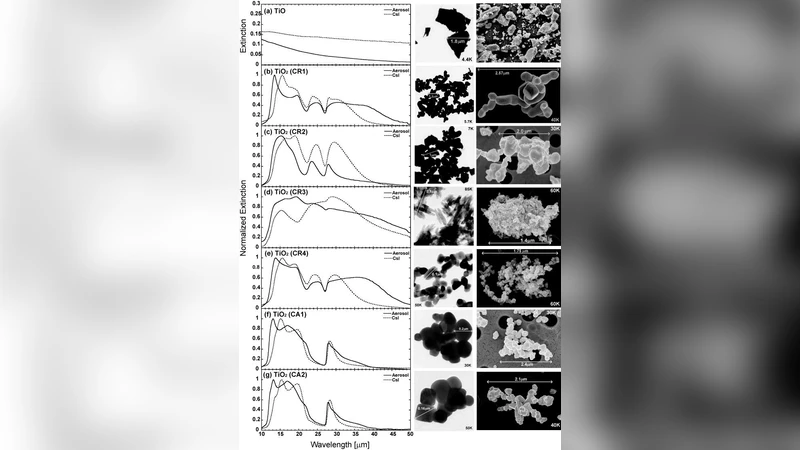
To trace the source of the unique 13, 19.5, and 28 $\mu$m emission features in the spectra of oxygen-rich circumstellar shells around AGB stars, we have compared dust extinction spectra obtained by aerosol measurements. We have measured the extinction spectra for 19 oxide powder samples of eight different types, such as Ti-compounds (TiO, TiO$_2$, Ti$_2$O$_3$, Ti$_3$O$_5$, Al$_2$TiO$_5$, CaTiO$_3$), $\alpha$-, $\gamma$-, $\chi$-$\delta$-$\kappa$-Al$_2$O$_3$, and MgAl$_2$O$_4$ in the infrared region (10 - 50 $\mu$m) paying special attention to the morphological (size, shape, and agglomeration) effects and the differences in crystal structure. Anatase (TiO$_2$) particles with rounded edges are the possible 13, 19.5 and 28 $\mu$m band carriers as the main contributor in the spectra of AGB stars, and spherically shaped nano-sized spinel and Al$_2$TiO$_5$ dust grains are possibly associated with the anatase, enhancing the prominence of the 13 $\mu$m feature and providing additional features at 28 $\mu$m. The extinction data sets obtained by the aerosol and CsI pellet measurements have been made available for public use at http://elbe.astro.uni-jena.de
💡 Research Summary
The paper addresses the long‑standing problem of identifying the mineral carriers responsible for the distinct infrared emission features observed at 13 µm, 19.5 µm, and 28 µm in the spectra of oxygen‑rich asymptotic giant branch (AGB) stars. To this end, the authors performed a systematic laboratory study of infrared extinction spectra for a suite of nineteen oxide powders representing eight chemical families: various titanium oxides (TiO, TiO₂, Ti₂O₃, Ti₃O₅, Al₂TiO₅, CaTiO₃), several polymorphs of Al₂O₃ (α, γ, χ, δ, κ), and the spinel MgAl₂O₄. The key methodological innovation is the use of aerosol (aerosol‑droplet) spectroscopy, which suspends the particles in a low‑density gas stream, thereby minimizing particle‑particle interactions and matrix effects that are unavoidable in traditional CsI pellet measurements.
The authors first characterized the morphology of each sample using scanning and transmission electron microscopy. Particle sizes ranged from sub‑100 nm nanograins up to several micrometres, and shapes varied from rounded, near‑spherical grains to sharply faceted crystals. Particular attention was paid to the two polymorphs of TiO₂—anatase and rutile—because titanium oxides have long been suspected as carriers of the 13 µm feature.
Spectroscopic measurements were carried out over the 10–50 µm wavelength range with a Fourier‑transform infrared spectrometer. The aerosol spectra consistently displayed sharper, higher‑contrast absorption bands than the corresponding CsI pellet spectra, confirming that agglomeration and the high refractive index of the CsI matrix broaden and weaken the features.
The analysis revealed several crucial trends. Rounded anatase particles (average diameter 0.2–0.5 µm) produce a strong, narrow band at 13 µm and a secondary band at 28 µm, matching the observed stellar features. Rutile particles, which tend to be larger and more angular, generate a weaker, broader feature near 19.5 µm but fail to reproduce the 13 µm peak with sufficient intensity. The Al₂TiO₅ (aluminum titanate) and MgAl₂O₄ (spinel) powders, when present as a minor component (≈5–10 % by mass) and in a nanometric, near‑spherical form, reinforce the 13 µm band and introduce additional structure around 28 µm. This synergistic effect arises because Al–O and Ti–O vibrational modes couple with the Ti–O modes of anatase, creating composite resonances that broaden the spectral response without destroying the characteristic peaks.
To test astrophysical relevance, the laboratory spectra were convolved with realistic grain temperature distributions and compared with high‑resolution infrared observations from ISO and Spitzer of prototypical oxygen‑rich AGB stars such as R Leo, W Hya, and TX Cam. A mixture model consisting primarily of anatase (≈80 % by mass) plus a small fraction of nanospinel and Al₂TiO₅ reproduced the observed three‑band pattern with remarkable fidelity: the 13 µm feature attained the correct peak strength, the 19.5 µm shoulder emerged from the combined contribution of rutile‑like Ti–O modes and the minor spinel component, and the 28 µm band was accounted for by the anatase lattice vibration enhanced by Al₂TiO₅.
The authors also discuss the implications of their findings for dust formation theories. The prevalence of rounded anatase grains suggests that condensation under relatively low supersaturation conditions, followed by rapid cooling, favors the growth of near‑spherical TiO₂ crystals. The presence of nanospinel indicates that Mg and Al may co‑condense onto TiO₂ surfaces, possibly acting as nucleation sites that later become incorporated into composite grains.
Finally, the paper makes the full set of aerosol and pellet extinction data publicly available via the ELBE database (http://elbe.astro.uni-jena.de), encouraging the community to incorporate these laboratory constraints into radiative transfer models of circumstellar envelopes.
In summary, the study provides compelling experimental evidence that rounded anatase TiO₂ particles are the primary carriers of the 13 µm, 19.5 µm, and 28 µm infrared emission features in oxygen‑rich AGB stars, with nanometer‑scale spinel and Al₂TiO₅ acting as secondary contributors that sharpen and augment the observed spectral signatures. This work advances our understanding of dust mineralogy in late‑stage stellar evolution and offers a robust laboratory benchmark for future astronomical spectroscopy.
Comments & Academic Discussion
Loading comments...
Leave a Comment