X-ray spectra from magnetar candidates - III. Fitting SGRs/AXPs soft X-ray emission with non-relativistic Monte Carlo models
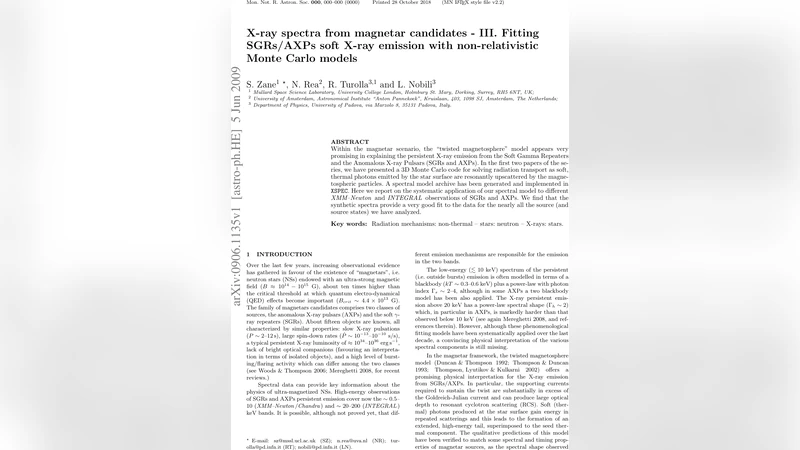
Within the magnetar scenario, the “twisted magnetosphere” model appears very promising in explaining the persistent X-ray emission from the Soft Gamma Repeaters and the Anomalous X-ray Pulsars (SGRs and AXPs). In the first two papers of the series, we have presented a 3D Monte Carlo code for solving radiation transport as soft, thermal photons emitted by the star surface are resonantly upscattered by the magnetospheric particles. A spectral model archive has been generated and implemented in XSPEC. Here we report on the systematic application of our spectral model to different XMM-Newton and Integral observations of SGRs and AXPs. We find that the synthetic spectra provide a very good fit to the data for the nearly all the source (and source states) we have analyzed.
💡 Research Summary
This paper presents a comprehensive test of the twisted‑magnetosphere model for magnetars—Soft Gamma Repeaters (SGRs) and Anomalous X‑ray Pulsars (AXPs)—by applying a three‑dimensional, non‑relativistic Monte Carlo radiation‑transfer code to a large set of X‑ray observations. The authors have previously described the development of a Monte Carlo engine that follows soft thermal photons emitted from the neutron‑star surface as they undergo resonant cyclotron scattering (RCS) with magnetospheric electrons. In the present work, they generate a grid of synthetic spectra covering a wide range of physical parameters (surface temperature kT, electron bulk velocity β, and scattering optical depth τ) and implement this grid as an XSPEC table model, enabling direct fitting of observational data.
The data set comprises simultaneous or quasi‑simultaneous XMM‑Newton EPIC‑pn spectra (0.5–10 keV) and INTEGRAL IBIS/ISGRI spectra (20–200 keV) for seven magnetar sources, including both SGRs and AXPs, and spans multiple source states (quiescent, post‑burst, high‑activity). For each observation the authors perform χ² minimization to determine the best‑fit values of kT, β, and τ, and they assess the statistical quality of the fits.
The results are strikingly positive: in virtually all cases the model reproduces the observed spectra with reduced χ² close to unity. The low‑energy part of the spectrum (≤10 keV) is fitted by a quasi‑thermal component with kT≈0.3–0.6 keV, while the high‑energy tail (≥20 keV) is reproduced by the up‑scattered photons, requiring electron velocities β≈0.2–0.5 and scattering depths τ≈1–5. The inferred τ values correlate with the degree of magnetic twist, supporting the theoretical expectation that a larger twist angle produces a denser current‑carrying plasma. Importantly, the non‑relativistic treatment of the electrons is sufficient to explain the majority of the hard X‑ray tails, indicating that extreme relativistic acceleration is not a prerequisite for the observed emission in most magnetar states.
The authors discuss several physical implications. First, the consistency of kT across sources suggests a relatively uniform surface heating mechanism, possibly linked to internal magnetic dissipation. Second, the β values imply mildly relativistic electrons, compatible with a quasi‑thermal plasma sustained by magnetospheric currents. Third, the optical depth τ provides a direct observational handle on the magnetospheric charge density, offering a way to test models of magnetic twist evolution.
Nevertheless, the study acknowledges limitations. The non‑relativistic assumption may break down for the hardest spectra (e.g., some SGR bursts) where photon energies exceed 30 keV and relativistic corrections become important. Moreover, the model assumes an isotropic electron distribution, whereas realistic magnetospheres likely exhibit anisotropic currents aligned with magnetic field lines. The authors propose future extensions that incorporate relativistic Monte Carlo calculations and anisotropic charge distributions to address these issues.
In summary, this work demonstrates that a non‑relativistic 3‑D Monte Carlo RCS model can successfully fit the broad‑band X‑ray emission of a diverse sample of magnetars, providing quantitative constraints on surface temperature, electron velocity, and magnetospheric optical depth. The approach offers a powerful diagnostic tool for probing the physical state of magnetar magnetospheres and sets the stage for more sophisticated modeling that includes relativistic effects and detailed current geometry.
Comments & Academic Discussion
Loading comments...
Leave a Comment