Limits on the location of planetesimal formation in self-gravitating protostellar discs
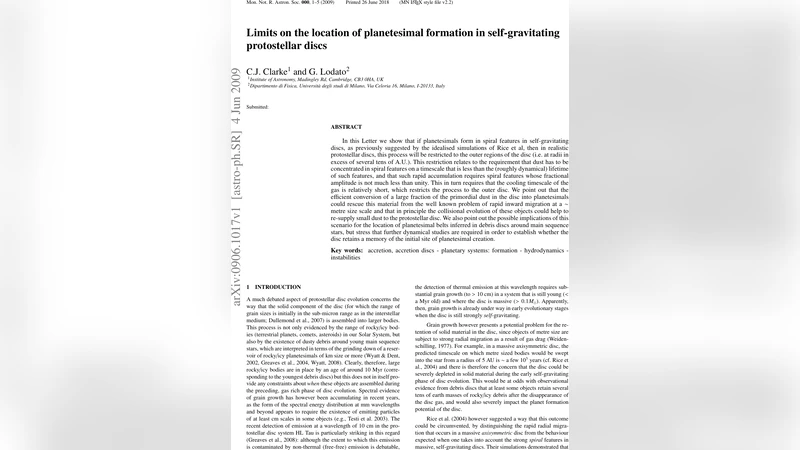
In this Letter we show that if planetesimals form in spiral features in self-gravitating discs, as previously suggested by the idealised simulations of Rice et al, then in realistic protostellar discs, this process will be restricted to the outer regions of the disc (i.e. at radii in excess of several tens of A.U.). This restriction relates to the requirement that dust has to be concentrated in spiral features on a timescale that is less than the (roughly dynamical) lifetime of such features, and that such rapid accumulation requires spiral features whose fractional amplitude is not much less than unity. This in turn requires that the cooling timescale of the gas is relatively short, which restricts the process to the outer disc. We point out that the efficient conversion of a large fraction of the primordial dust in the disc into planetesimals could rescue this material from the well known problem of rapid inward migration at a $\sim$ metre size scale and that in principle the collisional evolution of these objects could help to re-supply small dust to the protostellar disc. We also point out the possible implications of this scenario for the location of planetesimal belts inferred in debris discs around main sequence stars, but stress that further dynamical studies are required in order to establish whether the disc retains a memory of the initial site of planetesimal creation.
💡 Research Summary
The paper investigates where in a self‑gravitating protostellar disc planetesimals can realistically form via dust concentration in spiral density waves. Building on earlier idealised simulations (Rice et al.), the authors argue that the process is only viable when dust can be gathered into a spiral arm faster than the arm’s own dynamical lifetime. This requirement translates into a need for spiral features whose fractional amplitude A is of order unity. Theory and numerical experiments show that A scales roughly as (Ω τ_c)⁻¹ᐟ², where τ_c is the gas cooling time and Ω the local orbital frequency. Short cooling times therefore produce strong spirals, while long cooling times generate weak perturbations that cannot trap dust efficiently.
Two timescales are central to the argument. The first is the dynamical lifetime of a spiral arm, t_dyn ≈ Ω⁻¹, i.e. roughly one orbital period. The second is the concentration time t_conc for dust particles, which depends on the drag (stopping time) and the strength of the pressure gradient within the arm. For t_conc < t_dyn, the pressure maximum must be deep enough (high A) that the drag force drives particles into the arm on a sub‑orbital timescale. If A is much less than one, t_conc exceeds t_dyn and the arm dissolves before a significant dust overdensity can develop.
Applying these constraints to realistic disc models reveals a strong radial dependence. In the inner disc (a few AU), temperatures are high, densities are large, and radiative cooling is inefficient, giving τ_c ≫ Ω⁻¹ and consequently A ≪ 1. Spirals are therefore weak and dust cannot be concentrated quickly enough. In the outer disc (tens of AU), the temperature drops, cooling is dominated by infrared radiation, and τ_c becomes comparable to or shorter than the orbital period. Here A approaches unity, spiral arms are robust, and dust can be trapped efficiently. The authors estimate that the threshold radius lies at roughly 30–50 AU, beyond which the conditions satisfy t_conc < t_dyn.
If planetesimals do form in these outer spirals, a large fraction of the primordial solid mass can be locked up in kilometre‑scale bodies. This has two important consequences. First, it removes the bulk of the solid material from the “meter‑size barrier” regime, where aerodynamic drag would otherwise cause rapid inward migration on timescales of 10³–10⁴ yr. Second, the newly formed planetesimals can undergo collisional grinding, replenishing the disc with small dust grains and potentially explaining the persistent infrared excess observed in many young systems. Moreover, the location of the initial planetesimal formation zone may leave an imprint on the later architecture of debris discs, offering a possible explanation for the observed location of planetesimal belts around main‑sequence stars.
The paper also highlights several open questions. The exact cooling mechanisms (pure radiative cooling, convection, dust‑gas thermal coupling) need to be modelled in detail to refine τ_c as a function of radius. The dependence of t_conc on particle size distribution and on the local turbulence level remains uncertain. Finally, the long‑term dynamical evolution of the planetesimals—whether they retain memory of their birth radius or are scattered inward/outward by subsequent gravitational interactions—requires dedicated N‑body and hydrodynamic simulations.
In summary, the authors demonstrate that dust concentration in self‑gravitating spirals is a viable pathway to planetesimal formation only in the outer regions of protostellar discs where cooling is rapid enough to generate strong spiral arms. This mechanism naturally circumvents the rapid inward drift of metre‑sized solids and may provide a link between early planetesimal formation and the observed structure of debris discs. Further theoretical and numerical work is needed to quantify the cooling physics, particle‑gas coupling, and post‑formation dynamical evolution to fully assess the role of this process in planet formation.
Comments & Academic Discussion
Loading comments...
Leave a Comment