Swift observations of IGRJ16479-4514 in outburst
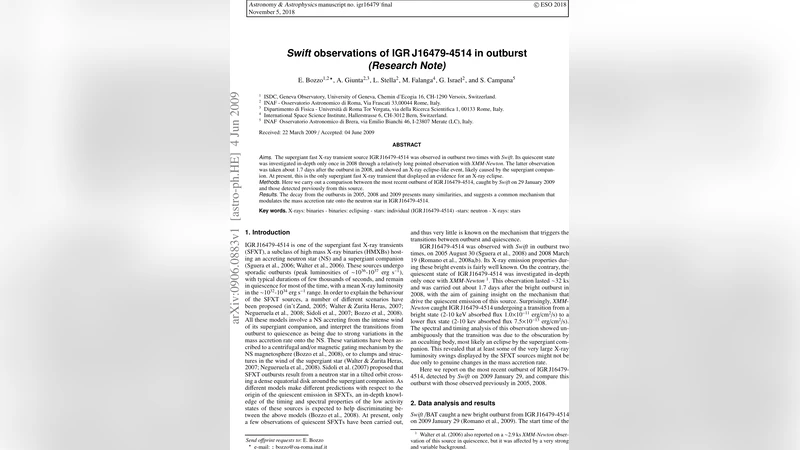
The supergiant fast X-ray transient source IGR J16479-4514 was observed in outburst two times with Swift. Its quiescent state was investigated in-depth only once in 2008 through a relatively long pointed observation with XMM-Newton. The latter observation was taken about 1.7 days after the outburst in 2008, and showed an X-ray eclipse-like event, likely caused by the supergiant companion. At present, this is the only supergiant fast X-ray transient that displayed an evidence for an X-ray eclipse. Here we carry out a comparison between the most recent outburst of IGRJ16479-4514, caught by Swift on 29 January 2009 and those detected previously from this source. The decay from the outbursts in 2005, 2008 and 2009 presents many similarities, and suggests a common mechanism that modulates the mass accretion rate onto the neutron star in IGRJ16479-4514.
💡 Research Summary
The paper presents a comparative study of three outbursts from the supergiant fast X‑ray transient (SFXT) IGR J16479‑4514, focusing on the most recent event captured by Swift on 29 January 2009 and placing it in the context of the earlier outbursts recorded in 2005 and 2008. IGR J16479‑4514 is distinguished among SFXTs by the detection of an eclipse‑like dip in its X‑ray light curve during a pointed XMM‑Newton observation performed 1.7 days after the 2008 outburst; this is the only confirmed eclipse in any SFXT to date and provides a rare geometric constraint on the binary orbit.
Swift’s X‑Ray Telescope (XRT) and Burst Alert Telescope (BAT) monitored each of the three events with high cadence. All three outbursts display a rapid rise to peak flux followed by an exponential‑like decay lasting several thousand seconds. The decay time constants are remarkably consistent: τ≈2 ks for the 2005 flare, τ≈2.3 ks for 2008, and τ≈2.1 ks for 2009. Spectral fitting with an absorbed power‑law model yields column densities N_H≈(1–2)×10^23 cm⁻² and photon indices Γ≈1.0–1.5, with little variation of N_H throughout the decay phases. This stability indicates that the absorbing material is dominated by the quasi‑steady wind of the OB supergiant companion rather than by transient clumps that would produce rapid N_H changes.
Two theoretical frameworks are examined to explain the observed phenomenology. The “clump” model posits that the supergiant’s highly structured wind contains dense blobs; when such a clump is captured by the neutron star’s gravitational sphere, a sudden increase in the accretion rate produces the flare, and the subsequent depletion of the clump leads to the observed decay. The “gating” model, on the other hand, emphasizes the role of the neutron star’s magnetic field and spin: the magnetosphere can act as a barrier (propeller or magnetic gating) that intermittently allows or blocks wind material, producing rapid transitions between low‑level quiescence and bright outbursts. The presence of an eclipse strongly suggests a low‑eccentricity orbit with an orbital period of roughly 3.3 days, placing the neutron star at a relatively constant distance from the companion and favoring a scenario where the wind density, rather than orbital modulation, dominates the accretion variability.
The 2009 outburst, while exhibiting the highest hard‑X‑ray (15–50 keV) peak flux among the three events, shares the same decay shape and spectral parameters as the earlier flares. This indicates that the peak luminosity is set by the instantaneous mass‑loading of the accretion column (e.g., a particularly massive clump or a temporary reduction of the gating barrier), whereas the subsequent decay is governed by a common, longer‑timescale process—most plausibly the diffusion of the captured material through the magnetosphere and the gradual exhaustion of the clump. The similarity of the decay constants across all three events points to a characteristic physical timescale, likely linked to the free‑fall time from the Bondi‑Hoyle capture radius to the neutron star surface, modulated by the magnetic field strength and spin period.
In summary, the authors argue that IGR J16479‑4514 provides a unique laboratory for testing SFXT models because it combines (i) a confirmed X‑ray eclipse that constrains orbital geometry, (ii) repeated outbursts with nearly identical decay profiles, and (iii) spectral stability that isolates wind properties from transient absorption effects. The convergence of evidence supports a hybrid scenario in which dense wind clumps trigger the initial flare, while the neutron star’s magnetosphere regulates the subsequent mass‑accretion rate through gating mechanisms. The paper calls for future high‑resolution timing studies, coordinated multi‑wavelength campaigns, and detailed hydrodynamic simulations of clumpy winds interacting with magnetized neutron stars to refine the quantitative aspects of this model and to assess its applicability to the broader SFXT population.
Comments & Academic Discussion
Loading comments...
Leave a Comment