Strongly correlated phases in rapidly rotating Bose gases
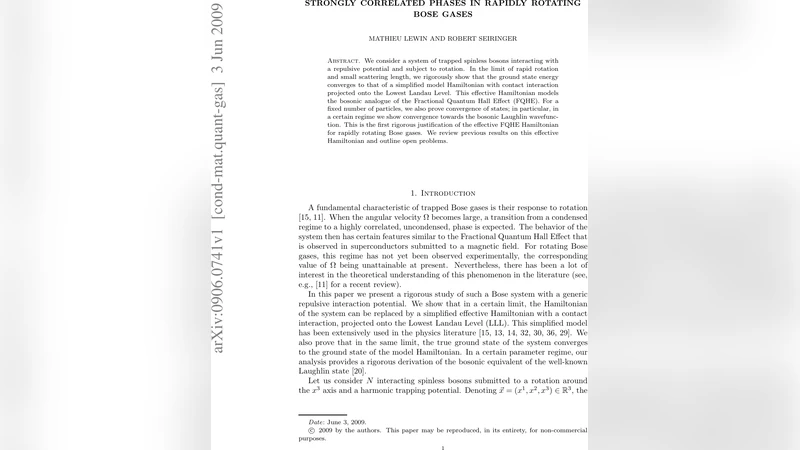
We consider a system of trapped spinless bosons interacting with a repulsive potential and subject to rotation. In the limit of rapid rotation and small scattering length, we rigorously show that the ground state energy converges to that of a simplified model Hamiltonian with contact interaction projected onto the Lowest Landau Level. This effective Hamiltonian models the bosonic analogue of the Fractional Quantum Hall Effect (FQHE). For a fixed number of particles, we also prove convergence of states; in particular, in a certain regime we show convergence towards the bosonic Laughlin wavefunction. This is the first rigorous justification of the effective FQHE Hamiltonian for rapidly rotating Bose gases. We review previous results on this effective Hamiltonian and outline open problems.
💡 Research Summary
The paper addresses a fundamental problem in the physics of rapidly rotating Bose–Einstein condensates (BECs): how to rigorously justify the widely used effective Hamiltonian that describes the system as a two‑dimensional gas of bosons confined to the Lowest Landau Level (LLL) with a contact interaction. The authors consider a three‑dimensional trapped gas of spin‑less bosons interacting via a short‑range repulsive potential. By letting the rotation frequency Ω approach the trap frequency ω (the “rapid‑rotation limit”) and simultaneously taking the scattering length a to be much smaller than the magnetic length ℓ_B = √(ħ/2mΩ), they place the system in a regime where the kinetic energy is dominated by the Coriolis‑induced effective magnetic field. In this regime the single‑particle spectrum collapses into highly degenerate Landau levels, and the particles are expected to occupy only the LLL.
The main technical achievement is a rigorous proof that, under the above scaling, the many‑body ground‑state energy of the full Gross‑Pitaevskians Hamiltonian converges to the ground‑state energy of the simplified LLL Hamiltonian
H_eff = g ∑_{i<j} P_LLL δ(r_i−r_j) P_LLL ,
where P_LLL projects onto the LLL and g ∝ a is the coupling constant of the contact interaction. The proof combines a Dyson‑Lemma lower bound for the original Hamiltonian with a coherent‑state analysis that controls excitations out of the LLL. The authors show that the contribution of higher Landau levels is of order a² and therefore negligible in the limit a → 0, Ω → ω. Consequently, the energy per particle of the full system and that of the effective model differ by a term that vanishes in the prescribed limit.
Beyond energy convergence, the paper establishes convergence of the many‑body wave function for a fixed particle number N. In a specific parameter regime—referred to as the “Laughlin regime”—the authors prove that the ground state of H_eff converges to the bosonic Laughlin wave function
ψ_Laughlin(z₁,…,z_N) = ∏_{i<j}(z_i−z_j)² exp(−∑|z_i|²/4ℓ_B²) .
This state is the bosonic analogue of the ν = 1/2 fractional quantum Hall (FQH) state and exhibits strong two‑particle correlations that suppress the probability of particles approaching each other. The convergence result provides the first mathematically rigorous justification that a rapidly rotating Bose gas can realize a bosonic Laughlin state, confirming long‑standing physical intuition.
The authors also review prior work on the LLL model, including numerical studies of its excitation spectrum, investigations of non‑abelian anyonic excitations, and proposals for experimental detection of FQH physics in cold atoms. They outline several open problems: extending the rigorous results to larger particle numbers (thermodynamic limit), incorporating finite‑temperature effects, treating more general interaction potentials (e.g., dipolar or finite‑range), and analyzing the impact of trap anisotropy or disorder. Moreover, they discuss the challenges of experimentally achieving the required rotation rates and scattering lengths, and suggest possible routes such as synthetic gauge fields or Feshbach‑tuned interactions.
In summary, the paper delivers a comprehensive and mathematically solid foundation for the effective LLL description of rapidly rotating Bose gases. It proves energy and state convergence to the LLL contact‑interaction model and, in a distinguished regime, to the bosonic Laughlin wave function. This work bridges the gap between heuristic physics arguments and rigorous many‑body analysis, opening a clear path for future theoretical and experimental exploration of bosonic fractional quantum Hall phenomena in ultracold atomic systems.
Comments & Academic Discussion
Loading comments...
Leave a Comment