The MAXI Mission on the ISS: Science and Instruments for Monitoring All Sky X-Ray Images
The MAXI (Monitor of All-sky X-ray Image) mission is the first astronomical payload to be installed on the Japanese Experiment Module-Exposed Facility (JEM-EF) on the ISS. It is scheduled for launch in the middle of 2009 to monitor all-sky X-ray objects on every ISS orbit. MAXI will be more powerful than any previous X-ray All Sky Monitor (ASM) payloads, being able to monitor hundreds of AGN. MAXI will provide all sky images of X-ray sources of about 20 mCrab in the energy band of 2-30 keV from observation on one ISS orbit (90 min), about 4.5 mCrab for one day, and about 1 mCrab for one month. A final detectability of MAXI could be 0.2 mCrab for 2 year observations.
💡 Research Summary
The paper presents a comprehensive overview of the MAXI (Monitor of All-sky X-ray Image) mission, the first astronomical payload installed on the Japanese Experiment Module‑Exposed Facility (JEM‑EF) of the International Space Station (ISS). Scheduled for launch in mid‑2009, MAXI is designed to continuously monitor the entire X‑ray sky in the 2–30 keV energy band by scanning the sky once every ISS orbit (approximately 90 minutes). The instrument suite consists of two complementary detectors: the Gas Slit Camera (GSC) and the Solid‑state Slit Camera (SSC).
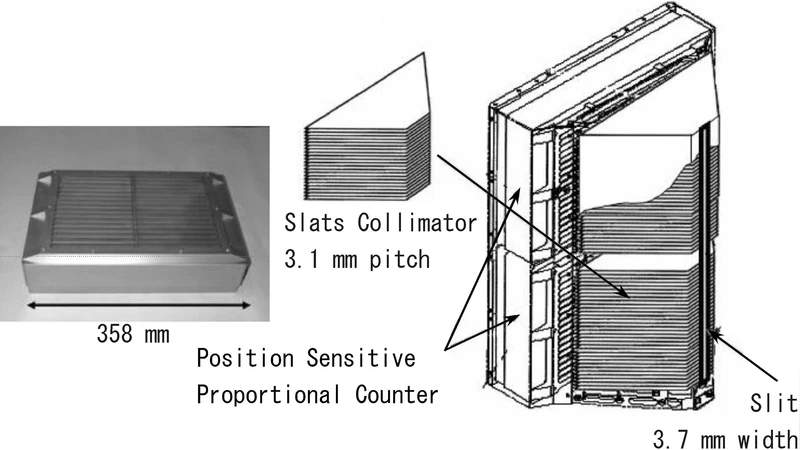
The GSC employs large‑area Xe/CO₂ proportional counters with a one‑dimensional position readout, providing a very wide field of view (1.5° × 160°). As the ISS orbits, the GSC sweeps across the sky, accumulating roughly 0.1 s of exposure per scan line. This scanning strategy yields a sensitivity of about 20 mCrab per orbit, 4.5 mCrab for a full day, and 1 mCrab for a month of integration. Over a two‑year mission the cumulative sensitivity can reach 0.2 mCrab, surpassing previous all‑sky monitors such as RXTE/ASM and Swift/BAT by factors of several.
The SSC covers the softer 0.5–12 keV band using two arrays of X‑ray CCDs (1024 × 1024 pixels each) operated at –70 °C. The CCDs deliver an energy resolution of ~150 eV (FWHM) and positional accuracy of ~1 arcminute, enabling detailed spectroscopy of faint sources and precise mapping of the soft X‑ray background. The dual‑detector approach allows MAXI to simultaneously acquire broad‑band fluxes and spectral information for each source.
A key feature of MAXI is its real‑time data processing pipeline. On‑board FPGA‑based trigger logic analyses event streams from both detectors, identifies transient candidates, and transmits alerts to the ground within ~30 seconds via the ISS communication link. This rapid alert system facilitates coordinated multi‑wavelength follow‑up observations, crucial for studying fast transients such as gamma‑ray bursts, X‑ray flashes, and the early phases of supernovae.
The scientific objectives are fourfold: (1) long‑term monitoring of hundreds of active galactic nuclei (AGN) to investigate black‑hole accretion physics and variability patterns; (2) early detection of X‑ray transients, including novae, tidal disruption events, and magnetar outbursts; (3) systematic study of the diffuse soft X‑ray background and Galactic absorption structures; and (4) discovery of previously unknown X‑ray sources, expanding the census of faint X‑ray emitters. By providing daily light curves for a large sample of AGN, MAXI will enable statistical studies of variability timescales and spectral state changes across the AGN population.
Operationally, MAXI leverages the ISS’s 51.6° inclination orbit to achieve uniform sky coverage. The GSC and SSC are mounted on a rotating platform that maintains a fixed orientation relative to the ISS structure, ensuring stable thermal and radiation environments. Power, thermal control, and data handling are designed to be robust against the ISS’s periodic day‑night cycles and occasional attitude adjustments.
In comparison with earlier all‑sky monitors, MAXI offers markedly improved sensitivity, broader energy coverage, and faster transient alert capability. Its ability to detect sources down to ~20 mCrab in a single orbit opens a new discovery space for faint, rapidly varying X‑ray phenomena. The mission’s data will be publicly released, encouraging community‑wide analysis and cross‑correlation with observations from other space missions (e.g., Swift, INTEGRAL, Fermi) and ground‑based facilities.
In summary, MAXI represents a significant advancement in X‑ray astronomy, exploiting the unique platform of the ISS to deliver continuous, high‑sensitivity monitoring of the X‑ray sky. The mission’s technical innovations and ambitious scientific program are poised to deepen our understanding of high‑energy processes in the universe, from supermassive black holes to explosive stellar events, and to lay the groundwork for future all‑sky monitoring concepts.
Comments & Academic Discussion
Loading comments...
Leave a Comment