Magnetic reversals in a simple model of MHD
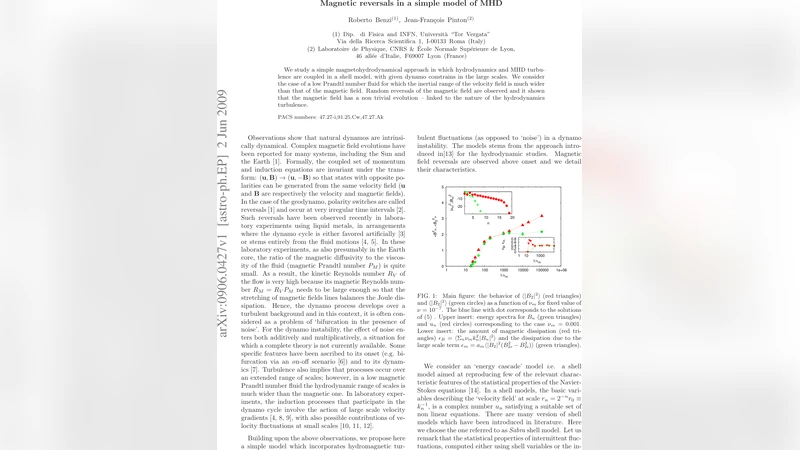
We study a simple magnetohydrodynamical approach in which hydrodynamics and MHD turbulence are coupled in a shell model, with given dynamo constrains in the large scales. We consider the case of a low Prandtl number fluid for which the inertial range of the velocity field is much wider than that of the magnetic field. Random reversals of the magnetic field are observed and it shown that the magnetic field has a non trivial evolution linked to the nature of the hydrodynamics turbulence.
💡 Research Summary
The paper presents a minimalist yet insightful magnetohydrodynamic (MHD) model that couples hydrodynamic turbulence and magnetic turbulence through a shell‑model framework. The authors focus on a low magnetic Prandtl number (Pm ≪ 1) regime, where the inertial range of the velocity field extends far beyond that of the magnetic field. By imposing a large‑scale dynamo constraint—implemented as a constant external forcing on the lowest‑wavenumber shell—they generate a self‑sustaining magnetic field while allowing the small‑scale turbulent motions to interact nonlinearly with the large‑scale magnetic component.
In the shell model, the continuous wavenumber space is discretized into N logarithmically spaced shells (k_n = k₀ λⁿ). Each shell carries a complex amplitude for velocity (u_n) and magnetic field (b_n). The governing equations consist of the usual triadic nonlinear terms that transfer energy between neighboring shells, linear viscous and resistive dissipation (ν k_n² u_n and η k_n² b_n), and the imposed dynamo forcing term acting only on the n = 0 shell. By choosing ν ≫ η, the authors achieve Pm ≈ 10⁻³, reproducing the conditions of liquid metal cores or laboratory plasmas where magnetic diffusion dominates over viscous diffusion.
Numerical integration is performed over several million time units with an adaptive time step respecting the Courant–Friedrichs–Lewy condition. The primary observables are the sign of the large‑scale magnetic field b₀(t), the kinetic energy spectrum E_u(k) = |u_n|², and the magnetic energy spectrum E_b(k) = |b_n|². The results reveal spontaneous, random reversals of the sign of b₀. Between reversals the magnetic field maintains a relatively constant amplitude; only its polarity flips. Crucially, each reversal is preceded by a pronounced burst of kinetic energy in the intermediate shells (typically n ≈ 5–8), indicating that a sudden re‑organization of the velocity field triggers the magnetic polarity change.
Statistical analysis shows that the waiting times between reversals follow an approximately exponential distribution, P(τ_rev) ∝ exp(−τ_rev/⟨τ_rev⟩), suggesting a Poisson‑like process driven by turbulent fluctuations. The magnetic autocorrelation function decays sharply at the moment of reversal and recovers over a timescale of tens to hundreds of large‑scale turnover times, reflecting the time needed for the dynamo to re‑establish a coherent field after being disrupted.
The authors also explore the dependence on the strength of the large‑scale forcing. When the forcing amplitude is reduced below a critical threshold, reversal frequency increases dramatically, and eventually the dynamo collapses, leaving the magnetic field to decay to zero. This demonstrates that the balance between external energy input and turbulent dissipation controls both the existence of a sustained dynamo and the statistics of its polarity switches.
In the discussion, the authors draw parallels with geomagnetic reversals, noting that Earth’s outer core operates at a similarly low Prandtl number and exhibits a wide separation between kinetic and magnetic inertial ranges. The shell‑model results suggest that the key ingredient for reversals is not the detailed geometry of the flow but the presence of intermittent, large‑amplitude kinetic bursts that can destabilize the large‑scale magnetic configuration. While real planetary dynamos involve additional complexities—Coriolis forces, buoyancy, and realistic boundary conditions—the simplified model captures the essential stochastic nature of polarity changes.
The paper concludes that shell models provide a powerful, computationally inexpensive platform for probing the fundamental physics of magnetic reversals in low‑Pm MHD turbulence. By isolating the role of scale separation and nonlinear coupling, the study offers a clear mechanistic picture: turbulent kinetic bursts act as triggers, while the large‑scale dynamo forcing determines the system’s ability to recover and maintain a coherent magnetic polarity. Future work could extend the model to include rotation, anisotropic forcing, or variable magnetic diffusivity, thereby bridging the gap between idealized shell dynamics and the full complexity of planetary and astrophysical dynamos.
Comments & Academic Discussion
Loading comments...
Leave a Comment