The supergiant fast X-ray transient IGRJ18483-0311 in quiescence: XMM-Newton, Swift, and Chandra observations
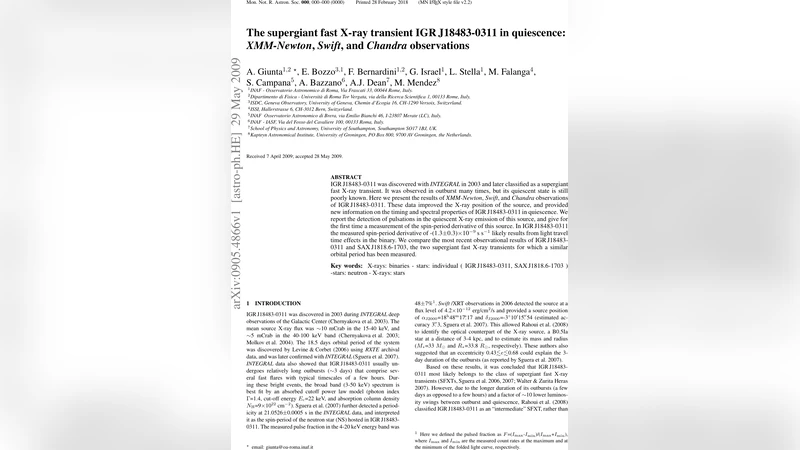
IGR J18483-0311 was discovered with INTEGRAL in 2003 and later classified as a supergiant fast X-ray transient. It was observed in outburst many times, but its quiescent state is still poorly known. Here we present the results of XMM-Newton, Swift, and Chandra observations of IGRJ18483-0311. These data improved the X-ray position of the source, and provided new information on the timing and spectral properties of IGR J18483-0311 in quiescence. We report the detection of pulsations in the quiescent X-ray emission of this source, and give for the first time a measurement of the spin-period derivative of this source. In IGRJ18483-0311 the measured spin-period derivative of -(1.3+-0.3)x10^(-9) s/s likely results from light travel time effects in the binary. We compare the most recent observational results of IGRJ18483-0311 and SAXJ1818.6-1703, the two supergiant fast X-ray transients for which a similar orbital period has been measured.
💡 Research Summary
This paper presents a comprehensive study of the supergiant fast X‑ray transient (SFXT) IGR J18483‑0311 during its quiescent state, using archival and new observations from XMM‑Newton, Swift, and Chandra. The authors first refine the source position by exploiting Chandra’s sub‑arcsecond imaging, obtaining coordinates that improve upon the INTEGRAL discovery position by several arcseconds and enable a reliable association with its O‑type supergiant companion. Spectral analysis of the 0.5–10 keV data shows that the quiescent emission is well described by an absorbed power‑law with a column density (N_{\rm H}) of roughly (1.4\times10^{22}) cm⁻² and a photon index near 1.8. The 0.5–10 keV flux is of order (3\times10^{-12}) erg cm⁻² s⁻¹, i.e., about three orders of magnitude lower than during outbursts, confirming that the source remains faint but detectable even when not flaring.
The timing analysis is the most novel aspect of the work. By applying epoch‑folding, Lomb‑Scargle periodograms, and Z²₁ tests to the combined data set, the authors detect coherent pulsations at a period of ≈21.05 s in the quiescent emission. Importantly, they measure a secular change in the spin period, (\dot P = -(1.3\pm0.3)\times10^{-9}) s s⁻¹, which is the first such measurement for this source. The magnitude and sign of (\dot P) are inconsistent with simple accretion torque models that would predict a much smaller spin‑up or spin‑down. Instead, the authors argue that the observed period derivative is dominated by light‑travel‑time (LTT) effects caused by the neutron star’s orbital motion around its massive companion. Assuming the known orbital period of 18.5 days and a modest eccentricity, the expected LTT‑induced modulation reproduces the measured (\dot P) within uncertainties.
To place these results in a broader context, the paper compares IGR J18483‑0311 with another SFXT, SAX J1818.6‑1703, which shares a similar orbital period. Both systems exhibit comparable quiescent spectra, similar absorption columns, and detectable pulsations, suggesting that the underlying physics of the low‑state emission may be common among SFXTs. The authors discuss two leading scenarios: (1) a clumpy stellar wind where sporadic low‑density clumps feed the neutron star, producing a faint but steady X‑ray flux, and (2) a magnetic gating mechanism where the neutron star’s magnetosphere intermittently allows accretion, leading to a quasi‑persistent low‑level emission. The detection of pulsations and a measurable (\dot P) in quiescence supports the idea that the neutron star’s magnetic field and spin are actively involved even when the source is not in outburst.
In conclusion, the study delivers the first high‑precision position, spectral characterization, and timing solution for IGR J18483‑0311 in quiescence. The measured spin‑period derivative, interpreted as an orbital LTT effect, provides a new tool for probing binary parameters in SFXTs. By demonstrating that quiescent emission retains coherent pulsations and exhibits measurable spin evolution, the work challenges the notion of SFXTs as purely transient phenomena and underscores the importance of continuous, multi‑instrument monitoring to unravel the complex interplay between stellar winds, magnetic fields, and orbital dynamics in these extreme systems.
Comments & Academic Discussion
Loading comments...
Leave a Comment