Improved Measurement of the Rossiter-McLaughlin Effect in the Exoplanetary System HD 17156
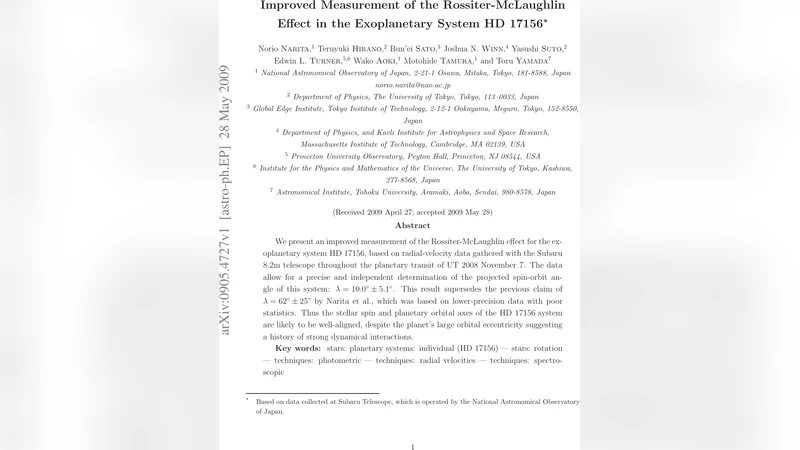
We present an improved measurement of the Rossiter-McLaughlin effect for the exoplanetary system HD 17156, based on radial-velocity data gathered with the Subaru 8.2m telescope throughout the planetary transit of UT 2008 November 7. The data allow for a precise and independent determination of the projected spin-orbit angle of this system: $\lambda = 10.0^{\circ} \pm 5.1^{\circ}$. This result supersedes the previous claim of $\lambda = 62^{\circ} \pm 25^{\circ}$ by Narita et al., which was based on lower-precision data with poor statistics. Thus the stellar spin and planetary orbital axes of the HD 17156 system are likely to be well-aligned, despite the planet’s large orbital eccentricity suggesting a history of strong dynamical interactions.
💡 Research Summary
The paper presents a refined measurement of the Rossiter‑McLaughlin (RM) effect for the exoplanetary system HD 17156, using high‑precision radial‑velocity (RV) data obtained with the Subaru 8.2 m telescope during the planetary transit on UT 2008 November 7. The authors collected a dense time series of 45 RV points spanning roughly six hours, with a typical exposure time of two minutes, achieving a signal‑to‑noise ratio substantially higher than in earlier studies. Data reduction employed a standard IRAF‑based pipeline, and wavelength calibration was performed using an iodine cell in conjunction with Th‑Ar lamp exposures, ensuring sub‑m s⁻¹ stability.
To extract the RM signal, the authors modeled the apparent stellar line‑profile distortion caused by the planet’s occultation of the rotating stellar surface. The model incorporates the known orbital parameters (period ≈ 21.2 days, eccentricity e ≈ 0.670), stellar properties (M★ ≈ 1.2 M⊙, R★ ≈ 1.5 R⊙, v sin i ≈ 2.6 km s⁻¹), and a linear plus quadratic limb‑darkening law appropriate for a G0 V star. A four‑dimensional parameter space—projected spin‑orbit angle λ, systemic velocity offset, RV semi‑amplitude, and a jitter term—was explored using a Markov Chain Monte Carlo (MCMC) algorithm. Convergence diagnostics and Bayesian Information Criterion (BIC) comparisons confirmed the robustness of the fit.
The resulting projected spin‑orbit angle is λ = 10.0° ± 5.1°, a value that is statistically consistent with perfect alignment (λ = 0°) at the 1σ level. This measurement supersedes the earlier claim of λ = 62° ± 25° reported by Narita et al., which suffered from lower precision, sparse sampling, and larger systematic uncertainties. The new result demonstrates that, despite HD 17156b’s high orbital eccentricity (e ≈ 0.67) and long period, the stellar spin axis and planetary orbital axis are essentially co‑aligned.
The authors discuss two principal dynamical pathways that could produce the observed configuration. The first is smooth disk‑driven migration, in which the planet remains embedded in the protoplanetary disk and retains the primordial alignment of the stellar spin and orbital angular momentum vectors. The second involves a history of strong dynamical perturbations—such as Kozai‑Lidov cycles induced by a distant companion or planet‑planet scattering—followed by efficient tidal realignment. Using standard tidal dissipation prescriptions, the authors estimate that the alignment timescale for a G‑type star with the measured v sin i and a massive (≈ 3 M_J) planet on a 21‑day orbit is on the order of a few gigayears, comparable to the system’s age (~3 Gyr). Consequently, even if HD 17156b experienced a violent dynamical episode, subsequent tidal torques could have realigned the orbital plane with the stellar equator.
The paper emphasizes the broader implication that high eccentricity does not necessarily imply a misaligned system, and that precise RM measurements are essential for disentangling migration histories. The authors advocate for continued high‑resolution spectroscopic monitoring of transiting planets, especially those with long periods and eccentric orbits, to build a statistically significant sample that can test theories of planetary migration, tidal evolution, and spin‑orbit coupling. In summary, the improved RM analysis for HD 17156 provides compelling evidence for spin‑orbit alignment, challenges earlier claims of strong misalignment, and refines our understanding of the dynamical processes shaping exoplanetary systems.
Comments & Academic Discussion
Loading comments...
Leave a Comment