A possible architecture of the planetary system HR 8799
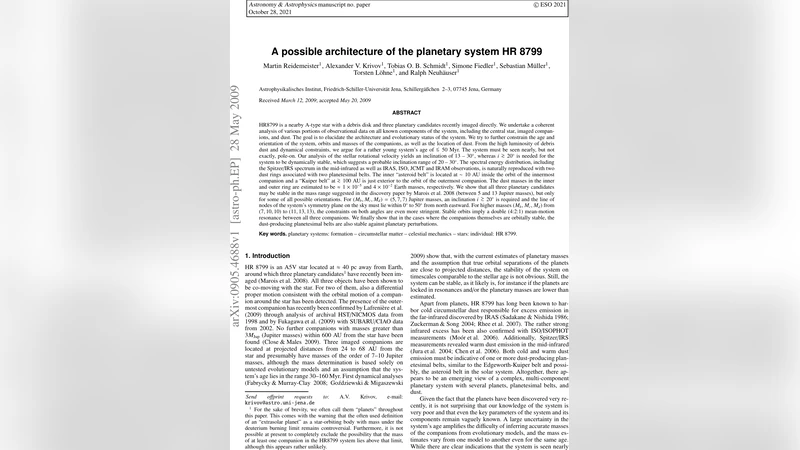
HR8799 is a nearby A-type star with a debris disk and three planetary candidates recently imaged directly. We undertake a coherent analysis of various portions of observational data on all known components of the system. The goal is to elucidate the architecture and evolutionary status of the system. We try to further constrain the age and orientation of the system, orbits and masses of the companions, as well as the location of dust. From the high luminosity of debris dust and dynamical constraints, we argue for a rather young system’s age of <50Myr. The system must be seen nearly, but not exactly, pole-on. Our analysis of the stellar rotational velocity yields an inclination of 13-30deg, whereas i>20deg is needed for the system to be dynamically stable, which suggests a probable inclination range of 20-30deg. The spectral energy distribution is naturally reproduced with two dust rings associated with two planetesimal belts. The inner “asteroid belt” is located at ~10AU inside the orbit of the innermost companion and a “Kuiper belt” at >100AU is just exterior to the orbit of the outermost companion. The dust masses in the inner and outer ring are estimated to be ~1E-05 and 4E-02 M_earth, respectively. We show that all three planetary candidates may be stable in the mass range suggested in the discovery paper by Marois et al. 2008 (between 5 and 13 Jupiter masses), but only for some of all possible orientations. Stable orbits imply a double (4:2:1) mean-motion resonance between all three companions. We finally show that in the cases where the companions themselves are orbitally stable, the dust-producing planetesimal belts are also stable against planetary perturbations.
💡 Research Summary
The paper presents a comprehensive, multi‑faceted investigation of the HR 8799 system—a nearby A‑type star surrounded by a bright debris disk and three directly imaged planetary candidates. By integrating stellar spectroscopy, photometry, dynamical modeling, and spectral energy distribution (SED) fitting, the authors aim to constrain the system’s age, inclination, planetary masses, orbital architecture, and the locations of the dust belts.
First, the authors re‑examine the host star’s rotational properties. Using high‑resolution spectra they measure a projected rotational velocity (v sin i) of roughly 49 km s⁻¹. Combining this with empirical rotation‑period relations for A‑type stars yields an inclination range of 13°–30°. Independent dynamical stability calculations require the system’s inclination to exceed about 20°, otherwise the three planets would quickly destabilize. The overlap of these constraints leads to a preferred inclination of 20°–30°, implying that the true planetary masses are larger than the minimum masses derived from imaging (M sin i) but still within the 5–13 M_Jup interval reported by Marois et al. (2008).
Second, the authors model the full SED from optical to far‑infrared wavelengths. A single black‑body component cannot reproduce the observed excess; instead, two distinct dust populations are required. The inner “asteroid‑belt‑like” component peaks at ∼10 AU, interior to the orbit of the innermost planet (HR 8799 d). The outer component, analogous to a Kuiper belt, begins beyond ∼100 AU, just outside the orbit of the outermost planet (HR 8799 b). By fitting the SED and assuming standard grain properties, they estimate dust masses of ≈1 × 10⁻⁵ M_⊕ for the inner belt and ≈4 × 10⁻² M_⊕ for the outer belt. The high fractional luminosity of the dust, together with the dynamical constraints, points to a relatively young system age of less than 50 Myr.
Third, the orbital dynamics of the three planets are explored in depth. Using the astrometric positions from direct imaging, the authors generate a suite of N‑body integrations spanning the allowed ranges of inclination, eccentricity, and planetary mass. They find that long‑term stability (≥10⁷ yr) is only achieved when the planets are locked in a 4:2:1 mean‑motion resonance (MMR): the middle planet (HR 8799 c) completes two orbits for every one of the inner planet (HR 8799 d), and the outer planet (HR 8799 b) completes two orbits for every one of the middle planet. Within this resonant configuration, the planets can retain masses up to the upper limit of 13 M_Jup without destabilizing each other, but only for a subset of the possible inclination angles (roughly the 20°–30° range identified earlier). Outside the resonance, even modest increases in mass or eccentricity lead to orbit crossing and rapid ejection.
Finally, the authors assess the impact of the resonant planetary system on the surrounding debris belts. They embed test particles representing planetesimals in the two dust rings and evolve them under the gravitational influence of the resonant planets. The simulations show that both belts remain largely intact over the same timescales required for planetary stability. The inner belt is protected because it lies well inside the innermost planet’s Hill sphere, while the outer belt is shielded by the 4:2:1 resonance, which prevents strong secular perturbations from propagating outward. No large resonance gaps or clearing zones develop, consistent with the observed continuous infrared excess.
In summary, the paper argues convincingly that HR 8799 is a young (≤50 Myr), near‑pole‑on (inclination 20°–30°) planetary system whose three massive companions are dynamically locked in a 4:2:1 mean‑motion resonance. This resonant architecture naturally explains the long‑term stability of the planets, the coexistence of two massive debris belts, and the high dust luminosity. The work demonstrates how a synthesis of stellar rotation analysis, SED modeling, and high‑precision N‑body simulations can jointly constrain the architecture and evolutionary state of directly imaged exoplanetary systems.
Comments & Academic Discussion
Loading comments...
Leave a Comment