The Science Case for PILOT II: the Distant Universe
PILOT (the Pathfinder for an International Large Optical Telescope) is a proposed 2.5 m optical/infrared telescope to be located at Dome C on the Antarctic plateau. The atmospheric conditions at Dome C deliver a high sensitivity, high photometric precision, wide-field, high spatial resolution, and high-cadence imaging capability to the PILOT telescope. These capabilities enable a unique scientific potential for PILOT, which is addressed in this series of papers. The current paper presents a series of projects dealing with the distant (redshift >) Universe, that have been identified as key science drivers for the PILOT facility. The potential for PILOT to detect the first populations of stars to form in the early Universe, via infrared projects searching for pair-instability supernovae and gamma-ray burst afterglows, is investigated. Two projects are proposed to examine the assembly and evolution of structure in the Universe: an infrared survey searching for the first evolved galaxies at high redshift, and an optical survey aimed at characterising moderate-redshift galaxy clusters. Finally, a large-area weak-lensing survey and a program to obtain supernovae infrared light-curves are proposed to examine the nature and evolution of dark energy and dark matter.
💡 Research Summary
The paper presents the scientific case for PILOT (Pathfinder for an International Large Optical Telescope), a 2.5‑meter optical/infrared telescope to be sited at Dome C on the Antarctic plateau. Dome C offers uniquely low atmospheric water vapour, exceptionally stable and thin turbulence, and a prolonged polar night, which together deliver a sky background and seeing far superior to most mid‑latitude sites. As a result, a modest‑aperture telescope can achieve sensitivities, spatial resolution, photometric stability, and cadence comparable to much larger facilities. The authors outline five major research programmes that exploit these capabilities to probe the distant Universe (z > 1).
-
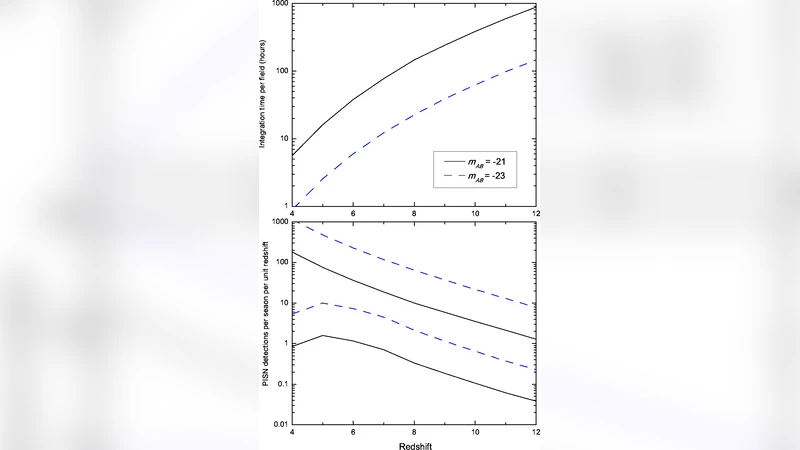
First‑generation star detection – The authors argue that pair‑instability supernovae (PISNe) from Population III stars should be observable in the near‑infrared out to redshifts of 12–15. With a 5σ point‑source limit of ≈25 mag in a one‑hour exposure, PILOT can conduct a wide‑area (≈1 000 deg² per year) survey to capture the rare, luminous PISNe. In parallel, rapid follow‑up of gamma‑ray burst (GRB) afterglows in the first minutes after trigger will enable the identification of GRBs at z > 10, providing a complementary probe of the earliest massive stars.
-
Search for evolved high‑z galaxies – By exploiting deep J‑ and K‑band imaging (≈26 mag, 5 h integration) over several thousand square degrees, PILOT can select Lyman‑break galaxies at z ≈ 7–9 using colour‑colour techniques. This wide‑field, moderate‑depth approach fills a niche between ultra‑deep, narrow JWST pointings and the shallower, wider surveys planned for Euclid and the Roman Space Telescope, delivering statistically robust samples to test models of early galaxy assembly and stellar mass buildup.
-
Optical study of intermediate‑z clusters – An optical (g′, r′, i′) survey targeting the 0.3 < z < 0.8 regime will map cluster richness, colour‑magnitude relations, and galaxy morphology with 0.2 arcsec resolution. The high‑quality imaging enables precise photometric redshifts and weak‑lensing mass estimates for thousands of clusters, improving constraints on the growth of structure and the influence of environment on galaxy evolution.
-
Large‑area weak‑lensing survey – Leveraging the stable PSF (≤0.3 arcsec) and high cadence, PILOT can image >5 000 deg² to the depth required for cosmic shear measurements. The Antarctic site’s low atmospheric turbulence reduces systematic PSF variations, a major source of error in ground‑based lensing studies. Combined with data from LSST and Euclid, PILOT’s shear catalog can tighten constraints on Ω_m and the dark‑energy equation‑of‑state parameter w to the sub‑percent level.
-
Infrared Type Ia supernova light‑curves – Near‑infrared observations of SNe Ia (1–2 µm) suffer far less from dust extinction and intrinsic colour variations than optical data. PILOT is projected to discover and monitor 200–300 SNe Ia per year in the 0.5 < z < 1.5 range, delivering high‑precision distance moduli that will reduce systematic uncertainties in the Hubble diagram and sharpen measurements of dark‑energy dynamics.
The paper details the required instrumentation (wide‑field IR camera, high‑resolution optical imager), survey strategies, and expected performance metrics. It also addresses logistical challenges unique to Antarctica—limited resupply windows, remote operation, and high‑volume data handling—proposing automated observatory control, on‑site data buffering, and satellite downlink as mitigation measures.
In summary, PILOT capitalises on Dome C’s unrivalled atmospheric conditions to provide a “high‑sensitivity, high‑resolution, high‑cadence” platform that bridges the gap between large space telescopes and next‑generation ground‑based surveys. Its five flagship programmes target the most pressing questions in modern cosmology: the formation of the first stars and galaxies, the evolution of large‑scale structure, and the nature of dark matter and dark energy. By delivering unique, complementary data sets, PILOT promises to play a pivotal role in the forthcoming era of precision cosmology.