VLT transit and occultation photometry for the bloated planet CoRoT-1b
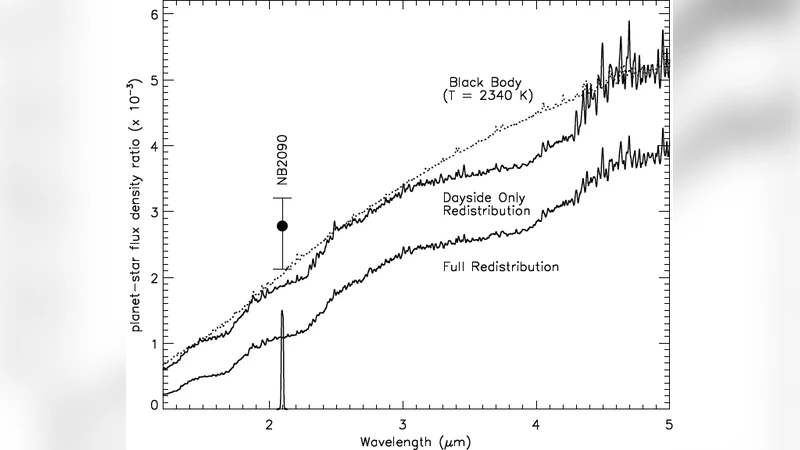
We present VLT eclipse photometry for the giant planet CoRoT-1b. We observed a transit in the R-band filter and an occultation in a narrow filter centered on 2.09 microns. Our analysis of this new photometry and published radial velocities, in combination with stellar-evolutionary modeling, leads to a planetary mass and radius of 1.07 (+0.13,-0.18) M_Jup and 1.45 (+0.07,-0.13) R_Jup, confirming the very low density previously deduced from CoRoT photometry. The large occultation depth that we measure at 2.09 microns (0.278 (+0.043,-0.066) %) is consistent with thermal emission and is better reproduced by an atmospheric model with no redistribution of the absorbed stellar flux to the night side of the planet.
💡 Research Summary
This paper presents high‑precision photometric observations of the transiting hot‑Jupiter CoRoT‑1b obtained with the Very Large Telescope (VLT). The authors recorded a transit in the optical R‑band and an occultation (secondary eclipse) in a narrow filter centered at 2.09 µm, a wavelength that probes the planet’s thermal emission. By combining these new light curves with previously published CoRoT space‑based photometry and radial‑velocity measurements, and by employing modern stellar‑evolution models to constrain the host star’s properties, the authors derived refined planetary parameters. The planet’s mass is determined to be 1.07 MJup (with +0.13/‑0.18 MJup uncertainty) and its radius 1.45 RJup (+0.07/‑0.13 RJup), confirming the extremely low bulk density (~0.35 g cm⁻³) inferred from earlier work.
The occultation depth measured at 2.09 µm is 0.278 % (±0.043/‑0.066 %). This relatively large signal is consistent with thermal radiation from a very hot dayside, implying a brightness temperature of roughly 2600 K. Atmospheric modeling using radiative‑transfer calculations shows that the observed depth is best reproduced by a model with negligible heat redistribution from the day side to the night side (i.e., a redistribution factor close to zero). Models that assume efficient redistribution underestimate the eclipse depth, indicating a strong day‑night temperature contrast.
Stellar parameters were refined using up‑to‑date isochrones (e.g., PARSEC, MIST), yielding a host star mass of ~0.95 M☉, radius of ~1.11 R☉, and near‑solar metallicity. These stellar constraints, together with the radial‑velocity semi‑amplitude, lead to the precise planetary mass quoted above.
The study demonstrates the power of ground‑based near‑infrared secondary‑eclipse measurements for probing the energy budget of highly irradiated exoplanets. The results confirm that CoRoT‑1b belongs to the class of “inflated” hot Jupiters, whose radii are larger than predicted by standard structural models, likely due to intense stellar irradiation and possibly additional internal heating mechanisms. The lack of efficient heat transport suggests weak atmospheric winds or a radiative upper atmosphere that limits energy redistribution.
Finally, the authors discuss the implications for future observations. The successful detection of a 2.09 µm eclipse with VLT paves the way for more extensive multi‑wavelength eclipse surveys using facilities such as JWST, ARIEL, and ground‑based high‑resolution spectrographs. Such observations will enable detailed spectroscopic characterization of atmospheric constituents (e.g., H₂O, CO, CH₄) and cloud properties, further elucidating the physics behind radius inflation and atmospheric dynamics in extreme hot‑Jupiter environments.
Comments & Academic Discussion
Loading comments...
Leave a Comment