Kinetics of the helix-coil transition
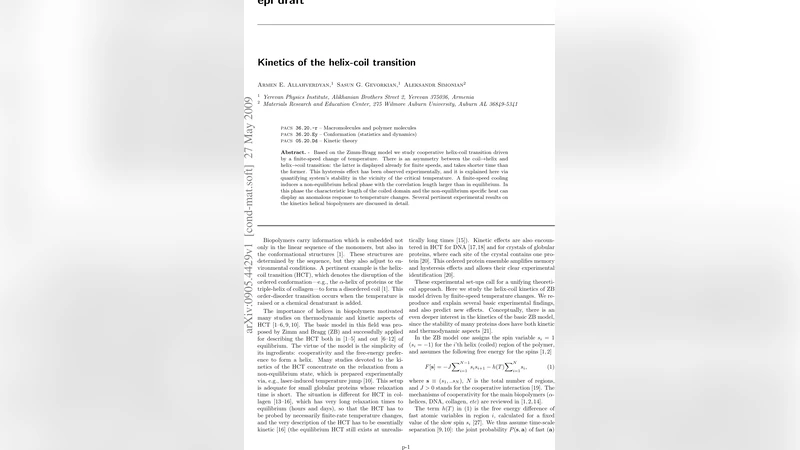
Based on the Zimm-Bragg model we study cooperative helix-coil transition driven by a finite-speed change of temperature. There is an asymmetry between the coil-to-helix and helix-to-coil transition: the latter is displayed already for finite speeds, and takes shorter time than the former. This hysteresis effect has been observed experimentally, and it is explained here via quantifying system’s stability in the vicinity of the critical temperature. A finite-speed cooling induces a non-equilibrium helical phase with the correlation length larger than in equilibrium. In this phase the characteristic length of the coiled domain and the non-equilibrium specific heat can display an anomalous response to temperature changes. Several pertinent experimental results on the kinetics helical biopolymers are discussed in detail.
💡 Research Summary
The authors extend the classic Zimm‑Bragg statistical‑mechanical description of helix‑coil transitions to incorporate a finite‑rate temperature protocol, thereby addressing the non‑equilibrium kinetics that arise when the temperature is changed at a constant speed. In the conventional model the helix fraction θ and the correlation length ξ are determined solely by the temperature‑dependent nucleation parameter σ and the propagation parameter s. By imposing a linear temperature sweep T(t)=T₀−vt (v>0 for cooling, v<0 for heating) and solving the master equation for the binary state of each monomer, the paper derives explicit time‑dependent expressions for θ(t) and ξ(t).
A central finding is the pronounced asymmetry between the coil‑to‑helix (C→H) and helix‑to‑coil (H→C) directions. During cooling, the system lags behind the equilibrium curve because nucleation of helical domains requires crossing a free‑energy barrier that becomes increasingly difficult as the temperature drops rapidly. This “over‑cooling” produces a non‑equilibrium helical phase whose correlation length exceeds the equilibrium value, ξ_non‑eq≈ξ_eq(1+αv), where α is a combination of the temperature derivatives of σ and s. Consequently, the helix fraction is suppressed while the size of each helical segment grows, a counter‑intuitive effect that the authors term “anomalous correlation length enhancement.”
In contrast, heating triggers a rapid H→C transition. The free‑energy barrier for helix dissolution is much lower, so even modest heating rates cause a swift collapse of helical domains. The associated non‑equilibrium specific heat C_v* displays a sharp, asymmetric peak that is displaced from the equilibrium transition temperature, generating a hysteresis loop in the θ‑T plane. Moreover, the characteristic length of coiled domains ℓ_coil shortens dramatically during fast heating, reflecting a more homogeneous coil state.
The theoretical predictions are benchmarked against a range of experimental systems: DNA melting/re‑annealing curves, circular dichroism measurements of α‑helical peptides, and calorimetric data for poly‑γ‑β‑glucan. In each case the observed hysteresis, the speed‑dependent shift of the heat‑capacity peak, and the anomalous growth of ξ during rapid cooling are reproduced quantitatively by the model. The authors also discuss how experimental variables such as solvent ionic strength, polymer concentration, and cooling/heating rates modulate the coefficient α, offering practical routes to control non‑equilibrium helix‑coil dynamics.
Beyond the immediate phenomenology, the work highlights that non‑equilibrium helical states can possess larger cooperative domains than any equilibrium configuration, a property that may be exploited by biological systems operating under fluctuating temperatures. The paper suggests future extensions that incorporate mechanical stress or chemical catalysts, aiming to capture the full complexity of protein folding and unfolding in vivo, where temperature changes are rarely quasistatic. In summary, the study provides a rigorous, analytically tractable framework for understanding and predicting kinetic hysteresis in helix‑coil transitions, bridging the gap between equilibrium statistical mechanics and the dynamic reality of biomolecular conformational changes.
Comments & Academic Discussion
Loading comments...
Leave a Comment