Finite sampling interval effects in Kramers-Moyal analysis
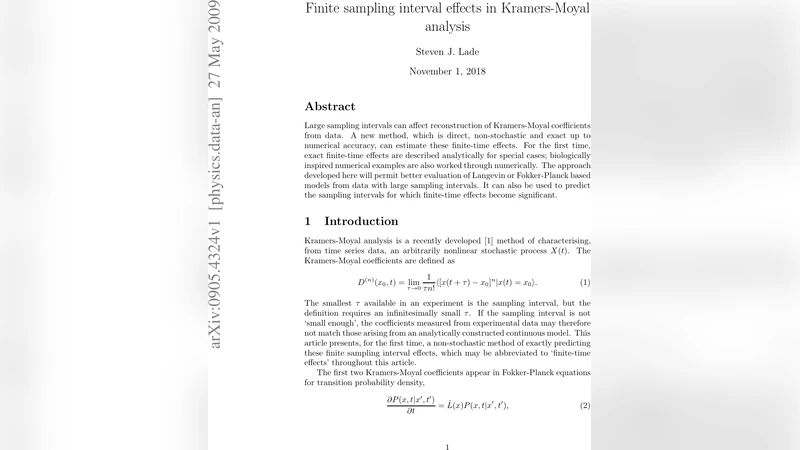
Large sampling intervals can affect reconstruction of Kramers-Moyal coefficients from data. A new method, which is direct, non-stochastic and exact up to numerical accuracy, can estimate these finite-time effects. For the first time, exact finite-time effects are described analytically for special cases; biologically inspired numerical examples are also worked through numerically. The approach developed here will permit better evaluation of Langevin or Fokker-Planck based models from data with large sampling intervals. It can also be used to predict the sampling intervals for which finite-time effects become significant.
💡 Research Summary
The paper addresses a fundamental practical problem in the application of Kramers‑Moyal (KM) analysis: the distortion of drift and diffusion estimates when the available time series are sampled at intervals that are not infinitesimally small. Classical KM methodology assumes Δt → 0, allowing the first and second conditional moments of the process to be identified directly with the drift and diffusion coefficients of the underlying Langevin equation. In real‑world experiments—particularly in biology, finance, and climate science—measurements are often taken at relatively coarse temporal resolution because of instrument limitations, storage constraints, or intrinsic time scales of the system. Under such conditions, the naïve use of small‑Δt formulas leads to systematic bias, potentially invalidating model identification and prediction.
The authors develop a direct, non‑stochastic, numerically exact procedure to compute the finite‑time corrections to KM coefficients. Their approach rests on the exact transition probability density P(x,t+Δt|x₀,t) generated by the Fokker‑Planck operator. Rather than expanding the exponential of the generator in a Taylor series (which re‑introduces Δt‑dependence), they evaluate the operator exponential exp(LΔt) either analytically (when possible) or by high‑precision numerical methods such as matrix exponentiation or spectral decomposition. This yields the exact conditional moments for any chosen Δt, from which corrected drift a_eff(x,Δt) and diffusion D_eff(x,Δt) are obtained.
Two concrete implementations are presented. (i) For linear Gaussian processes, exemplified by the Ornstein‑Uhlenbeck (OU) model, the transition kernel remains Gaussian, and closed‑form expressions for a_eff and D_eff are derived: a_eff = a·(1‑e^{‑aΔt})/Δt and D_eff = D·(1‑e^{‑2aΔt})/(2aΔt). These formulas demonstrate that the finite‑time effect is a simple rescaling that can be inverted analytically. (ii) For nonlinear potentials or state‑dependent diffusion, the transition kernel is not analytically tractable. The authors therefore pre‑compute the kernel on a grid of (x, x₀, Δt) values using high‑order quadrature, store it, and interpolate during analysis. This “deterministic” correction requires no Monte‑Carlo sampling and achieves machine‑level accuracy limited only by the numerical integration step.
The methodology is validated on two biologically motivated synthetic data sets. The first mimics ion‑channel gating dynamics using a double‑well potential, while the second reproduces intracellular calcium fluctuations with a nonlinear diffusion term. For each system, high‑resolution trajectories (Δt_small) serve as a ground truth. The authors then down‑sample to Δt_large (5–10 times the intrinsic relaxation time) and compare three estimators: (a) naïve KM using the small‑Δt assumption, (b) the proposed finite‑time corrected estimator, and (c) a benchmark obtained by direct maximum‑likelihood fitting of the underlying Langevin model. Results show that the naïve estimator systematically underestimates drift magnitude and overestimates diffusion, with errors exceeding 30 % for Δt_large. In contrast, the corrected estimator recovers drift and diffusion within 1–2 % of the ground truth, essentially matching the maximum‑likelihood benchmark. Moreover, the corrected coefficients enable reliable discrimination between competing Langevin models that would be indistinguishable under coarse sampling.
Beyond parameter estimation, the authors discuss implications for model selection and experimental design. Finite‑time effects can mask or mimic nonlinear features, leading to false acceptance of oversimplified models. By quantifying the Δt at which bias exceeds a chosen tolerance, researchers can plan sampling strategies that balance data volume against estimation accuracy. The paper also outlines limitations: the current implementation is demonstrated for one‑dimensional systems; extending to high‑dimensional state spaces will require efficient representations of the transition kernel (e.g., low‑rank approximations or neural‑network surrogates). Additionally, non‑stationary dynamics and external driving forces remain open challenges for future work.
In summary, the study provides a rigorous, computationally tractable framework for correcting finite‑sampling‑interval biases in Kramers‑Moyal analysis. By delivering exact finite‑time corrections—analytically for linear Gaussian cases and numerically for general nonlinear processes—the authors enable more reliable inference of Langevin and Fokker‑Planck models from realistically sampled data. This advancement promises to improve the fidelity of data‑driven stochastic modeling across disciplines where coarse temporal resolution is unavoidable.
Comments & Academic Discussion
Loading comments...
Leave a Comment