Building the Terrestrial Planets: Constrained Accretion in the Inner Solar System
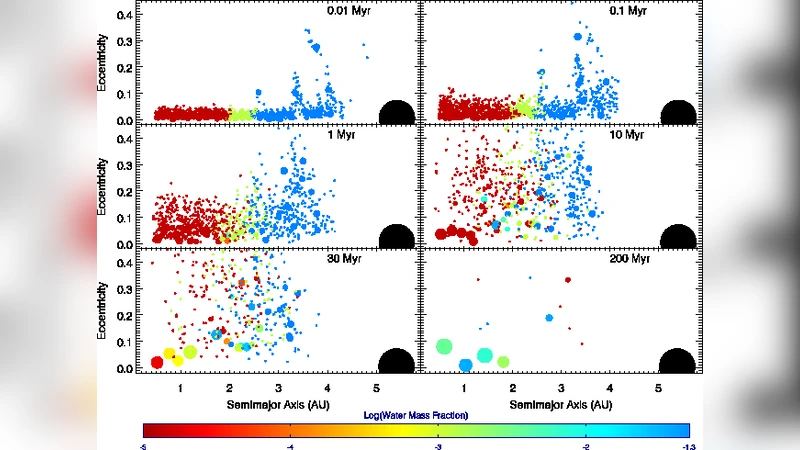
To date, no accretion model has succeeded in reproducing all observed constraints in the inner Solar System. These constraints include 1) the orbits, in particular the small eccentricities, and 2) the masses of the terrestrial planets – Mars’ relatively small mass in particular has not been adequately reproduced in previous simulations; 3) the formation timescales of Earth and Mars, as interpreted from Hf/W isotopes; 4) the bulk structure of the asteroid belt, in particular the lack of an imprint of planetary embryo-sized objects; and 5) Earth’s relatively large water content, assuming that it was delivered in the form of water-rich primitive asteroidal material. Here we present results of 40 high-resolution (N=1000-2000) dynamical simulations of late-stage planetary accretion with the goal of reproducing these constraints, although neglecting the planet Mercury. We assume that Jupiter and Saturn are fully-formed at the start of each simulation, and test orbital configurations that are both consistent with and contrary to the “Nice model.” We find that a configuration with Jupiter and Saturn on circular orbits forms low-eccentricity terrestrial planets and a water-rich Earth on the correct timescale, but Mars’ mass is too large by a factor of 5-10 and embryos are often stranded in the asteroid belt. A configuration with Jupiter and Saturn in their current locations but with slightly higher initial eccentricities (e = 0.07-0.1) produces a small Mars, an embryo-free asteroid belt, and a reasonable Earth analog but rarely allows water delivery to Earth. None of the configurations we tested reproduced all the observed constraints. (abridged)
💡 Research Summary
The paper tackles the long‑standing problem of reproducing the observed architecture of the inner Solar System—Earth, Venus, Mars and the asteroid belt—within a single accretion model. Five key constraints are identified: (1) low eccentricities of the terrestrial planets, (2) the actual masses, especially the small mass of Mars, (3) formation timescales inferred from Hf‑W isotopes (≈30–50 Myr for Earth, ≈1–10 Myr for Mars), (4) an asteroid belt that shows no evidence of surviving planetary embryos, and (5) Earth’s relatively high water content, presumed to be delivered by water‑rich primitive asteroids.
To explore whether different early configurations of the giant planets could satisfy these constraints, the authors performed 40 high‑resolution N‑body simulations of late‑stage accretion, each with 1,000–2,000 bodies representing planetary embryos and planetesimals distributed from 0.5 to 4 AU. Jupiter and Saturn are assumed fully formed at the start of each run, and two families of initial conditions are tested. The first family (CJS) places Jupiter and Saturn on nearly circular orbits, consistent with the classic Nice‑model pre‑instability configuration. The second family (EJS) keeps the planets at their present semimajor axes but gives them modest eccentricities (e ≈ 0.07–0.10).
In the CJS runs, the weak perturbations from the giants allow the inner disk to remain dynamically cold. Earth and Venus acquire low‑eccentricity orbits and accrete sufficient water‑bearing material from beyond 2.5 AU, matching the Earth‑water constraint. However, the same calm environment leads to excessive mass accumulation near 1.5 AU, producing a Mars analogue that is 5–10 times too massive, and leaves several embryo‑sized bodies stranded in the asteroid belt, contrary to observations.
Conversely, the EJS simulations generate strong secular resonances and mean‑motion resonances that sweep material out of the Mars‑forming region. This yields a Mars analogue with the correct small mass and clears the asteroid belt of large embryos, satisfying constraints (2), (3) and (4). The downside is that the same resonances act as a barrier to the inward transport of water‑rich planetesimals, so Earth ends up dramatically drier than the real planet, violating constraint (5).
Both sets of simulations are evaluated against Hf‑W chronometry. The CJS cases reproduce Earth’s formation timescale but fail on Mars’s mass; the EJS cases get Mars’s mass right but often produce Earth analogues that form too slowly or lack sufficient water. No single configuration meets all five constraints simultaneously.
The authors conclude that the inner Solar System’s final architecture cannot be explained solely by varying the initial eccentricities of Jupiter and Saturn. Additional processes—such as non‑uniform initial disk mass distributions, residual gas drag, early dynamical instabilities involving other planetary embryos, or a more complex migration history for the giant planets—are likely required. The study highlights the delicate balance between dynamical excitation (which helps limit Mars’s growth and clean the asteroid belt) and material transport (which is essential for delivering water to Earth). Future work should incorporate these extra physical ingredients and compare the outcomes with the growing body of isotopic and dynamical constraints.
Comments & Academic Discussion
Loading comments...
Leave a Comment