Sky Surface Brightness at Mount Graham: UBVRI Science Observations with the Large Binocular Telescope
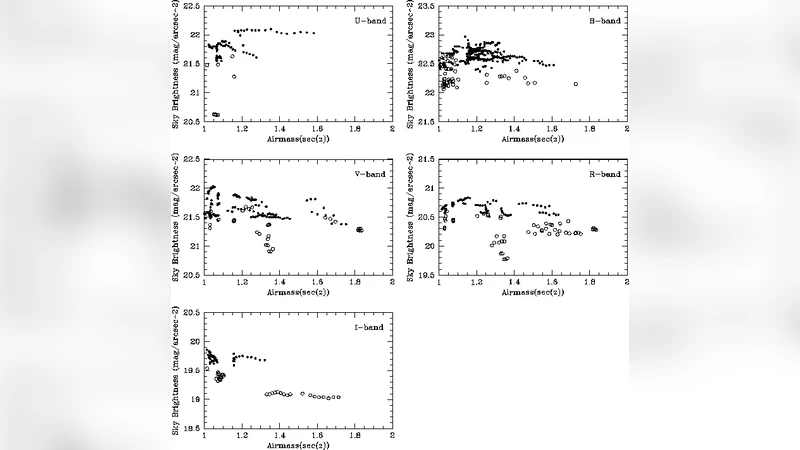
We present the measurements of sky surface brightness on Mount Graham International Observatory obtained during the first binocular-mode science runs at the Large Binocular Telescope (LBT). A total of 860 images obtained on 23 moonless nights in the period Feb 2008-Jun 2008 were analyzed with our data quality assessment procedure. These data, taken at the solar minimum, show that Mt.Graham, in photometric conditions, still has one of the darkest skies, competing with the other first-class observatories. The zenith-corrected values are 21.98, 22.81, 21.81, 20.82 and 19.78 mag/arcsec^2 in U, B, V R and I, respectively. In photometric conditions, the sky background is ~0.1 mag/arcsec^2 higher than the median when observing toward Tucson and Phoenix but it may be up to ~0.5 mag/arcsec^2 higher in non-photometric conditions. The sky at Mt.Graham is ~0.32 mag/arcsec^2 brighter at airmass ~1.4 than at zenith but no significant trend was found with the time of the night. We demonstrated the dependence of the sky background at Mt.Graham on the solar activity for the first time. In fact in 2008, at B and V bands, the sky was ~0.3 mag /arcsec^2 darker than in 1999-2002. With these results we conclude that Mt.Graham is still a first-class observing site, comparable to the darkest sites in Hawaii, Chile and Canary Islands.
💡 Research Summary
This paper presents a comprehensive assessment of the night‑sky surface brightness at the Mount Graham International Observatory (MGIO) based on data collected during the first binocular‑mode science runs of the Large Binocular Telescope (LBT). A total of 860 images obtained over 23 moonless, photometric nights between February and June 2008 were processed through an automated data‑quality pipeline that removes electronic bias, dark current, and point‑source contamination, yielding reliable background measurements for each exposure. The authors applied airmass corrections to reference all values to the zenith and incorporated the contemporaneous 10.7 cm solar radio flux as a proxy for solar activity, enabling a comparison with earlier measurements taken during higher solar activity periods (1999‑2002).
The zenith‑corrected sky brightness values are 21.98 mag arcsec⁻² in U, 22.81 mag arcsec⁻² in B, 21.81 mag arcsec⁻² in V, 20.82 mag arcsec⁻² in R, and 19.78 mag arcsec⁻² in I. These figures place MGIO among the darkest sites worldwide, comparable to the premier observatories in Hawaii (Mauna Kea, Mauna Loa), Chile (Cerro Paranal, La Silla), and the Canary Islands (Teide, Roque de los Muchachos).
Directional analysis shows that observations toward Tucson and Phoenix are on average 0.1 mag arcsec⁻² brighter than the median, while non‑photometric conditions (e.g., thin clouds, elevated aerosol content) can increase the background by up to 0.5 mag arcsec⁻². The airmass dependence is modest but measurable: at an airmass of ~1.4 (≈45° elevation) the sky is on average 0.32 mag arcsec⁻² brighter than at the zenith, reflecting the longer atmospheric path and enhanced Rayleigh‑Mie scattering. No statistically significant trend with time of night was detected, indicating that neither nocturnal human activity nor rapid atmospheric changes substantially affect the background at this site.
A key result is the demonstrated correlation between sky brightness and solar activity. Because the 2008 observations were taken near solar minimum, the B and V band backgrounds are about 0.3 mag arcsec⁻² darker than those recorded during the 1999‑2002 period, which coincided with higher solar flux. This confirms that airglow—primarily driven by upper‑atmospheric oxygen and nitrogen emissions—varies with the solar cycle, an effect that must be accounted for in long‑term exposure‑time calculators and scheduling tools.
From an operational perspective, the authors argue that the quantified sky brightness directly informs exposure‑time planning for LBT and other large‑aperture facilities. Darker skies reduce the integration time needed to achieve a given signal‑to‑noise ratio, thereby increasing the overall scientific throughput. Moreover, the modest azimuthal dependence suggests that strategic scheduling (e.g., avoiding low‑elevation pointings toward nearby cities) can further optimize observing efficiency.
The study concludes that MGIO remains a first‑class observing site, with sky conditions that rival the best global locations. To preserve this status, the authors recommend continued enforcement of light‑pollution mitigation measures (shielded lighting, curfews), systematic monitoring of atmospheric transparency and aerosol content, and periodic re‑evaluation of sky brightness in relation to the 11‑year solar cycle. Such proactive site management will ensure that MGIO continues to support high‑precision optical and near‑infrared astronomy for the next generation of large telescopes.
Comments & Academic Discussion
Loading comments...
Leave a Comment