Exact corrections for finite-time drift and diffusion coefficients
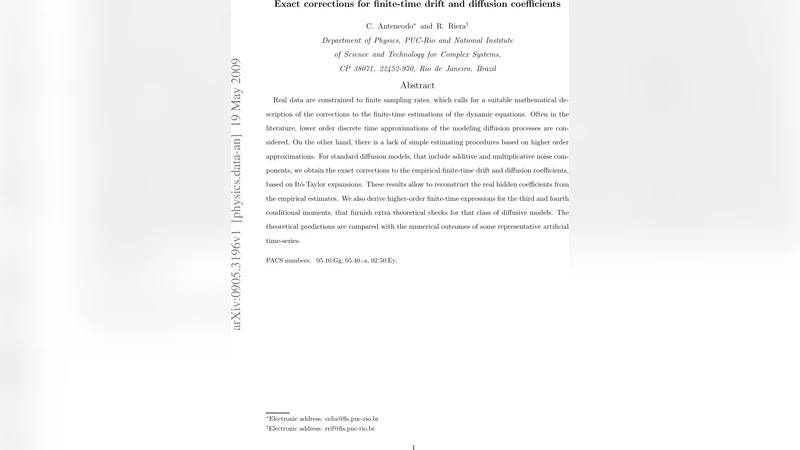
Real data are constrained to finite sampling rates, which calls for a suitable mathematical description of the corrections to the finite-time estimations of the dynamic equations. Often in the literature, lower order discrete time approximations of the modeling diffusion processes are considered. On the other hand, there is a lack of simple estimating procedures based on higher order approximations. For standard diffusion models, that include additive and multiplicative noise components, we obtain the exact corrections to the empirical finite-time drift and diffusion coefficients, based on It^o-Taylor expansions. These results allow to reconstruct the real hidden coefficients from the empirical estimates. We also derive higher-order finite-time expressions for the third and fourth conditional moments, that furnish extra theoretical checks for that class of diffusive models. The theoretical predictions are compared with the numerical outcomes of some representative artificial time-series.
💡 Research Summary
The paper addresses a fundamental problem in the empirical analysis of stochastic differential equations (SDEs): real-world time series are recorded at finite sampling intervals (Δt), which inevitably introduces systematic biases into the estimated drift and diffusion coefficients. While many studies rely on low‑order discrete approximations such as the Euler‑Maruyama scheme, these methods become inaccurate when Δt is not sufficiently small, a situation common in experimental, financial, and environmental data.
To overcome this limitation, the authors employ a full Itô‑Taylor expansion of the SDE up to high order in Δt. By systematically expanding the increment ΔX over a single sampling step, they derive exact correction formulas for the empirical first and second conditional moments (the finite‑time estimates of drift D̂₁(x) and diffusion D̂₂(x)). The corrections take the form of series in Δt whose coefficients are explicit functions of the true drift D₁(x), diffusion D₂(x), and their derivatives. Symbolically,
D̂₁(x) = D₁(x) + a₁(x)Δt + a₂(x)Δt² + …,
D̂₂(x) = D₂(x) + b₁(x)Δt + b₂(x)Δt² + …,
where aₖ(x) and bₖ(x) are combinations of D₁, D₂, D₁′, D₂′, etc. Crucially, these series can be inverted analytically, allowing one to reconstruct the hidden continuous‑time coefficients D₁ and D₂ directly from the measured D̂₁, D̂₂ and the known sampling interval. The paper treats both additive noise (constant σ₀) and multiplicative noise (σ₁·x) and provides compact expressions for the correction terms in these common cases.
Beyond the first two moments, the authors also derive finite‑time expressions for the third and fourth conditional moments, M₃(x,Δt) and M₄(x,Δt). For standard diffusion processes these higher‑order moments have known theoretical values (e.g., M₃ should vanish, M₄ should equal 3D₂² for Gaussian increments). The derived formulas therefore supply an additional consistency check: after correcting D̂₁ and D̂₂, one can compute M₃ and M₄ from the data and verify whether they match the theoretical predictions, thereby confirming the adequacy of the chosen SDE model.
The theoretical results are validated through extensive numerical experiments. Three representative models are examined: (i) the Ornstein‑Uhlenbeck process (linear drift, additive noise), (ii) geometric Brownian motion (multiplicative noise), and (iii) a synthetic nonlinear SDE featuring both additive and multiplicative components. For each model, synthetic time series are generated at several Δt values (0.01, 0.05, 0.1). The authors compare the traditional first‑order correction (ignoring higher‑order terms) with their full high‑order correction. Across all cases, the high‑order scheme dramatically reduces the mean‑square error of the reconstructed drift and diffusion, especially when Δt is as large as 0.1. The improvement is most pronounced for the nonlinear, mixed‑noise model, where low‑order approximations fail to capture the curvature of D₁ and the state‑dependence of D₂.
Finally, the paper outlines a practical workflow for applying the methodology to real data: (1) segment the time series into intervals of length Δt, (2) compute empirical conditional means and variances to obtain D̂₁ and D̂₂, (3) apply the derived inversion formulas to recover D₁ and D₂, (4) evaluate the corrected third and fourth moments as model diagnostics, and (5) optionally refine parameter estimates via maximum‑likelihood or Bayesian techniques using the corrected coefficients. This pipeline is readily implementable in standard data‑analysis environments and can be extended to multidimensional SDEs with minor modifications.
In summary, the authors provide a mathematically rigorous, yet computationally tractable, solution to the finite‑time sampling problem in diffusion processes. By delivering exact correction terms up to arbitrary order in Δt and demonstrating their practical utility, the work significantly advances the reliability of drift‑diffusion inference from discretely sampled data, opening new possibilities for accurate modeling in physics, finance, biology, and beyond.
Comments & Academic Discussion
Loading comments...
Leave a Comment