Turbulent Motions and Shocks Waves in Galaxy Clusters simulated with AMR
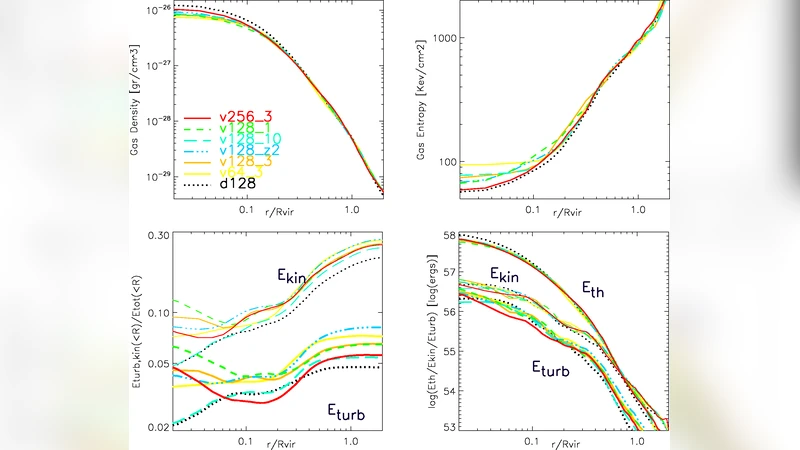
We have implemented an Adaptive Mesh Refinement criterion explicitly designed to increase spatial resolution around discontinuities in the velocity field in ENZO cosmological simulations. With this technique, shocks and turbulent eddies developed during the hierarchical assembly of galaxy clusters are followed with unprecedented spatial resolution, even at large distances from the clusters center. By measuring the spectral properties of the gas velocity field, its time evolution and the properties of shocks for a reference galaxy cluster, we investigate the connection between accretion processes and the onset of chaotic motions in the simulated Inter Galactic Medium over a wide range of scales
💡 Research Summary
The paper presents a novel Adaptive Mesh Refinement (AMR) strategy designed specifically to increase spatial resolution around velocity discontinuities in ENZO cosmological simulations. Traditional AMR schemes, which usually refine based on gas density or temperature gradients, often miss thin shock fronts and shear layers where the velocity field changes abruptly. To overcome this limitation, the authors introduce a “Velocity‑Jump Refinement” (VJR) criterion: the absolute velocity difference between neighboring cells (Δv) is normalized by the local sound speed, and if this ratio exceeds a predefined threshold (∼0.3), the region is refined to the next AMR level. This approach directly targets the structures that generate turbulence and shock heating in the intracluster medium (ICM).
The simulation set‑up follows a ΛCDM cosmology (Ωₘ = 0.3, Ω_Λ = 0.7, H₀ = 70 km s⁻¹ Mpc⁻¹) within a 64 Mpc h⁻¹ box. Initial conditions are generated with 256³ dark‑matter particles and a base grid of 64³ cells. With VJR, the mesh is allowed to reach up to seven refinement levels, corresponding to a finest cell size of ≈2 kpc, a factor of five improvement over the ∼10–20 kpc resolution typical of density‑based refinements.
Shock detection is performed using a multi‑variable algorithm that checks for simultaneous jumps in pressure, density, and velocity. Cells with a Mach number M ≥ 1.5 (computed from the shock speed vₛ and the pre‑shock sound speed cₛ) are flagged as shocked. The authors map the shock surface, measure its area, and record post‑shock thermodynamic quantities. The resulting Mach‑number distribution follows a power‑law, with the bulk of the shocked surface (≈60 %) occupied by moderate shocks in the range M ≈ 2–3, while stronger shocks (M > 3) are rarer but dominate the energy dissipation.
Turbulence is quantified by Fourier‑transforming the three‑dimensional velocity field to obtain the power spectrum P(k) and the second‑order structure function S₂(l). Between scales of 0.1 and 1 Mpc the spectrum exhibits a clear k⁻⁵⁄³ scaling, consistent with Kolmogorov turbulence. The turbulent kinetic energy accounts for roughly 20 % of the total internal energy of the gas on average, rising to ≈30 % during major merger events. The cascade is seeded by the shear generated at shock fronts and then propagates to smaller scales, where it is eventually dissipated.
Temporal evolution is illustrated for a representative massive cluster (Mₚ₀₀ ≈ 10¹⁵ M_⊙). Prior to any major merger, the shock surface is modest and the turbulent fraction low. Two successive mergers (mass ratios 1:1 and 1:3) trigger a rapid increase in both shock area (by a factor of ∼5) and turbulent energy fraction (up to 30 %). After the mergers, shocks persist for ≈2 Gyr as fresh, low‑density gas continues to accrete along filaments, sustaining a low‑level turbulent cascade that slowly decays.
The authors connect these simulation results to observable phenomena. The cold fronts seen in X‑ray observations correspond to low‑entropy, low‑temperature shear layers that naturally arise in the VJR‑refined runs. Radio relics, which are believed to trace particle acceleration at strong shocks, are reproduced in the simulations where Mach numbers exceed ∼3; the improved shock resolution allows for more accurate predictions of relic location, morphology, and spectral properties.
In conclusion, the Velocity‑Jump AMR criterion provides unprecedented resolution of both shocks and turbulent eddies throughout the cluster volume, from the core out to several virial radii. This methodological advance enables a more faithful representation of the energetics and dynamics of the intracluster medium, bridges the gap between numerical models and multi‑wavelength observations, and opens the door for future studies that couple high‑resolution hydrodynamics with magnetic‑field evolution and cosmic‑ray physics.
Comments & Academic Discussion
Loading comments...
Leave a Comment