Secular increase of the Astronomical Unit: a possible explanation in terms of the total angular momentum conservation law
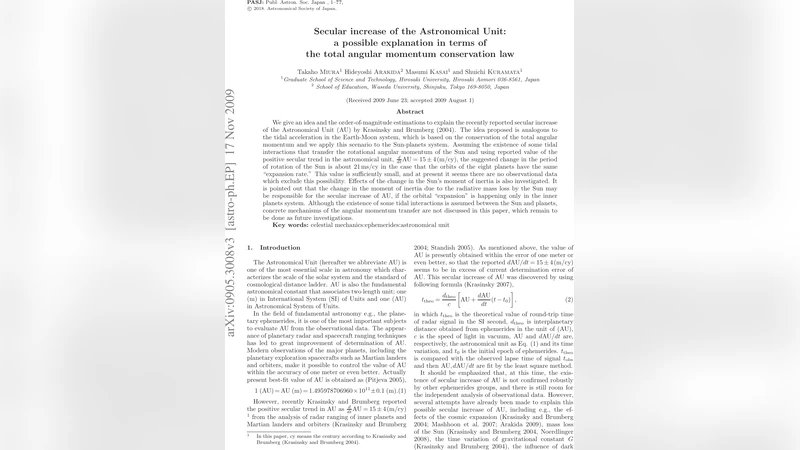
We give an idea and the order-of-magnitude estimations to explain the recently reported secular increase of the Astronomical Unit (AU) by Krasinsky and Brumberg (2004). The idea proposed is analogous to the tidal acceleration in the Earth-Moon system, which is based on the conservation of the total angular momentum and we apply this scenario to the Sun-planets system. Assuming the existence of some tidal interactions that transfer the rotational angular momentum of the Sun and using reported value of the positive secular trend in the astronomical unit, $\frac{d}{dt}{AU} = 15 \pm 4 {(m/cy)}$, the suggested change in the period of rotation of the Sun is about $21 {ms/cy}$ in the case that the orbits of the eight planets have the same “expansion rate.” This value is sufficiently small, and at present it seems there are no observational data which exclude this possibility. Effects of the change in the Sun’s moment of inertia is also investigated. It is pointed out that the change in the moment of inertia due to the radiative mass loss by the Sun may be responsible for the secular increase of AU, if the orbital “expansion” is happening only in the inner planets system. Although the existence of some tidal interactions is assumed between the Sun and planets, concrete mechanisms of the angular momentum transfer are not discussed in this paper, which remain to be done as future investigations.
💡 Research Summary
The paper addresses the puzzling observation reported by Krasinsky and Brumberg (2004) that the astronomical unit (AU) appears to be increasing at a rate of 15 ± 4 m per century. The authors propose an explanation that parallels the tidal acceleration observed in the Earth‑Moon system, invoking the conservation of total angular momentum in the Sun‑planet system. In the Earth‑Moon case, tidal torques transfer Earth’s rotational angular momentum to the Moon’s orbital motion, causing Earth’s spin to slow and the Moon’s orbit to expand. By analogy, the authors hypothesize that some form of tidal‑like interaction between the Sun and the planets gradually transfers a fraction of the Sun’s rotational angular momentum to the planetary orbital angular momentum.
The central assumption is that the total angular momentum
L_total = L_sun,rot + ∑ L_planet,orb
remains constant. Differentiating with respect to time and setting dL_total/dt = 0 yields a relationship between the Sun’s spin‑down rate (dΩ_sun/dt) and the secular change in the planetary semi‑major axes (da_i/dt). If all planetary orbits expand at the same fractional rate, the average increase in the orbital radius of the eight planets can be identified with the observed AU growth. Substituting the measured value (≈ 15 m century⁻¹) into the derived expression gives an estimated increase in the Sun’s rotation period of roughly 21 ms per century. This change is far below the current precision of helioseismic or surface‑feature measurements, so it is not presently excluded by observations.
The authors also examine the effect of the Sun’s decreasing moment of inertia due to radiative mass loss. The Sun loses mass at a rate of about 9 × 10⁻¹⁴ yr⁻¹, which reduces its moment of inertia I_sun. A decreasing I_sun would tend to increase the Sun’s spin rate, partially offsetting the spin‑down caused by angular‑momentum transfer. If the AU expansion is confined to the inner planets (Mercury through Mars), the mass‑loss‑induced change in I_sun could be sufficient to account for the observed secular increase without invoking any exotic tidal mechanism.
A major limitation of the study is the lack of a concrete physical mechanism for the Sun‑planet angular‑momentum exchange. Possible candidates—magnetohydrodynamic waves in the solar interior, plasma drag from the solar wind, or resonant interactions between the solar magnetic field and planetary magnetospheres—are mentioned only in passing. Quantifying the efficiency of any such process would require sophisticated MHD simulations and long‑term observational constraints that are currently unavailable.
The paper concludes that, while the angular‑momentum‑conservation framework provides a simple and internally consistent way to translate the observed AU drift into a minute solar spin‑down, the hypothesis remains speculative. Future work must (i) obtain more precise, independent measurements of the Sun’s rotation period over centuries, (ii) track planetary semi‑major axes with independent techniques (e.g., laser ranging to spacecraft), and (iii) develop detailed models of non‑gravitational Sun‑planet couplings. Only with such data can the proposed tidal‑analogy explanation be tested, refined, or ruled out.
Comments & Academic Discussion
Loading comments...
Leave a Comment