First Results from the CHEPS: Exoplanets and the Discovery of an Eccentric Brown Dwarf in the Desert
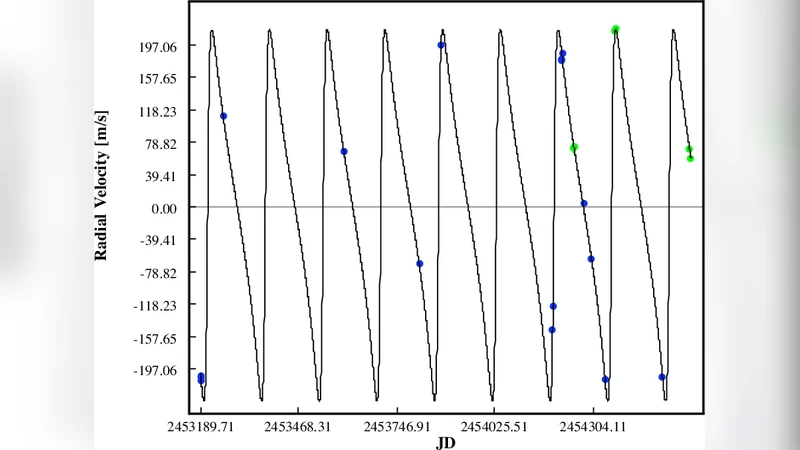
We report the discovery of a brown dwarf on an eccentric orbit and with a semimajor axis that places it in the brown dwarf desert region around the star HD191760. The star has a spectral type of G3IV/V and a metallicity ([Fe/H]) of 0.29 dex. HD191760 adds to the small number of metal-rich stars with brown dwarf companions. The brown dwarf (HD191760b) is found to have an orbital period of 505.57+/-0.40 days and semimajor axis of 1.35+/-0.01 AU, placing it firmly in the brown dwarf desert. The eccentricity of HD191760b is found to be 0.63+/-0.01, meaning it reaches as close as 0.5 AU from the host star. Dynamical simulations indicate that no inner planets could reside at separations beyond ~0.17 AU due to the disastrous gravity imposed by HD191760b. In addition to these first results we also refine the orbits found for the exoplanets around the stars HD48265, HD143361 and HD154672. All 1-planet solutions are in agreement with those previously published by the Magellan Planet Search.
💡 Research Summary
The paper presents the first results from the Calan‑Harvard‑ESO Planet Search (CHEPS), focusing on the detection of a massive sub‑stellar companion in the so‑called brown‑dwarf desert and on the refinement of three previously known exoplanetary systems. The target star HD 191760 is a metal‑rich (
Comments & Academic Discussion
Loading comments...
Leave a Comment