Dynamic Monte Carlo radiation transfer in SPH. Radiation pressure force implementation
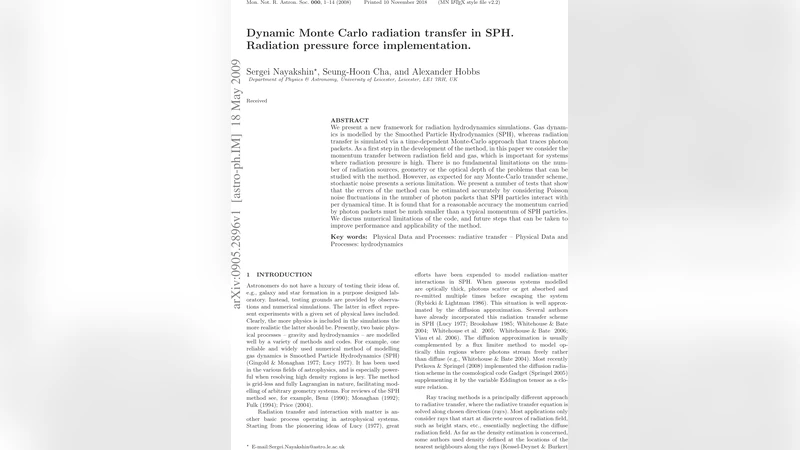
We present a new framework for radiation hydrodynamics simulations. Gas dynamics is modelled by the Smoothed Particle Hydrodynamics (SPH) method, whereas radiation transfer is simulated via a time-dependent Monte-Carlo approach that traces photon packets. As a first step in the development of the method, in this paper we consider the momentum transfer between radiation field and gas, which is important for systems where radiation pressure is high. There is no fundamental limitations on the number of radiation sources, geometry or the optical depth of the problems that can be studied with the method. However, as expected for any Monte-Carlo transfer scheme, stochastic noise presents a serious limitation. We present a number of tests that show that the errors of the method can be estimated accurately by considering Poisson noise fluctuations in the number of photon packets that SPH particles interact with per dynamical time. It is found that for a reasonable accuracy the momentum carried by photon packets must be much smaller than a typical momentum of SPH particles. We discuss numerical limitations of the code, and future steps that can be taken to improve performance and applicability of the method.
💡 Research Summary
The paper introduces a novel radiation‑hydrodynamics framework that couples Smoothed Particle Hydrodynamics (SPH) for gas dynamics with a time‑dependent Monte‑Carlo (MC) scheme for radiation transport. In this first implementation the authors focus exclusively on the momentum exchange between radiation and gas, i.e., radiation pressure, which is crucial in many astrophysical environments such as massive star formation, super‑Eddington accretion flows, and AGN feedback.
The method treats radiation as discrete photon packets. Each packet carries an energy (E_{\gamma}) and a corresponding momentum (p_{\gamma}=E_{\gamma}/c). Packets are emitted from any number of sources with random directions drawn from the appropriate angular distribution. As a packet traverses the simulation domain it interacts with SPH particles according to the local opacity (absorption plus scattering). The optical depth (\tau) along the packet’s path through a particle’s smoothing kernel is computed, and a stochastic decision is made whether the packet is absorbed, scattered, or transmitted. When an interaction occurs, the packet’s momentum change is transferred to the SPH particle, ensuring strict momentum conservation. The packet may then be re‑emitted with a new direction (in the case of scattering) or terminated (in the case of absorption). Time stepping is adaptive: the MC step size is limited by the mean free path of the packets and by the Courant condition of the SPH particles, guaranteeing that radiation and hydrodynamics remain synchronized.
A central concern of any MC approach is statistical noise. The authors develop a quantitative error model based on Poisson fluctuations in the number of packet‑particle interactions per dynamical time. If a particle experiences (N) interactions, the relative error in the momentum transfer scales as (\sqrt{N}/N). From a series of controlled tests they infer a practical guideline: the momentum carried by an individual packet must be at least an order of magnitude smaller than the typical momentum of an SPH particle. This ensures that the stochastic noise remains well below the physical signal.
The paper validates the scheme with several benchmark problems. First, a static slab illuminated by a uniform radiation field reproduces the analytic radiation‑pressure force to within the predicted Poisson error. Second, a dusty sphere with known analytical pressure profiles demonstrates that the method handles spherical symmetry and varying optical depth correctly. Third, a multi‑source configuration with complex geometry shows that the algorithm imposes no restrictions on source number or arrangement. Finally, a high‑optical‑depth test (τ ≫ 1) confirms that energy and momentum are conserved even when packets undergo many scatterings before escaping. In all cases the measured errors match the Poisson‑based estimates, confirming the reliability of the error model.
Performance analysis reveals that computational cost scales linearly with the total number of photon packets, as expected for MC methods. Nevertheless, the authors achieve high parallel efficiency (>80 %) on multi‑core CPUs by distributing packets across processors. Memory usage remains modest because packets are short‑lived and can be recycled after interaction.
The discussion acknowledges current limitations. The present implementation treats only radiation pressure; radiative heating, cooling, and frequency‑dependent opacities are not yet included. Moreover, the requirement that packet momentum be much smaller than SPH particle momentum can lead to a large number of packets for high‑resolution simulations, increasing runtime. The authors propose several avenues for improvement: importance sampling to concentrate packets where gradients are steep, weight‑based resampling (splitting/merging) to control packet numbers, and GPU acceleration to exploit massive parallelism inherent in MC transport.
In summary, the work delivers a flexible, source‑agnostic, and geometry‑independent radiation‑pressure module for SPH that is rigorously benchmarked and equipped with a clear statistical error framework. By addressing the identified performance bottlenecks, the method promises to become a powerful tool for studying radiation‑dominated astrophysical phenomena ranging from star‑forming regions to active galactic nuclei.
Comments & Academic Discussion
Loading comments...
Leave a Comment