Asteroid Confusions with Extremely Large Telescopes
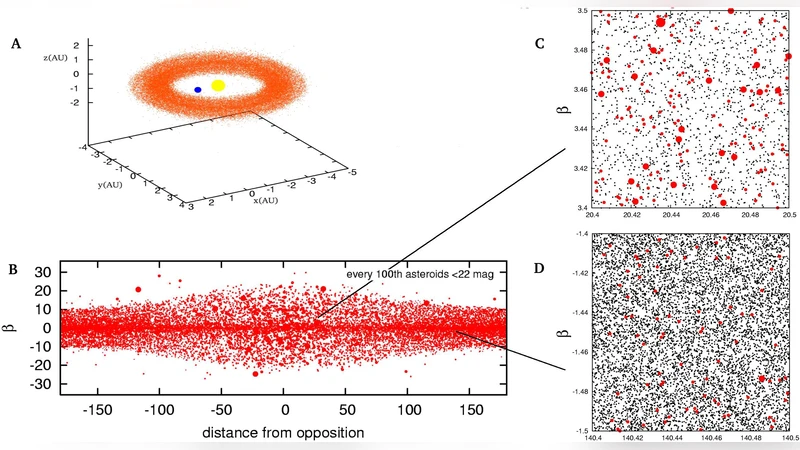
Asteroids can be considered as sources of contamination of point sources and also sources of confusion noise, depending whether their presence is detected in the image or their flux is under the detection limit. We estimate that at low ecliptic latitudes, ~10,000–20,000 asteroids/sq. degree will be detected with an E-ELT like telescope, while by the end of Spitzer and Herschel missions, infrared space observatories will provide ~100,000 serendipitous asteroid detections. The detection and identification of asteroids is therefore an important step in survey astronomy.
💡 Research Summary
The paper investigates the impact of asteroids on large‑scale astronomical surveys carried out with extremely large telescopes (ELTs) such as the European Extremely Large Telescope (E‑ELT) and with infrared space observatories, specifically Spitzer and Herschel. Asteroids can act either as contaminating point sources that are mistakenly identified as astrophysical objects or as a source of confusion noise when their flux falls below the detection threshold but still contributes to the background.
Using existing asteroid orbital distributions, size‑frequency relations, and albedo statistics, the authors model the sky density of asteroids as a function of ecliptic latitude and apparent magnitude in both optical (0.5–2 µm) and infrared (24–70 µm) bands. They find that at low ecliptic latitudes (near the ecliptic plane) the surface density of detectable asteroids is high enough that an ELT with a 39 m primary mirror and a diffraction‑limited resolution of ~0.01 arcsec would resolve roughly 10 000–20 000 asteroids per square degree. This number exceeds previous estimates based on smaller telescopes by a factor of one to two, indicating that asteroid contamination will be a significant issue for deep, high‑resolution imaging surveys, especially in crowded fields such as galaxy cluster cores or star‑forming regions.
For infrared space missions, the situation is different but equally important. The thermal emission of asteroids peaks in the 70–160 µm range, which coincides with the most sensitive bands of Herschel’s PACS and SPIRE instruments. By combining the instruments’ sensitivities (5σ ≈ 0.1 mJy) with the mission‑wide scanning strategies, the authors estimate that the Spitzer and Herschel programs will serendipitously detect on the order of 100 000 asteroids by the end of their operational lifetimes. Most of these detections will be at flux levels near the detection limit, meaning that many will appear as faint, moving sources that can be easily missed in standard static‑source pipelines.
The paper then explores the consequences of these asteroid detections for data reduction and scientific analysis. Moving asteroids produce trailed point‑spread functions (PSFs) when multiple exposures are co‑added, leading to systematic biases in PSF modeling, background estimation, and source extraction. In optical surveys, bright asteroids can be mistaken for stars or compact galaxies, inflating source counts and affecting luminosity function measurements. In infrared surveys, unresolved asteroid flux adds a low‑level, spatially varying noise component that can masquerade as diffuse emission from interstellar dust or high‑redshift galaxies.
To mitigate these effects, the authors propose a multi‑pronged strategy: (1) cross‑match observed fields with existing asteroid catalogs (e.g., the Minor Planet Center database) prior to source extraction; (2) employ multi‑band observations to exploit the distinct spectral energy distributions of asteroids versus astrophysical sources; (3) incorporate realistic asteroid trail simulations into image‑processing pipelines to identify and mask trailed detections; and (4) schedule observations preferentially at higher ecliptic latitudes where asteroid surface densities are lower. They also suggest that future survey designs should allocate a fraction of observing time to dedicated asteroid monitoring, which would improve the completeness of asteroid catalogs and reduce the risk of contamination in primary science programs.
In summary, the study demonstrates that asteroids constitute a non‑negligible source of both point‑source contamination and confusion noise for next‑generation ground‑based ELTs and for infrared space missions. Accurate identification and removal of asteroid signals are essential steps in the data‑processing chain to preserve the scientific integrity of large‑scale surveys, ranging from galaxy evolution studies to exoplanet direct imaging. The paper’s quantitative estimates and recommended mitigation techniques provide a valuable framework for astronomers planning future high‑precision, high‑throughput observational campaigns.
Comments & Academic Discussion
Loading comments...
Leave a Comment