A Super-Earth caught in a trap
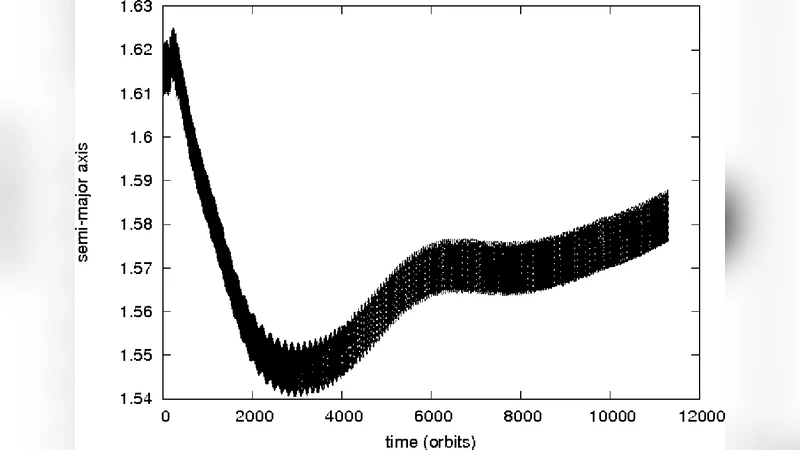
This paper is an extension of the work done by Pierens & Nelson (2008) in which they have investigated the behaviour of a two-planet system embedded in a protoplanetary disc. They have put a Jupiter mass gas giant on the internal orbit and a lower mass planet on the external one. We consider here a similar problem taking into account a gas giant with masses in the range of 0.5 to 1 Jupiter mass and a Super-Earth as the outermost planet. By changing disc parameters and planet masses we have succeeded in getting the convergent migration which allows for the possibility of their resonant locking. However, in the case in which the gas giant has the mass of Jupiter, before any mean motion first order commensurability could be achieved, the Super-Earth is caught in a trap when it is very close to the edge of the gap opened by the giant planet. This confirms the result obtained by Pierens & Nelson (2008) in their simulations. Additionally, we have found that, in a very thin disc, an apsidal resonance is observed in the system if the Super-Earth is captured in the trap. Moreover, the eccentricity of the small planet remains low, while that of the gas giant increases slightly due to the imbalance between Lindblad and corotational resonances. We have also studied analogous systems in which the gas giant is allowed to take Sub-Jupiter masses. In this case, after performing an extensive survey over all possible parameters, we have succeeded in getting the 1:2 mean motion resonant configuration only in a disc with low aspect ratio and low surface density. However, the resonance is maintained just for few thousand orbits. Thus, we conclude that for typical protoplanetary discs the mean motion commensurabilities are rare if the Super-Earth is located on the external orbit relative to the gas giant. (abridged)
💡 Research Summary
This paper extends the work of Pierens & Nelson (2008) by investigating the orbital evolution of a two‑planet system embedded in a protoplanetary disc, where a gas giant occupies the inner orbit and a Super‑Earth (≈5–10 M⊕) the outer one. The authors explore a range of gas‑giant masses (0.5–1 MJ) and systematically vary disc parameters—aspect ratio (h = H/r), surface density (Σ₀), and viscosity (α = 10⁻³)—using two‑dimensional hydrodynamic simulations (FARGO). Their goal is to determine under which conditions convergent migration can bring the planets into a first‑order mean‑motion resonance (MMR), such as the 1:2 commensurability.
Key findings are as follows:
-
Gap‑edge trapping dominates for a Jupiter‑mass giant. When the inner planet has a mass of 1 MJ, it opens a deep, wide gap in the disc. The outer Super‑Earth migrates inward under the action of a positive Lindblad torque, but as it approaches the outer edge of the gap it encounters a steep pressure gradient and a strong positive corotation torque. This creates a “trap” that halts further inward migration. Consequently, the Super‑Earth never reaches the location required for a 1:2 (or any other first‑order) MMR with the giant. This reproduces the “gap‑edge trap” reported by Pierens & Nelson.
-
Apsidal (secular) resonance in very thin discs. In discs with a very low aspect ratio (h ≈ 0.03) the trap is even more effective, and the two planets become locked in an apsidal resonance: the difference of their longitudes of pericentre (Δϖ) librates around 0°. In this configuration the Super‑Earth’s eccentricity remains low (e ≲ 0.01), while the giant’s eccentricity grows modestly (e ≈ 0.02–0.03) due to an imbalance between Lindblad and corotation torques.
-
Sub‑Jupiter giants allow temporary MMR capture. Reducing the giant’s mass to 0.5 MJ (a “Sub‑Jupiter”) weakens the gap and the associated trap. In a disc that is both thin (h ≈ 0.04) and of low surface density (Σ₀ ≈ 8–10 g cm⁻²), the Super‑Earth can cross the gap edge and become locked in a 1:2 MMR. However, the resonance is fragile: after a few thousand orbital periods (∼3 × 10³ orbits) the resonant angles begin to circulate as viscous diffusion and wave damping erode the resonant torque balance. The system then drifts out of resonance.
-
Parameter space for stable resonances is narrow. An extensive survey of disc aspect ratios, surface densities, and planetary masses shows that stable first‑order MMRs only appear in a limited region of parameter space: thin, low‑mass discs combined with a Sub‑Jupiter inner planet. For more typical disc conditions (h ≈ 0.05, Σ₀ ≈ 15–20 g cm⁻²) the gap‑edge trap prevents resonance capture altogether.
-
Implications for observed exoplanetary architectures. The rarity of resonant configurations when the Super‑Earth lies exterior to a massive gas giant suggests that many observed systems with a close‑in giant and a more distant low‑mass planet are unlikely to be in a first‑order MMR. The presence of an apsidal resonance in thin discs may be detectable through precise measurements of pericentre alignment, but such discs are expected to be short‑lived.
Overall, the study concludes that, under realistic protoplanetary disc conditions, convergent migration leading to mean‑motion commensurabilities between an outer Super‑Earth and an inner gas giant is uncommon. The dominant dynamical barrier is the gap‑edge trap created by the giant’s gap, and only in unusually thin, low‑density discs with a sub‑Jupiter inner planet can a temporary 1:2 resonance be achieved, and even then it is short‑lived. The work highlights the importance of disc structure and planetary mass ratios in shaping the final orbital architecture of planetary systems.
Comments & Academic Discussion
Loading comments...
Leave a Comment