Finding the best proxies for the solar UV irradiance
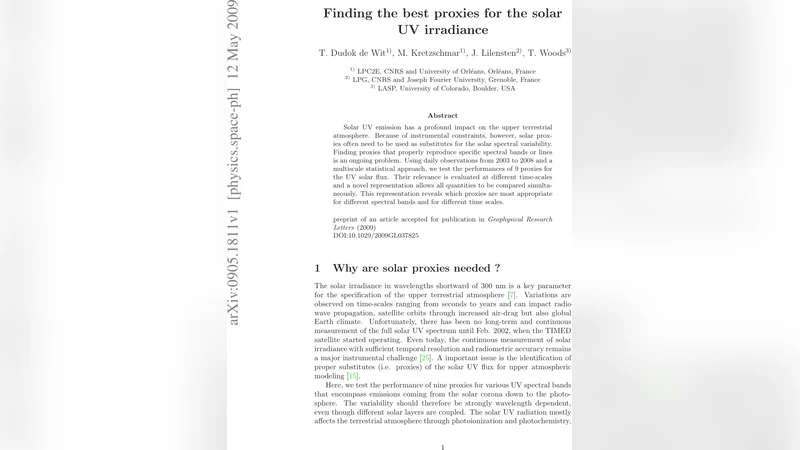
Solar UV emission has a profound impact on the upper terrestrial atmosphere. Because of instrumental constraints, however, solar proxies often need to be used as substitutes for the solar spectral variability. Finding proxies that properly reproduce specific spectral bands or lines is an ongoing problem. Using daily observations from 2003 to 2008 and a multiscale statistical approach, we test the performances of 9 proxies for the UV solar flux. Their relevance is evaluated at different time-scales and a novel representation allows all quantities to be compared simultaneously. This representation reveals which proxies are most appropriate for different spectral bands and for different time scales.
💡 Research Summary
The paper addresses a fundamental challenge in space‑weather and atmospheric science: how to reliably substitute direct measurements of solar ultraviolet (UV) irradiance with more readily available solar proxies. Direct UV observations are limited by instrument degradation, calibration drifts, and gaps in coverage, especially in the far‑UV (115–180 nm) and middle‑UV (180–300 nm) ranges that drive photochemistry in the mesosphere and thermosphere. The authors therefore evaluate nine widely used proxies—F10.7 cm radio flux, F30 cm flux, Mg II core‑to‑wing index, Ca II K index, S10.7, Lyman‑α flux, SORCE‑SOLSTICE measurements, and two newer indices—against daily solar UV spectra recorded between 2003 and 2008, a period that spans both solar minimum and the rising phase of solar cycle 23.
Methodology
A multiscale statistical framework is employed. Each time series (both proxies and UV spectral bands) is decomposed using continuous wavelet transform (CWT) into three dominant temporal scales: (i) the solar rotation scale (~27 days), (ii) an intermediate scale of a few months to a year, and (iii) a long‑term scale of 1–2 years that captures the solar‑cycle trend. For each scale, the authors compute Pearson and Spearman correlation coefficients, linear regression slopes, and the coefficient of determination (R²) between each proxy and three UV wavelength bands (115‑180 nm, 180‑240 nm, 240‑300 nm). To visualise the high‑dimensional relationships, they apply multidimensional scaling (MDS) and hierarchical clustering, producing a “proxy‑wavelength‑time” map where colour intensity encodes R² values.
Key Findings
-
Band‑specific performance
- Mg II core‑to‑wing index shows the strongest correlation for the 180‑240 nm band across all scales (R² > 0.8), making it the best surrogate for the middle‑UV that controls ozone production.
- Lyman‑α and SORCE‑SOLSTICE excel in reproducing long‑term trends in the far‑UV (115‑180 nm) but underperform on the rotation scale (R² ≈ 0.4–0.5).
- F10.7 provides a reasonably uniform, though modest, correlation across all bands (R² ≈ 0.6–0.7), but it systematically underestimates rotational variability in the 240‑300 nm range, which is important for heating rates in the lower thermosphere.
-
Scale‑dependent behaviour
- On the 27‑day rotation scale, proxies that are directly linked to chromospheric emission (Mg II, Ca II K) capture the rapid variability better than radio‑flux proxies.
- For intermediate scales (3–6 months), the combination of Mg II and Ca II K retains high skill, while the radio proxies lag due to their smoother response.
- At the longest scales (≥ 1 year), all proxies converge toward similar R² values, reflecting the dominance of the solar‑cycle envelope; however, Lyman‑α remains uniquely sensitive to the far‑UV component.
-
Proxy clustering
- MDS reveals three distinct clusters: (a) radio‑flux proxies (F10.7, F30) that are broadly correlated with all UV bands but lack fine‑scale fidelity; (b) chromospheric indices (Mg II, Ca II K) that specialize in the middle‑UV and capture rotational dynamics; (c) far‑UV specific proxies (Lyman‑α, SOLSTICE) that dominate the long‑term far‑UV reconstruction.
Novel Representation
The authors introduce a “proxy‑wavelength‑time matrix” where rows correspond to the three UV bands, columns to the three temporal scales, and each cell is colour‑coded by the R² of a given proxy. This compact visual tool allows researchers to instantly identify the optimal proxy (or proxy combination) for a specific modelling need—e.g., selecting Mg II for short‑term middle‑UV forcing in a chemistry‑climate model, or Lyman‑α for long‑term far‑UV forcing in thermospheric density forecasts.
Implications
The study demonstrates that no single proxy can universally replace UV measurements across all wavelengths and timescales. Modelers must therefore tailor their proxy selection to the spectral band of interest and the temporal resolution required. The multiscale approach also highlights that proxy performance can be dramatically different when examined at rotational versus solar‑cycle scales, a nuance often overlooked in previous validation studies.
Future Directions
The framework can be extended to newer datasets (e.g., SDO/EVE, GOES‑R) and to incorporate machine‑learning techniques that blend multiple proxies into a composite predictor. Additionally, the methodology could be applied to reconstruct historical UV irradiance before the satellite era by calibrating proxies against limited ground‑based observations.
In summary, by dissecting proxy‑UV relationships across wavelength and time, the paper provides a rigorous, practical guide for selecting the most appropriate solar proxy for atmospheric and space‑weather applications, and introduces a visual analytics tool that streamlines this decision‑making process.
Comments & Academic Discussion
Loading comments...
Leave a Comment