Dynamics of a microorganism moving by chemotaxis in its own secretion
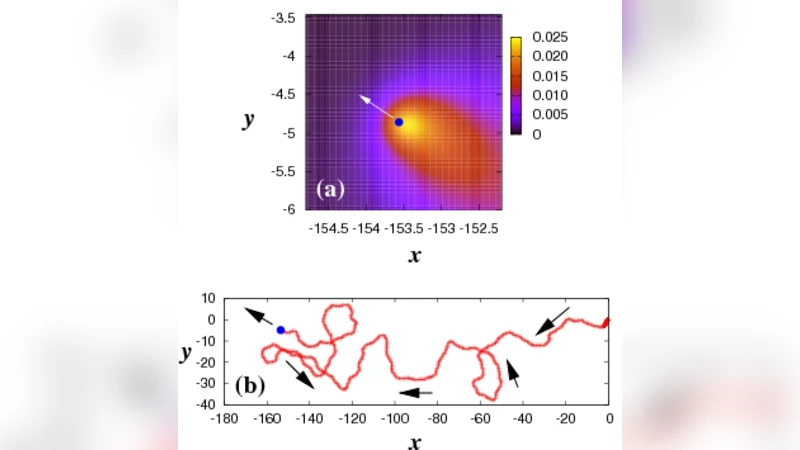
The Brownian dynamics of a single microorganism coupled by chemotaxis to a diffusing concentration field which is secreted by the microorganism itself is studied by computer simulations in spatial dimensions $d=1,2,3$. Both cases of a chemoattractant and a chemorepellent are discussed. For a chemoattractant, we find a transient dynamical arrest until the microorganism diffuses for long times. For a chemorepellent, there is a transient ballistic motion in all dimensions and a long-time diffusion. These results are interpreted with the help of a theoretical analysis.
💡 Research Summary
The paper investigates the stochastic dynamics of a solitary microorganism that interacts chemotactically with a concentration field it secretes itself. The authors formulate a coupled set of equations: an overdamped Langevin equation for the particle’s position r(t) with diffusion coefficient D_r and a chemotactic drift term χ∇c(r(t),t), and a diffusion equation for the chemical concentration c(r,t) with diffusion coefficient D_c, a point source of strength λ located at the particle’s instantaneous position. The chemotactic coupling constant χ determines whether the chemical acts as an attractant (χ > 0) or a repellent (χ < 0).
Using Brownian dynamics simulations in one, two, and three spatial dimensions, the authors explore a broad parameter space (varying χ, D_c/D_r, and source strength λ). They monitor the mean‑squared displacement (MSD) ⟨|r(t)−r(0)|²⟩ and velocity autocorrelation functions to characterize the motion.
For attractant chemotaxis, the particle quickly becomes trapped in the high‑concentration cloud it creates. The MSD exhibits a sub‑diffusive regime (⟨Δr²⟩ ∝ t^α with α < 1) that can be interpreted as a transient dynamical arrest. The arrest is more pronounced in lower dimensions because the diffusing chemical returns to the particle’s vicinity more efficiently. After a crossover time that grows with |χ| and decreases with D_c, the particle resumes normal diffusion, but with an effective diffusion coefficient D_eff significantly reduced relative to the bare D_r.
In contrast, for repellent chemotaxis the particle experiences a self‑generated low‑concentration region and is pushed away from it. The MSD initially follows a ballistic law (⟨Δr²⟩ ∝ t²), indicating a transient persistent motion. This ballistic regime is essentially dimension‑independent and lasts until the chemical gradient smooths out by diffusion. Beyond this period the motion again becomes diffusive, with a diffusion constant that may be slightly enhanced compared with the attractant case because the effective friction is temporarily lowered.
The authors complement the simulations with an analytical treatment based on the Green’s function G(r,t) of the diffusion equation. By integrating out the concentration field they obtain a memory kernel K(t) = χ G(0,t) that enters the effective Langevin equation as a time‑dependent friction term. For χ > 0 the kernel is positive and increases the friction, producing a self‑generated potential well that traps the particle. For χ < 0 the kernel is negative, temporarily reducing friction and yielding self‑propulsion. Laplace‑transform analysis yields stability conditions 1 + χ Ĝ(0,s) > 0 (attractant) and 1 − |χ| Ĝ(0,s) > 0 (repellent). The dimensional dependence follows from the asymptotic behavior of G(0,t) ∝ t^{-d/2}; in d ≤ 2 the kernel decays slowly, leading to long‑lived trapping or ballistic phases, whereas in d = 3 the kernel decays rapidly and the transient regimes are shorter.
Overall, the study demonstrates that a single organism can generate complex, time‑dependent motility patterns solely through feedback with its own secreted chemical field. The transient dynamical arrest for attractants and the transient ballistic motion for repellents are both rooted in the non‑Markovian memory introduced by the self‑generated gradient. These findings extend the conventional picture of chemotaxis, which usually assumes an externally imposed chemical landscape, and suggest new mechanisms for pattern formation in microbial populations and for designing self‑propelled synthetic swimmers that exploit autochemotactic feedback. Future work is proposed to address many‑body interactions, nonlinear reaction kinetics, and more realistic environmental rheology, which could further enrich the phenomenology uncovered here.
Comments & Academic Discussion
Loading comments...
Leave a Comment