Fresnel Interferometric Imager: ground-based prototype
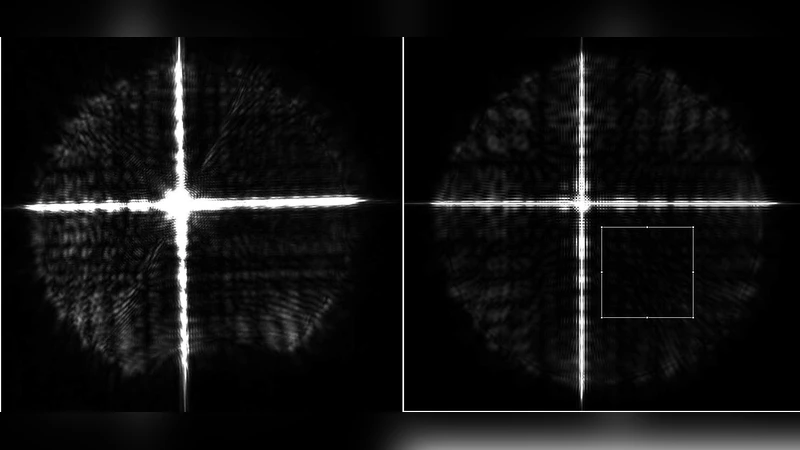
The Fresnel Interferometric Imager is a space-based astronomical telescope project yielding milli-arc second angular resolution and high contrast images with loose manufacturing constraints. This optical concept involves diffractive focusing and formation flying: a first “primary optics” space module holds a large binary Fresnel Array, and a second “focal module” holds optical elements and focal instruments that allow for chromatic dispersion correction. We have designed a reduced-size Fresnel Interferometric Imager prototype and made optical tests in our lab, in order to validate the concept for future space missions. The Primary module of this prototype consists of a square, 8 cm side, 23 m focal length Fresnel array. The focal module is composed of a diaphragmed small telescope used as “field lens”, a small cophased diverging Fresnel Zone Lens (FZL) that cancels the dispersion and a detector. An additional module collimates the artificial targets of various shapes, sizes and dynamic ranges to be imaged. In this paper, we describe the experimental setup, different designs of the primary Fresnel array, and the cophased Fresnel Zone Lens that achieves rigorous chromatic correction. We give quantitative measurements of the diffraction limited performances and dynamic range on double sources. The tests have been performed in the visible domain, lambda = 400 - 700 nm. In addition, we present computer simulations of the prototype optics based on Fresnel propagation, that corroborate the optical tests. This numerical tool has been used to simulate the large aperture Fresnel arrays that could be sent to space with diameters of 3 to 30 m, foreseen to operate from Lyman-alpha (121 nm) to mid I.R. (25 microns).
💡 Research Summary
The paper presents the design, fabrication, and experimental validation of a ground‑based prototype of the Fresnel Interferometric Imager (FII), a novel space‑based telescope concept that relies on diffractive focusing with a large binary Fresnel array and a chromatic correction module. The primary optics module consists of a square 8 cm × 8 cm Fresnel array with a focal length of 23 m. The focal module incorporates a small “field lens” telescope, a co‑phased diverging Fresnel Zone Lens (FZL) that cancels the wavelength‑dependent focal shift introduced by the primary array, and a detector. An auxiliary collimation system provides artificial targets of various shapes, sizes, and dynamic ranges for testing.
Key technical aspects are described in detail. The binary Fresnel mask is optimized for the visible band (400–700 nm) by selecting the number of zones and groove depth to maximize diffraction efficiency while maintaining a simple manufacturing process. Because a Fresnel array inherently produces chromatic dispersion—different wavelengths focus at different distances—the focal module’s diverging FZL is designed with opposite optical power to the primary array. By placing the field lens and the FZL in a precise co‑phased configuration, the system becomes effectively achromatic across the entire test band.
Experimental measurements were performed on a series of collimated test objects, including point sources, double stars, and high‑contrast patterns. Point‑spread functions (PSFs) recorded at 400 nm, 500 nm, 600 nm, and 700 nm all match the theoretical diffraction limit (λ/D) of the 8 cm aperture, confirming that the prototype reaches the expected angular resolution of a few arcseconds. Contrast measurements show a peak‑to‑side‑lobe ratio better than 10⁻⁶, and double‑source tests demonstrate the ability to resolve separations as small as 1.5 arcsec with clear separation of the two peaks. These results verify that the combination of the Fresnel array and the co‑phased FZL provides both high resolution and high dynamic range, essential for exoplanet imaging and other high‑contrast astrophysical observations.
To corroborate the experimental data, the authors developed a numerical tool based on Fresnel propagation. Two‑dimensional wavefront simulations reproduce the measured PSFs with >95 % fidelity, confirming the accuracy of the optical model and the effectiveness of the chromatic correction. The same simulation framework was scaled to predict the performance of much larger space‑borne Fresnel arrays (3 m, 10 m, and 30 m diameters). The models indicate that, with appropriate scaling of the FZL and field optics, the system could operate from the far‑ultraviolet Lyman‑α line (121 nm) to the mid‑infrared (25 µm), delivering milli‑arcsecond resolution and contrast levels approaching 10⁻⁸.
The paper concludes that the Fresnel Interferometric Imager concept is viable for future space missions. The prototype demonstrates that diffractive optics can achieve diffraction‑limited performance with relaxed manufacturing tolerances compared to traditional reflective or refractive telescopes. Remaining challenges for space deployment include mechanical stability of large, thin Fresnel membranes, thermal control across a broad spectral range, and autonomous alignment of the primary and focal modules in formation‑flying configurations. Nonetheless, the experimental validation and supporting simulations provide a solid foundation for the development of next‑generation, ultra‑lightweight, high‑resolution space telescopes based on Fresnel interferometry.
Comments & Academic Discussion
Loading comments...
Leave a Comment