A near-infrared excess in the continuum of high-redshift galaxies: a tracer of star formation and circumstellar disks?
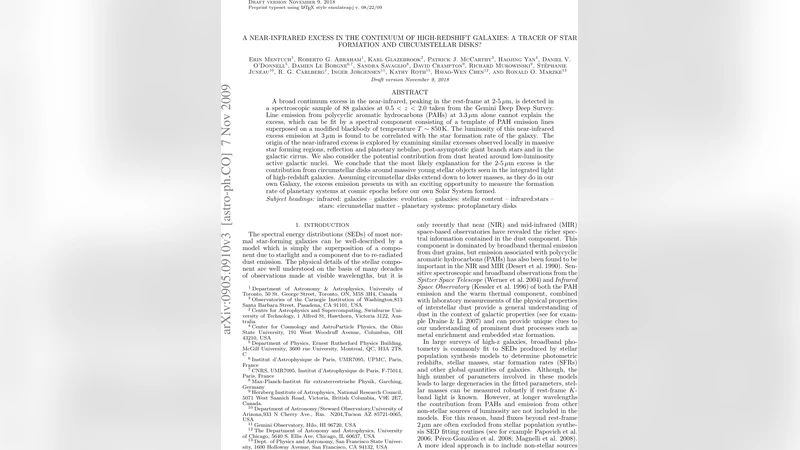
A broad continuum excess in the near-infrared, peaking in the rest-frame at 2-5 micron, is detected in a spectroscopic sample of 88 galaxies at 0.5<z<2.0 taken from the Gemini Deep Deep Survey. Line emission from polycyclic aromatic hydrocarbons (PAHs) at 3.3 micron alone cannot explain the excess, which can be fit by a spectral component consisting of a template of PAH emission lines superposed on a modified blackbody of temperature T~850 K. The luminosity of this near-infrared excess emission at 3 micron is found to be correlated with the star formation rate of the galaxy. The origin of the near-infrared excess is explored by examining similar excesses observed locally in massive star forming regions, reflection and planetary nebulae, post-asymptotic giant branch stars and in the galactic cirrus. We also consider the potential contribution from dust heated around low-luminosity active galactic nuclei. We conclude that the most likely explanation for the 2-5 micron excess is the contribution from circumstellar disks around massive young stellar objects seen in the integrated light of high-redshift galaxies. Assuming circumstellar disks extend down to lower masses, as they do in our own Galaxy, the excess emission presents us with an exciting opportunity to measure the formation rate of planetary systems at cosmic epochs before our own solar system formed.
💡 Research Summary
The authors present a systematic investigation of a broad near‑infrared (NIR) continuum excess observed in a spectroscopic sample of 88 galaxies drawn from the Gemini Deep Deep Survey (GDDS) spanning redshifts 0.5 < z < 2.0. By stacking the rest‑frame spectra they identify a pronounced excess that peaks between 2 µm and 5 µm, a wavelength range that is not accounted for by the well‑known 3.3 µm polycyclic aromatic hydrocarbon (PAH) emission line alone. To model the excess they adopt a two‑component fit: a modified blackbody with an emissivity proportional to λ⁻¹ and a temperature of roughly 850 K, plus a PAH template that reproduces the discrete aromatic features. This composite model reproduces the observed shape and amplitude of the excess across the entire sample, achieving low χ² values and, crucially, matching the continuum level at ∼3 µm where the PAH contribution is strongest.
The authors then explore the physical origin of the excess by correlating the 3 µm excess luminosity (L₃µm) with independent star‑formation rate (SFR) indicators such as Hα, UV+IR, and far‑infrared luminosities. They find a near‑linear relationship, L₃µm ∝ SFR¹·⁰⁴, indicating that the NIR excess scales directly with the galaxy’s current star‑forming activity. This tight correlation argues against rare or stochastic phenomena and points toward a component that is ubiquitous in star‑forming systems.
A comprehensive review of possible contributors is presented. Thermal emission from large H II regions or giant molecular clouds is dismissed because their dust temperatures (∼100–300 K) are far too low to produce the observed 850 K blackbody. Reflection nebulae and planetary nebulae can reach higher temperatures but are too scarce and would not scale with SFR in the observed manner. Post‑asymptotic‑giant‑branch (post‑AGB) stars and the diffuse Galactic cirrus also fail to reproduce both the spectral shape and the luminosity budget. Low‑luminosity active galactic nuclei (AGN) could in principle heat dust to several hundred kelvin, yet the majority of the GDDS galaxies lack AGN signatures in optical or X‑ray diagnostics, and the required covering factor would be unrealistically large.
The most compelling explanation is emission from circumstellar disks surrounding massive young stellar objects (YSOs). Such disks contain hot inner rims where dust reaches temperatures of 800–1000 K, naturally yielding a modified blackbody component at ∼850 K. They also host PAH molecules that produce the observed aromatic features. Importantly, the number of massive YSOs—and therefore the total disk surface area—scales with the global SFR, providing a natural mechanism for the observed L₃µm–SFR correlation. If the disk population extends down to lower‑mass stars, as is the case in the Milky Way, the integrated NIR excess could serve as a proxy for the overall rate of planetary‑system formation in distant galaxies.
The paper concludes that the 2–5 µm NIR excess in high‑redshift galaxies is most plausibly dominated by thermal emission from circumstellar disks around massive YSOs, with a secondary contribution from PAH line emission. This interpretation opens a novel avenue for probing the early stages of planet formation on cosmological timescales, well before the epoch of the Solar System. The authors suggest that forthcoming facilities such as the James Webb Space Telescope (JWST) will be able to resolve the individual disk spectra in high‑z galaxies, allowing direct measurement of the disk temperature distribution and, ultimately, a quantitative assessment of the cosmic history of planetary system assembly.