A Giant Crater on 90 Antiope?
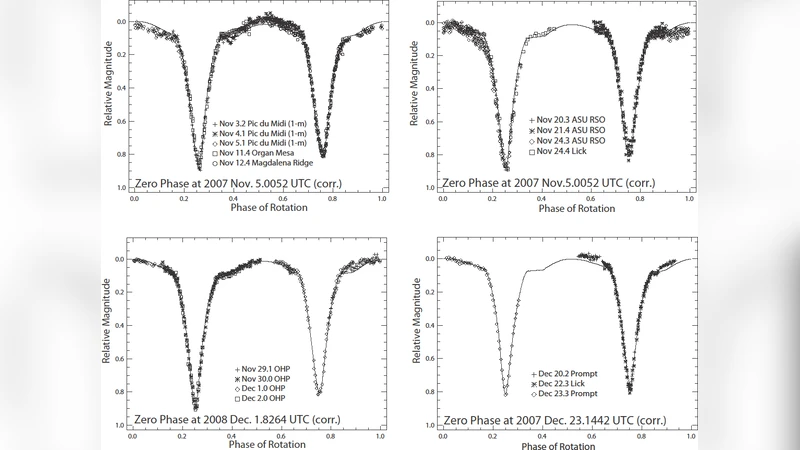
Mutual event observations between the two components of 90 Antiope were carried out in 2007-2008. The pole position was refined to lambda0 = 199.5+/-0.5 eg and beta0 = 39.8+/-5 deg in J2000 ecliptic coordinates, leaving intact the physical solution for the components, assimilated to two perfect Roche ellipsoids, and derived after the 2005 mutual event season (Descamps et al., 2007). Furthermore, a large-scale geological depression, located on one of the components, was introduced to better match the observed lightcurves. This vast geological feature of about 68 km in diameter, which could be postulated as a bowl-shaped impact crater, is indeed responsible of the photometric asymmetries seen on the “shoulders” of the lightcurves. The bulk density was then recomputed to 1.28+/-0.04 gcm-3 to take into account this large-scale non-convexity. This giant crater could be the aftermath of a tremendous collision of a 100-km sized proto-Antiope with another Themis family member. This statement is supported by the fact that Antiope is sufficiently porous (~50%) to survive such an impact without being wholly destroyed. This violent shock would have then imparted enough angular momentum for fissioning of proto-Antiope into two equisized bodies. We calculated that the impactor must have a diameter greater than ~17 km, for an impact velocity ranging between 1 and 4 km/s. With such a projectile, this event has a substantial 50% probability to have occurred over the age of the Themis family.
💡 Research Summary
The paper presents a comprehensive re‑analysis of the binary asteroid 90 Antiope using mutual‑event photometry obtained during the 2007–2008 observing seasons. By fitting the timing and depth of the eclipses and occultations, the authors refined the pole orientation of the system to λ₀ = 199.5° ± 0.5° and β₀ = 39.8° ± 5° (J2000 ecliptic), confirming the earlier solution that treats both components as perfect Roche ellipsoids derived after the 2005 mutual‑event season (Descamps et al., 2007).
However, the new light curves display a systematic asymmetry on the “shoulders” of the brightness variations that cannot be reproduced by a purely convex Roche model. To resolve this discrepancy, the authors introduced a large non‑convex depression on the surface of one component. The feature is modeled as a bowl‑shaped impact crater with a diameter of roughly 68 km and an estimated depth of about 10 km. Incorporating this crater into the shape model successfully reproduces the observed photometric asymmetries.
Because the crater removes a non‑negligible volume from the primary, the overall bulk density of the system must be revised. Using the updated volume, the authors calculate a bulk density of 1.28 ± 0.04 g cm⁻³, slightly lower than the previously reported 1.33 g cm⁻³. This density, combined with the measured mass, implies a macroporosity of approximately 50 %, indicating that the bodies are highly fractured and contain substantial void space.
The paper then explores a plausible formation scenario for both the crater and the binary configuration. The authors propose that the present system originated from a single ~100‑km‑diameter proto‑Antiope that suffered a catastrophic impact with another member of the Themis family. Dynamical calculations show that an impactor larger than ~17 km in diameter, striking at a relative velocity between 1 and 4 km s⁻¹, would deliver enough kinetic energy to excavate a crater of the observed size and, more importantly, to inject a sufficient amount of angular momentum into the proto‑body. This angular‑momentum boost could spin the proto‑Antiope up to the critical rotation rate at which it would fission into two nearly equal‑mass components, naturally explaining the present binary state.
Statistical considerations based on the age of the Themis family (≈ 2.5 Gyr) suggest that such an impact has a roughly 50 % probability of having occurred over the family’s lifetime. The high porosity inferred for Antiope makes it plausible that the body could survive a high‑energy collision without being completely disrupted, preserving enough cohesion to undergo rotational fission rather than total fragmentation.
In addition to the dynamical and structural analysis, the authors discuss observational prospects. Direct detection of the crater—through high‑resolution radar imaging, adaptive‑optics observations, or a future spacecraft fly‑by—would provide a decisive test of the model. Measurements of crater depth, rim morphology, and surrounding topography could constrain the impact angle, velocity, and projectile size, refining the collision scenario.
In summary, the paper makes four major contributions: (1) a refined pole solution for the Antiope system, (2) the introduction of a large non‑convex surface feature that resolves light‑curve asymmetries, (3) a revised bulk density and porosity estimate that supports survival of a high‑energy impact, and (4) a quantitative impact‑fission formation model that links the crater to the binary’s origin. These results advance our understanding of how large‑scale collisions can both sculpt asteroid surfaces and drive the formation of binary systems in the main belt.
Comments & Academic Discussion
Loading comments...
Leave a Comment