Constrained correlation functions
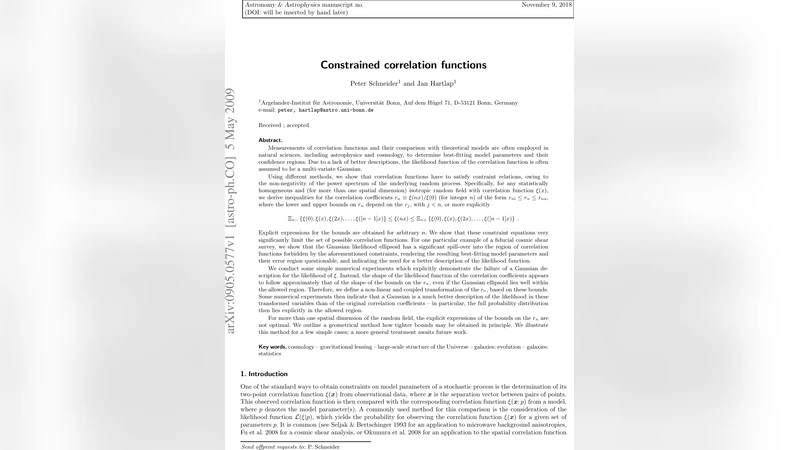
We show that correlation functions have to satisfy contraint relations, owing to the non-negativity of the power spectrum of the underlying random process. Specifically, for any statistically homogeneous and (for more than one spatial dimension) isotropic random field with correlation function $\xi(x)$, we derive inequalities for the correlation coefficients $r_n\equiv \xi(n x)/\xi(0)$ (for integer $n$) of the form $r_{n{\rm l}}\le r_n\le r_{n{\rm u}}$, where the lower and upper bounds on $r_n$ depend on the $r_j$, with $j<n$. Explicit expressions for the bounds are obtained for arbitrary $n$. These constraint equations very significantly limit the set of possible correlation functions. For one particular example of a fiducial cosmic shear survey, we show that the Gaussian likelihood ellipsoid has a significant spill-over into the forbidden region of correlation functions, rendering the resulting best-fitting model parameters and their error region questionable, and indicating the need for a better description of the likelihood function. We conduct some simple numerical experiments which explicitly demonstrate the failure of a Gaussian description for the likelihood of $\xi$. Instead, the shape of the likelihood function of the correlation coefficients appears to follow approximately that of the shape of the bounds on the $r_n$, even if the Gaussian ellipsoid lies well within the allowed region. For more than one spatial dimension of the random field, the explicit expressions of the bounds on the $r_n$ are not optimal. We outline a geometrical method how tighter bounds may be obtained in principle. We illustrate this method for a few simple cases; a more general treatment awaits future work.
💡 Research Summary
The paper addresses a fundamental statistical property of homogeneous (and, in dimensions greater than one, isotropic) random fields: the non‑negativity of their power spectrum imposes strict inequalities on the two‑point correlation function. By defining the normalized correlation coefficients (r_n = \xi(n x)/\xi(0)) for integer multiples of a chosen lag (x), the authors show that each (r_n) is bounded from above and below by functions that depend only on the preceding coefficients (r_1, \dots, r_{n-1}). The derivation rests on the fact that the Toeplitz matrix built from the set ({r_0, r_1, \dots, r_n}) must be positive‑semidefinite because it is the Fourier transform of a non‑negative power spectrum. By requiring all principal minors of this matrix to be non‑negative, recursive analytic expressions for the bounds (r_{n\ell}) and (r_{nu}) are obtained for arbitrary (n). In one dimension the bounds can be written in closed form, often involving simple trigonometric functions; in higher dimensions the expressions are less tight, and the authors propose a geometric convex‑hull method that can, in principle, yield optimal bounds.
To illustrate the practical impact, the authors consider a mock cosmic‑shear survey. In typical analyses the measured correlation function (\xi(\theta)) is assumed to follow a multivariate Gaussian likelihood, and a Fisher matrix is used to infer cosmological parameters such as (\Omega_m) and (\sigma_8). When the Gaussian 68 % confidence ellipsoid is overlaid on the allowed region defined by the derived inequalities, a substantial portion of the ellipsoid lies outside the physically admissible domain. This demonstrates that the Gaussian approximation can assign non‑zero probability to forbidden correlation functions, leading to biased best‑fit parameters and underestimated uncertainties.
Monte‑Carlo simulations confirm that the true sampling distribution of the coefficients (r_n) is highly non‑Gaussian. The empirical probability density is sharply truncated at the theoretical bounds and exhibits a shape that mirrors the envelope of the allowed region. Near the centre the distribution may appear roughly symmetric, but the tails are strongly suppressed, a behavior that cannot be captured by a simple Gaussian model.
The authors conclude that any statistical inference based on correlation functions must respect these constraints. They advocate the inclusion of the bounds as explicit priors or as hard constraints in the likelihood, and they suggest alternative non‑Gaussian likelihood constructions (e.g., transformed variables that become approximately normal, beta‑type distributions, or maximum‑entropy models) that naturally respect the admissible region.
Future work outlined includes: (i) deriving optimal bounds for multi‑dimensional isotropic fields, possibly by extending the convex‑hull approach; (ii) implementing constrained likelihoods in real weak‑lensing data sets such as DES, KiDS, and LSST; (iii) developing efficient algorithms for high‑order Toeplitz positivity checks; and (iv) exploring Bayesian frameworks that incorporate the constraints as informative priors. By doing so, cosmological parameter estimation can become both statistically rigorous and physically consistent.
Comments & Academic Discussion
Loading comments...
Leave a Comment