Turbulent viscosity by convection in accretion discs - a self-consistent approach
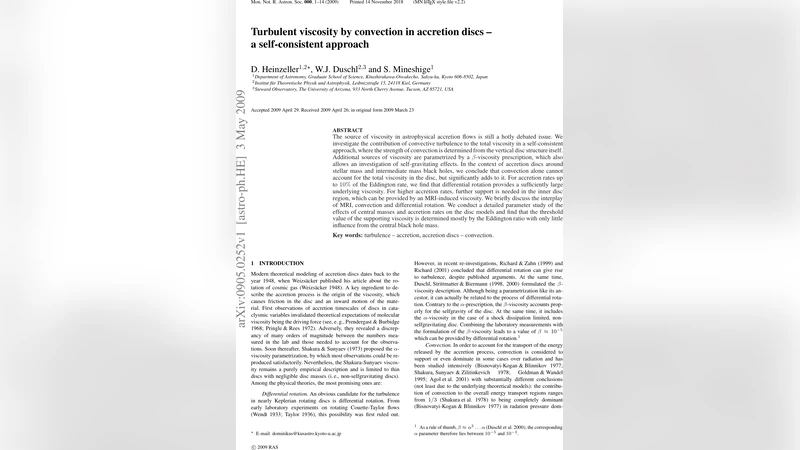
The source of viscosity in astrophysical accretion flows is still a hotly debated issue. We investigate the contribution of convective turbulence to the total viscosity in a self-consistent approach, where the strength of convection is determined from the vertical disc structure itself. Additional sources of viscosity are parametrized by a beta-viscosity prescription, which also allows an investigation of self-gravitating effects. In the context of accretion discs around stellar mass and intermediate mass black holes, we conclude that convection alone cannot account for the total viscosity in the disc, but significantly adds to it. For accretion rates up to 10% of the Eddington rate, we find that differential rotation provides a sufficiently large underlying viscosity. For higher accretion rates, further support is needed in the inner disc region, which can be provided by an MRI-induced viscosity. We briefly discuss the interplay of MRI, convection and differential rotation. We conduct a detailed parameter study of the effects of central masses and accretion rates on the disc models and find that the threshold value of the supporting viscosity is determined mostly by the Eddington ratio with only little influence from the central black hole mass.
💡 Research Summary
The paper tackles the long‑standing problem of identifying the physical origin of viscosity in astrophysical accretion discs. While the classic α‑disc model treats viscosity as a phenomenological parameter, the authors adopt a self‑consistent approach that derives the contribution of convective turbulence directly from the vertical structure of the disc. They solve the hydrostatic equilibrium, energy transport, and radiative transfer equations in the vertical direction to obtain temperature and density gradients. When these gradients exceed the Schwarzschild criterion, convection sets in. The authors then estimate a mixing length (taken as a fraction of the disc scale height) and a convective velocity from the convective heat flux, allowing them to compute a convective turbulent viscosity ν_conv = l_mix v_mix.
In parallel, they retain a β‑viscosity prescription, ν_β = β c_s H, which represents the baseline angular‑momentum transport supplied by differential rotation. The total effective viscosity is taken as the sum ν_total = ν_β + ν_conv. This formulation enables the model to determine, for each set of global parameters, how much of the required transport can be supplied by convection alone and how much must be provided by other mechanisms.
A comprehensive parameter study is performed for central black‑hole masses ranging from 10 M_⊙ to 10⁴ M_⊙ and for accretion rates spanning 10⁻³ – 1 Ṁ_Edd. The main findings are:
-
Magnitude of the convective contribution – Across most of the explored parameter space, ν_conv accounts for roughly 10 % to 30 % of ν_total. Convection therefore cannot replace the primary viscosity source but provides a non‑negligible boost.
-
Dependence on the Eddington ratio – For sub‑Eddington accretion (Ṁ/Ṁ_Edd ≲ 0.1) the β‑viscosity alone yields a sufficiently large ν_β to sustain steady accretion. In this regime convection is merely a secondary effect. When the accretion rate exceeds ~10 % of the Eddington limit, ν_β drops sharply in the innermost radii (≲ 10 R_S), and the disc requires an additional transport mechanism.
-
Role of the magnetorotational instability (MRI) – In the high‑Ṁ regime the authors invoke an MRI‑driven viscosity ν_MRI, typically of order 0.01 – 0.1 c_s H, to fill the deficit left by β‑viscosity. Convection adds to this baseline, so the combined ν_total = ν_β + ν_MRI + ν_conv can meet the angular‑momentum transport demands. The paper therefore argues for a layered picture: differential rotation supplies a floor, MRI dominates when the disc becomes radiation‑pressure dominated, and convection supplies a modest but systematic enhancement.
-
Self‑gravity effects – The β‑viscosity prescription is extended to include a self‑gravity correction that becomes relevant when the disc mass exceeds ~1 % of the central mass. The study shows that, although self‑gravity modifies the vertical structure, its impact on the critical viscosity threshold is minor compared with the dependence on the Eddington ratio.
-
Weak dependence on black‑hole mass – Increasing the central mass makes the disc geometrically thicker and reduces the temperature gradient, slightly diminishing the convective driving. Nevertheless, the overall balance between ν_β, ν_MRI, and ν_conv is governed primarily by the accretion rate rather than the black‑hole mass.
The authors conclude that convection alone cannot account for the full viscosity required in accretion discs, especially in the inner, high‑luminosity regions. However, it contributes a measurable fraction and should be incorporated into any realistic viscosity prescription. The study provides a physically motivated alternative to the purely phenomenological α‑model, offering a framework that naturally integrates differential rotation, MRI, and convective turbulence. This composite approach is particularly valuable for modelling discs around stellar‑mass and intermediate‑mass black holes at moderate to high accretion rates, and it sets the stage for future work that couples these analytic results with global MHD simulations and observational diagnostics such as spectral state transitions and variability patterns.
Comments & Academic Discussion
Loading comments...
Leave a Comment