Circumplanetary disc properties obtained from radiation hydrodynamical simulations of gas accretion by protoplanets
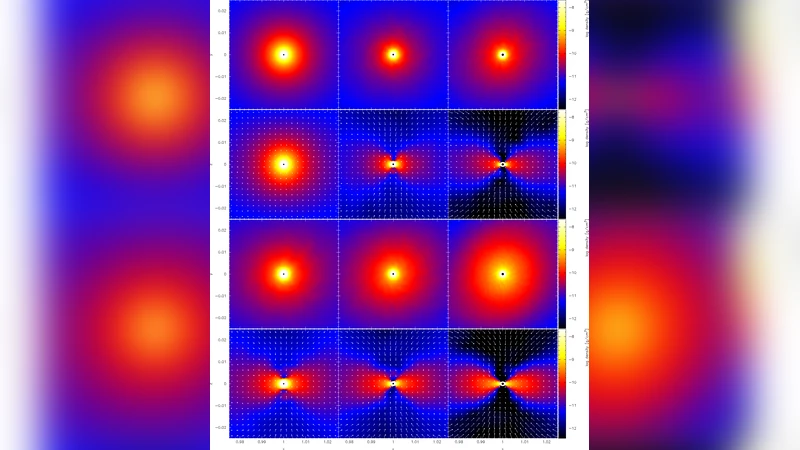
We investigate the properties of circumplanetary discs formed in three-dimensional, self-gravitating radiation hydrodynamical models of gas accretion by protoplanets. We determine disc sizes, scaleheights, and density and temperature profiles for different protoplanet masses, in solar nebulae of differing grain opacities. We find that the analytical prediction of circumplanetary disc radii in an evacuated gap (R_Hill/3) from Quillen & Trilling (1998) yields a good estimate for discs formed by high mass protoplanets. The radial density profiles of the circumplanetary discs may be described by power-laws between r^-2 and r^-3/2. We find no evidence for the ring-like density enhancements that have been found in some previous models of circumplanetary discs. Temperature profiles follow a ~r^-7/10 power-law regardless of protoplanet mass or nebula grain opacity. The discs invariably have large scaleheights (H/r > 0.2), making them thick in comparison with their encompassing circumstellar discs, and they show no flaring.
💡 Research Summary
This paper presents a comprehensive investigation of circumplanetary discs (CPDs) that develop around accreting protoplanets, using fully three‑dimensional, self‑gravitating radiation hydrodynamics simulations. The authors explore how CPD size, vertical thickness (H/r), and radial density and temperature structures depend on two key parameters: the mass of the protoplanet and the grain opacity of the surrounding protoplanetary nebula.
The numerical experiment is built on a solar‑mass central star and a Minimum‑Mass Solar Nebula (MMSN) gas disc. Grain opacities are scaled to 0.1, 0.01, and 0.001 of the interstellar‑medium value to mimic a range of cooling efficiencies. Protoplanet masses are chosen as 10, 30, 100, 166 (≈0.5 MJ), and 333 M⊕ (≈1 MJ). For each combination, gas inflow onto the planet’s Hill sphere is followed for several thousand years, allowing a quasi‑steady CPD to emerge.
The main findings can be summarised as follows. First, for high‑mass protoplanets (≥100 M⊕) the surrounding gas clears an evacuated gap, and the resulting CPD radius settles at roughly one‑third of the Hill radius (Rdisc ≈ RHill/3). This matches the analytical estimate of Quillen & Trilling (1998) and validates the simple scaling law for massive planets. Low‑mass planets (≤30 M⊕) do not open a clean gap; their CPDs are smaller than the R_Hill/3 prediction and display more irregular shapes.
Second, the radial surface density of the CPDs follows a power‑law Σ(r) ∝ r^−p with p ranging between 1.5 and 2.0 across the suite of simulations. No pronounced ring‑like density enhancements appear, contrary to some earlier lower‑resolution studies. The authors argue that those rings were artefacts of limited numerical resolution and imposed boundary conditions.
Third, the temperature profile is remarkably robust: T(r) ∝ r^−7/10 for all planet masses and opacity values. This exponent is consistent with a disc whose thermal balance is dominated by radiative cooling rather than viscous heating, and it is insensitive to the opacity scaling used. The temperature gradient is closely linked to the vertical structure: thicker discs retain higher mid‑plane temperatures at a given radius.
Fourth, all CPDs are geometrically thick, with H/r > 0.2 throughout the simulated radial extent. This is substantially larger than the thin‑disc approximation (H/r ≈ 0.05) commonly adopted for circumstellar discs. Moreover, the discs do not exhibit flaring; the scale height remains roughly constant with radius, indicating that vertical pressure support (including radiation pressure) balances gravity without a strong radial dependence. Such a thick, non‑flared geometry has important implications for satellite formation, because it influences solid‑particle settling, pebble accretion rates, and the migration pathways of nascent moons.
Methodologically, the study demonstrates the value of incorporating full radiative transfer and self‑gravity in three dimensions. By resolving the vertical structure and allowing realistic cooling, the simulations capture the interplay between heating, cooling, and gravitational torques that shape CPDs. The authors also discuss convergence tests that confirm the robustness of the measured power‑law exponents and the disc thickness against changes in spatial resolution.
In conclusion, the paper provides strong numerical evidence that (i) the simple R_Hill/3 scaling accurately predicts CPD radii for massive, gap‑opening planets, (ii) CPD surface densities obey a steep power‑law without forming rings, (iii) temperature declines as r^−7/10 irrespective of opacity, and (iv) CPDs are intrinsically thick and non‑flared. These results supply essential constraints for theoretical models of satellite formation and for the interpretation of future high‑resolution observations (e.g., with ALMA or the JWST) that may directly probe circumplanetary environments.
Comments & Academic Discussion
Loading comments...
Leave a Comment